
PUBLISHER: Global Market Insights Inc. | PRODUCT CODE: 2027500

PUBLISHER: Global Market Insights Inc. | PRODUCT CODE: 2027500
Membrane Electrode Assembly Market Opportunity, Growth Drivers, Industry Trend Analysis, and Forecast 2026 - 2035
The Global Membrane Electrode Assembly Market was valued at USD 6.9 billion in 2025 and is estimated to grow at a CAGR of 8.6% to reach USD 17.1 billion by 2035.
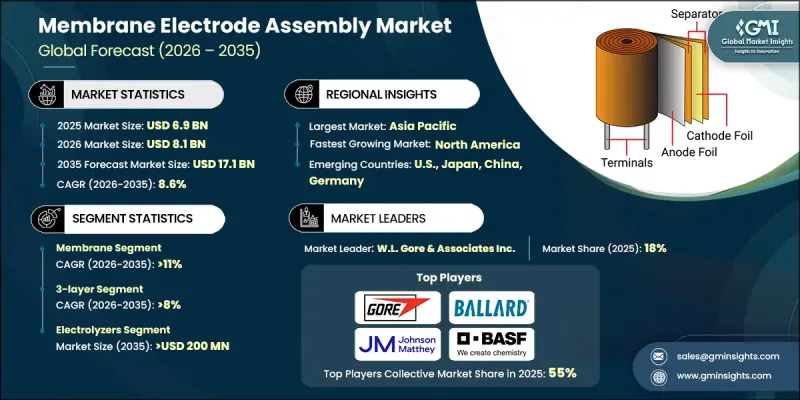
The membrane electrode assembly (MEA) serves as the central functional unit of a fuel cell, enabling the electrochemical reactions required for electricity generation through efficient ion, electron, and gas exchange. The market is gaining strong momentum due to the rising adoption of alternative propulsion technologies, including fuel cell electric vehicles, hybrid systems, and battery electric platforms. Expansion of green hydrogen initiatives worldwide is further strengthening demand, supported by continuous advancements that improve efficiency, durability, and cost performance of MEA components. Government-backed decarbonization strategies, along with incentives and subsidies promoting hydrogen-based energy systems, are accelerating industry development. The growing deployment of fuel cell technologies in heavy-duty transportation and long-distance mobility applications is also boosting product demand. At the same time, ongoing research and development efforts are focusing on improving catalyst efficiency, reducing dependence on platinum group metals, and extending operational lifespan, all of which are enhancing commercial viability and adoption across multiple end-use sectors.
| Market Scope | |
|---|---|
| Start Year | 2025 |
| Forecast Year | 2026-2035 |
| Start Value | $6.9 Billion |
| Forecast Value | $17.1 Billion |
| CAGR | 8.6% |
The membrane segment is projected to grow at a CAGR of 11% through 2035, driven by its high energy conversion efficiency and compatibility with evolving fuel technologies. Continuous innovation in material science is improving performance characteristics such as water management, durability, and operational stability. Its adaptable design also enables customization across diverse application requirements, supporting broader market penetration.
The 3-layer MEA segment is expected to grow at an 8% CAGR through 2035, supported by its simplified structure, cost efficiency, and reduced material usage. This configuration enables streamlined manufacturing processes and reduced system weight and volume, making it suitable for compact and portable applications. Its adoption is also supported in high-power applications such as transportation systems and large-scale energy generation, particularly in environments where water management demands are less complex.
U.S. Membrane Electrode Assembly Market is projected to grow at a CAGR of 6.2% by 2035. Market expansion is supported by strong policy frameworks promoting clean energy and fuel cell technologies. Financial incentives, grants, and funding programs encourage wider adoption and technological advancement. Increasing deployment across stationary power systems, backup energy solutions, and energy storage applications is further strengthening demand. Additionally, the growing interest in fuel cell electric vehicles as a sustainable transportation option continues to support market growth in the region.
Key companies operating in the Global Membrane Electrode Assembly Market include DuPont, BASF SE, 3M, Johnson Matthey, Cummins, Plug Power Inc., Ballard Power Systems, Panasonic Holdings Corporation, FuelCell Energy, Inc., W. L. Gore & Associates, Inc., Toshiba Corporation, Advent Technologies Inc., Danish Power System, Giner Inc., Ion Power, Inc., HyPlat Pty Ltd., IRD Fuel Cells, Greenerity GmbH, TOPPAN Holdings Inc., PAC Electronics Co., Ltd., Yangtze Energy Technologies, Inc., YuanBo Engineering Co., Ltd., and EC21 Inc. Companies in the Membrane Electrode Assembly Market are strengthening their market position by investing heavily in research and development to enhance efficiency, durability, and cost performance of fuel cell components. Many players are focusing on reducing reliance on precious metal catalysts while improving overall energy conversion efficiency. Strategic collaborations with automotive and energy sector stakeholders are helping accelerate commercialization and large-scale deployment. Firms are also expanding production capacity to meet rising demand from hydrogen and fuel cell applications. Technological innovation aimed at improving manufacturing processes and scalability is another key focus area.
Table of Contents
Chapter 1 Methodology & Scope
- 1.1 Research Design
- 1.1.1 Research approach
- 1.1.2 Data collection methods
- 1.2 Base estimates and calculations
- 1.2.1 Base year calculation
- 1.2.2 Key trends for market estimates
- 1.3 Forecast model
- 1.3.1 Key trends for market estimates
- 1.3.1.1 Quantified market impact analysis
- 1.3.1.2 Mathematical impact of growth parameters on forecast
- 1.3.2 Scenario analysis framework
- 1.3.1 Key trends for market estimates
- 1.4 Primary research and validation
- 1.4.1 Some of the primary sources (but not limited to)
- 1.5 Data mining sources
- 1.5.1 Paid Sources
- 1.5.2 Sources, by region
- 1.6 Research trail & scoring components
- 1.6.1 Research trail components
- 1.6.2 Scoring components
- 1.7 Research transparency addendum
- 1.7.1 Source attribution framework
- 1.7.2 Quality assurance metrics
- 1.7.3 Our commitment to trust
- 1.8 Market definitions
Chapter 2 Executive Summary
- 2.1 Industry 360-degree synopsis, 2022 - 2035
- 2.2 Business trends
- 2.3 Component trends
- 2.4 Application trends
- 2.5 Product type trends
- 2.6 Regional trends
Chapter 3 Industry Insights
- 3.1 Industry ecosystem
- 3.1.1 Raw material availability & sourcing analysis
- 3.1.2 Manufacturing capacity assessment
- 3.1.3 Supply chain resilience & risk factors
- 3.1.4 Distribution network analysis
- 3.2 Regulatory landscape
- 3.3 Industry impact forces
- 3.3.1 Growth drivers
- 3.3.2 Industry pitfalls & challenges
- 3.4 Growth potential analysis
- 3.5 Porter's analysis
- 3.5.1 Bargaining power of suppliers
- 3.5.2 Bargaining power of buyers
- 3.5.3 Threat of new entrants
- 3.5.4 Threat of substitutes
- 3.6 PESTEL analysis
- 3.6.1 Political factors
- 3.6.2 Economic factors
- 3.6.3 Social factors
- 3.6.4 Technological factors
- 3.6.5 Legal factors
- 3.6.6 Environmental factors
- 3.7 Emerging opportunities & trends
- 3.7.1 Digitalization & IoT integration
- 3.7.2 Emerging market penetration
- 3.8 Investment analysis and future outlook
Chapter 4 Competitive landscape, 2026
- 4.1 Introduction
- 4.2 Company market share analysis, 2025
- 4.2.1 North America
- 4.2.2 Europe
- 4.2.3 Asia Pacific
- 4.2.4 Middle East & Africa
- 4.2.5 Latin America
- 4.3 Strategic dashboard
- 4.4 Strategic initiatives
- 4.5 Innovation & technology landscape
Chapter 5 Market Size and Forecast, By Component, 2022 - 2035 (USD Million)
- 5.1 Key trends
- 5.2 Membranes
- 5.3 Gas Diffusion Layers
- 5.4 Gaskets
- 5.5 Others
Chapter 6 Market Size and Forecast, By Application, 2022 - 2035 (USD Million)
- 6.1 Key trends
- 6.2 Fuel cells
- 6.3 Electrolyzers
Chapter 7 Market Size and Forecast, By Product Type, 2022 - 2032 (USD Million)
- 7.1 Key trends
- 7.2 3-layer
- 7.3 5-layer
- 7.4 7-layer
Chapter 8 Market Size and Forecast, By Region, 2022 - 2035 (USD Million & ‘000 Units)
- 8.1 Key trends
- 8.2 North America
- 8.2.1 U.S.
- 8.2.2 Canada
- 8.3 Europe
- 8.3.1 Germany
- 8.3.2 UK
- 8.3.3 Italy
- 8.3.4 France
- 8.3.5 Austria
- 8.3.6 Spain
- 8.4 Asia Pacific
- 8.4.1 China
- 8.4.2 Japan
- 8.4.3 South Korea
- 8.4.4 Australia
- 8.4.5 India
- 8.5 Middle East
- 8.5.1 Saudi Arabia
- 8.5.2 UAE
- 8.5.3 South Africa
- 8.6 Latin America
- 8.6.1 Brazil
- 8.6.2 Peru
- 8.6.3 Mexico
Chapter 9 Company Profiles
- 9.1 3M
- 9.2 Advent technologies Inc
- 9.3 Ballard Power Systems
- 9.4 BASF SE
- 9.5 Cummins
- 9.6 Danish Power System
- 9.7 DuPont
- 9.8 EC21 Inc.
- 9.9 FuelCell Energy, Inc.
- 9.10 Giner Inc.
- 9.11 Greenerity GmbH
- 9.12 HyPlat Pty Ltd.
- 9.13 Ion Power, Inc.
- 9.14 IRD Fuel Cells
- 9.15 Johnson Matthey
- 9.16 PAC Electronics Co., Ltd.
- 9.17 Panasonic Holdings Corporation
- 9.18 Plug Power Inc.
- 9.19 TOPPAN Holdings Inc.
- 9.20 Toshiba Corporation
- 9.21 W. L. Gore & Associates, Inc.
- 9.22 Yangtze Energy Technologies, Inc.
- 9.23 YuanBo Engineering Co., Ltd.

