PUBLISHER: Global Market Insights Inc. | PRODUCT CODE: 2027507

PUBLISHER: Global Market Insights Inc. | PRODUCT CODE: 2027507
Power Bank Market Opportunity, Growth Drivers, Industry Trend Analysis, and Forecast 2026 - 2035
The Global Power Bank Market was valued at USD 18.6 billion in 2025 and is estimated to grow at a CAGR of 9.6% to reach USD 46 billion by 2035.
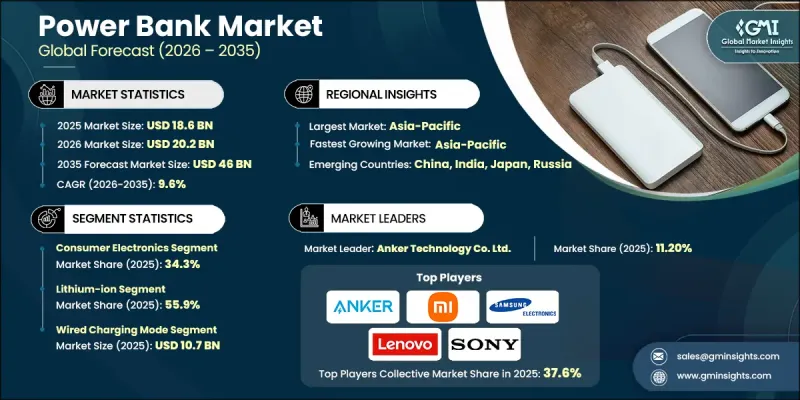
Market expansion is driven by the growing reliance on smartphones, tablets, wearable devices, and other portable electronics that require frequent recharging. Increasing mobile usage, app consumption, and the need to maintain connectivity across multiple devices are fueling power bank demand. Consumers are seeking faster, more efficient, and wireless charging solutions, prompting manufacturers to integrate thinner lithium-polymer cells, advanced thermal management systems, and high-speed charging standards. Next-generation wireless power banks with faster magnetic alignment and Power Delivery (PD) compatibility are gaining traction, especially for devices with high power demands. Rising awareness of on-the-go energy solutions and portable charging convenience continues to support market growth globally.
| Market Scope | |
|---|---|
| Start Year | 2025 |
| Forecast Year | 2026-2035 |
| Start Value | $18.6 Billion |
| Forecast Value | $46 Billion |
| CAGR | 9.6% |
The commercial segment is expected to grow at a CAGR of 10.6% through 2035 as businesses increasingly adopt portable power solutions for corporate mobility, field operations, logistics, travel, and professional equipment. Demand from sectors such as transportation, hospitality, retail, and emergency services is driving the adoption of high-output, durable power banks. As enterprises digitize operations and rely more heavily on mobile devices, commercial-grade solutions are becoming essential for operational continuity.
The wireless charging mode segment is projected to grow at a CAGR of 11.8% through 2035, driven by consumer preference for cable-free convenience, cross-device compatibility, and integration with modern wireless charging standards. Consumers increasingly value the ability to charge multiple devices such as smartphones, tablets, and wearables without the clutter of cables, making wireless power banks a practical choice for on-the-go lifestyles. Technological advancements in magnetic alignment, Qi-standard compliance, and faster power delivery have significantly enhanced charging efficiency, reliability, and safety.
North America Power Bank Market accounted for 31.7% share in 2025, supported by the widespread use of high-drain smartphones, wearables, and portable electronics. Adoption is boosted by fast-charging technology, wireless charging ecosystems, premium mobility accessories, and investments in work-from-home infrastructure and mobile enterprise deployments. Safety-certified lithium batteries also contribute to increasing demand in logistics, outdoor, and professional sectors. Consumers in North America continue to prioritize performance, reliability, and energy-efficient solutions, which is encouraging manufacturers to offer advanced, high-capacity devices in the region.
Prominent players operating in the Global Power Bank Market include ADATA Technology Co., Ltd., BASEUS TECHNOLOGY, Ambrane India Private Ltd., Anker Technology Co. Ltd., ASUSTeK Computer Inc., Aukey, Beijing Xiaomi Technology Co., Ltd., CELLULARLINE S.P.A, Energizer, Intex Technologies, Koninklijke Philips NV, Lenovo Group Ltd., Microsoft Corporation, Omnicharge Inc., Panasonic Corporation, Ravpower, Samsung Electronics, Sony Corporation, Syska Led Lights Pvt Ltd, and Zendure Power Bank USA Inc. Key strategies adopted by companies in the Power Bank Market focus on product innovation, technological advancement, and expanding distribution networks. Firms are investing in high-capacity, fast-charging, and wireless-enabled devices with improved battery chemistry and thermal management. Partnerships with smartphone manufacturers, electronics brands, and mobile service providers enhance market visibility and integration with devices. Companies are leveraging e-commerce, direct-to-consumer platforms, and global retail networks to reach broader audiences. Safety certifications, energy-efficient designs, and premium product launches are used to build trust and brand reputation.
Table of Contents
Chapter 1 Methodology and Scope
- 1.1 Market scope and definition
- 1.2 Research design
- 1.2.1 Research approach
- 1.2.2 Data collection methods
- 1.3 Data mining sources
- 1.3.1 Global
- 1.3.2 Regional/Country
- 1.4 Base estimates and calculations
- 1.4.1 Base year calculation
- 1.4.2 Key trends for market estimation
- 1.5 Primary research and validation
- 1.5.1 Primary sources
- 1.6 Forecast model
- 1.7 Research assumptions and limitations
Chapter 2 Executive Summary
- 2.1 Industry 360° synopsis, 2022 - 2035
- 2.2 Key market trends
- 2.2.1 Battery Type trends
- 2.2.2 Capacity Range trends
- 2.2.3 Charging Mode trends
- 2.2.4 Sales Channel trends
- 2.2.5 Application trends
- 2.2.6 Regional trends
- 2.3 TAM Analysis, 2026-2035
- 2.4 CXO perspectives: Strategic imperatives
- 2.4.1 Executive decision points
- 2.4.2 critical success factors
- 2.5 Future outlook and strategic recommendations
Chapter 3 Industry Insights
- 3.1 Industry ecosystem analysis
- 3.1.1 Supplier Landscape
- 3.1.2 Profit Margin
- 3.1.3 Cost structure
- 3.1.4 Value addition at each stage
- 3.1.5 Factor affecting the value chain
- 3.1.6 Disruptions
- 3.2 Industry impact forces
- 3.2.1 Growth drivers
- 3.2.1.1 Rising dependence on smartphones, wearables, and portable electronics
- 3.2.1.2 Increasing travel, outdoor activities, and remote work culture
- 3.2.1.3 Technological advancements in battery efficiency and fast-charging standards
- 3.2.1.4 Expansion of e-commerce and omnichannel retail networks
- 3.2.1.5 Rise of eco-friendly, solar-powered, and smart power banks
- 3.2.2 Industry pitfalls and challenges
- 3.2.2.1 High cost pressures from advanced battery and charging-technology integration
- 3.2.2.2 Stringent safety, transport, and compliance requirements for lithium-ion batteries
- 3.2.3 Market opportunities
- 3.2.3.1 Growing integration of AI-enabled smartphones and high-performance mobile devices
- 3.2.3.2 Expansion of public fast-charging infrastructure and travel-oriented power solutions
- 3.2.1 Growth drivers
- 3.3 Growth potential analysis
- 3.4 Regulatory landscape
- 3.4.1 North America
- 3.4.2 Europe
- 3.4.3 Asia Pacific
- 3.4.4 Latin America
- 3.4.5 Middle East & Africa
- 3.5 Porter’s analysis
- 3.6 PESTEL analysis
- 3.7 Technology and Innovation landscape
- 3.7.1 Current technological trends
- 3.7.2 Emerging technologies
- 3.8 Price trends
- 3.8.1 By region
- 3.8.2 By product
- 3.9 Pricing Strategies
- 3.10 Emerging Business Models
- 3.11 Compliance Requirements
- 3.12 Patent and IP analysis
- 3.13 Geopolitical and trade dynamics
Chapter 4 Competitive Landscape, 2025
- 4.1 Introduction
- 4.2 Company market share analysis
- 4.2.1 By region
- 4.2.1.1 North America
- 4.2.1.2 Europe
- 4.2.1.3 Asia Pacific
- 4.2.1.4 Latin America
- 4.2.1.5 Middle East & Africa
- 4.2.2 Market concentration analysis
- 4.2.1 By region
- 4.3 Competitive benchmarking of key players
- 4.3.1 Financial performance comparison
- 4.3.1.1 Revenue
- 4.3.1.2 Profit margin
- 4.3.1.3 R&D
- 4.3.2 Product portfolio comparison
- 4.3.2.1 Product range breadth
- 4.3.2.2 Technology
- 4.3.2.3 Innovation
- 4.3.3 Geographic presence comparison
- 4.3.3.1 Global footprint analysis
- 4.3.3.2 Service network coverage
- 4.3.3.3 Market penetration by region
- 4.3.4 Competitive positioning matrix
- 4.3.4.1 Leaders
- 4.3.4.2 Challengers
- 4.3.4.3 Followers
- 4.3.4.4 Niche players
- 4.3.5 Strategic outlook matrix
- 4.3.1 Financial performance comparison
- 4.4 Key developments
- 4.4.1 Mergers and acquisitions
- 4.4.2 Partnerships and collaborations
- 4.4.3 Technological advancements
- 4.4.4 Expansion and investment strategies
- 4.4.5 Digital transformation initiatives
- 4.5 Emerging/ startup competitors landscape
Chapter 5 Market Estimates and Forecast, By Battery Type, 2022 - 2035
- 5.1 Key trends
- 5.2 Lithium-Ion
- 5.3 Lithium Polymer
Chapter 6 Market Estimates and Forecast, By Capacity Range, 2022 - 2035
- 6.1 Key trends
- 6.2 Up to 3,000 mAh
- 6.2.1 3,001 mAh-8,000 mAh
- 6.2.2 8,001 mAh-20,000 mAh
- 6.3 Above 20,000 mAh
Chapter 7 Market Estimates and Forecast, By Charging Mode, 2022 - 2035
- 7.1 Key trends
- 7.2 Wired
- 7.3 Wireless
Chapter 8 Market Estimates and Forecast, By Application, 2022 - 2035
- 8.1 Key trends
- 8.2 Consumer Electronics
- 8.2.1 Smartphone
- 8.2.2 Tablet
- 8.2.3 Laptop
- 8.2.4 Wearable Devices
- 8.2.5 Others
- 8.3 Commercial
- 8.4 Industrial
- 8.5 Others
Chapter 9 Market Estimates and Forecast, By Sales Channel, 2022 - 2035
- 9.1 Key trends
- 9.2 Online
- 9.3 Offline
Chapter 10 Market Estimates and Forecast, By Region, 2022 - 2035
- 10.1 Key trends
- 10.2 North America
- 10.2.1 U.S.
- 10.2.2 Canada
- 10.3 Europe
- 10.3.1 Germany
- 10.3.2 UK
- 10.3.3 France
- 10.3.4 Spain
- 10.3.5 Italy
- 10.3.6 Russia
- 10.4 Asia Pacific
- 10.4.1 China
- 10.4.2 India
- 10.4.3 Japan
- 10.4.4 Australia
- 10.4.5 South Korea
- 10.5 Latin America
- 10.5.1 Brazil
- 10.5.2 Mexico
- 10.5.3 Argentina
- 10.6 Middle East and Africa
- 10.6.1 South Africa
- 10.6.2 Saudi Arabia
- 10.6.3 UAE
Chapter 11 Company Profiles
- 11.1 Global Key Players
- 11.1.1 Anker Technology Co. Ltd.
- 11.1.2 Beijing Xiaomi Technology Co., Ltd.
- 11.1.3 Samsung Electronics
- 11.1.4 Lenovo Group Ltd.
- 11.1.5 Sony Corporation
- 11.2 Regional key players
- 11.2.1 North America
- 11.2.1.1 Energizer
- 11.2.1.2 Microsoft Corporation
- 11.2.1.3 Omnicharge Inc.
- 11.2.1.4 Zendure Power Bank USA Inc.
- 11.2.2 Asia Pacific
- 11.2.2.1 ADATA Technology Co., Ltd.
- 11.2.2.2 Ambrane India Private Ltd.
- 11.2.2.3 Anker Technology Co. Ltd.
- 11.2.2.4 ASUSTeK Computer Inc.
- 11.2.2.5 Aukey
- 11.2.2.6 BASEUS TECHNOLOGY
- 11.2.2.7 Beijing Xiaomi Technology Co., Ltd.
- 11.2.2.8 Intex Technologies
- 11.2.2.9 Lenovo Group Ltd.
- 11.2.2.10 Panasonic Corporation
- 11.2.2.11 Samsung Electronics
- 11.2.2.12 Sony Corporation
- 11.2.2.13 Syska Led Lights Pvt Ltd
- 11.2.3 Europe
- 11.2.3.1 CELLULARLINE S.P.A
- 11.2.3.2 Koninklijke Philips NV
- 11.2.1 North America
- 11.3 Niche Players/Disruptors
- 11.3.1 Ravpower

