PUBLISHER: Global Market Insights Inc. | PRODUCT CODE: 2027510

PUBLISHER: Global Market Insights Inc. | PRODUCT CODE: 2027510
Rock Breaker Market Opportunity, Growth Drivers, Industry Trend Analysis, and Forecast 2026 - 2035
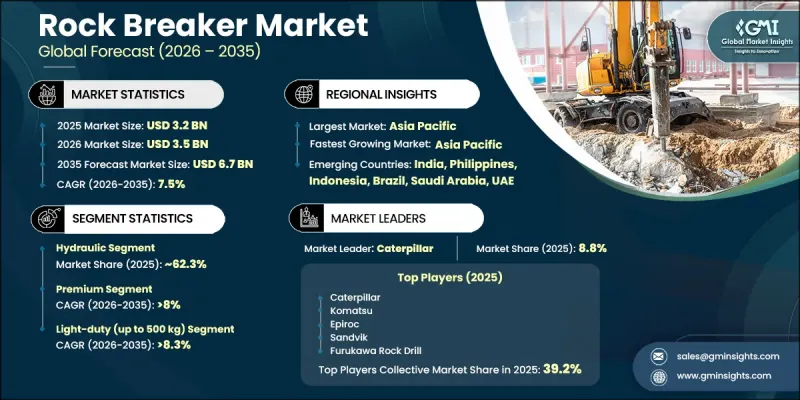
The Global Rock Breaker Market was valued at USD 3.2 billion in 2025 and is estimated to grow at a CAGR of 7.5% to reach USD 6.7 billion by 2035.
Market growth is driven by the rapid expansion of mining, quarrying, and infrastructure development activities worldwide. Rock breakers, once primarily used for basic demolition and secondary material processing, are now integral to modern construction and mining operations that demand higher efficiency and precision. Increasing project complexity and scale are pushing companies to adopt advanced equipment that enhances productivity while reducing reliance on manual labor. These machines contribute significantly to improved operational safety, optimized project timelines, and cost efficiency. Growing emphasis on automation and high-performance machinery is further strengthening their role across industrial applications. Rising demand for efficient material fragmentation solutions continues to support adoption, particularly as industries prioritize durability, operational consistency, and reduced downtime. Continuous technological progress and increasing investment in large-scale development projects are reinforcing the long-term growth outlook of the rock breaker market.
| Market Scope | |
|---|---|
| Start Year | 2025 |
| Forecast Year | 2026-2035 |
| Start Value | $3.2 Billion |
| Forecast Value | $6.7 Billion |
| CAGR | 7.5% |
The rock breaker market is gaining momentum as demand for precise and high-speed excavation solutions continues to rise across construction and mining sectors. Increasing use of advanced equipment in large-scale projects is accelerating adoption, particularly in applications requiring efficiency and durability. Manufacturers are focusing on improving product design by incorporating lightweight yet strong materials to enhance performance while minimizing maintenance requirements. Growing investments in infrastructure development and resource extraction are further driving demand for advanced rock-breaking equipment. The shift toward mechanized and automated operations is also supporting the demand for high-capacity machines capable of performing across varied environments and material conditions.
The hydraulic segment held a 62.3% share in 2025 and is expected to grow at a CAGR of 7.3% through 2035. This segment leads the market due to its superior efficiency, precision, and adaptability across different applications. Hydraulic systems deliver consistent performance under demanding conditions, making them highly suitable for continuous operations. Their ability to provide high-impact force while maintaining operational control enhances their appeal. Additional benefits such as reduced noise levels, lower vibration, and improved safety further contribute to widespread adoption. Ongoing advancements in automation and energy-efficient technologies continue to strengthen this segment's position.
The premium segment captured 64.1% share in 2025 and is anticipated to grow at a CAGR of 8% from 2026 to 2035. This segment leads due to increasing demand for advanced, high-performance equipment that offers reliability and durability. Premium rock breakers provide enhanced operational efficiency and longer service life, which helps reduce maintenance costs and improve productivity. Advanced features such as automation capabilities and improved control systems are further supporting demand, as companies prioritize safety, efficiency, and compliance with evolving industry standards.
China Rock Breaker Market held a 64.2% share, generating USD 817.5 million in 2025. Strong growth in the country is supported by extensive infrastructure development and large-scale mining operations. Continuous investment in construction and energy projects is driving demand for efficient excavation solutions. Increasing adoption of mechanized technologies and advanced equipment is further boosting market expansion. Domestic manufacturers are enhancing production capabilities and focusing on innovation, while stricter regulations are encouraging the adoption of efficient and environmentally compliant machinery.
Key players operating in the Global Rock Breaker Market include Caterpillar, DEVELON, Epiroc, Furukawa Rock Drill, Hitachi, JCB, Komatsu, NPK Construction, Sandvik, Soosan Heavy Industries, and Volvo. Companies in the Rock Breaker Market are strengthening their market position through innovation, expansion, and strategic partnerships. They are investing in advanced technologies to improve equipment performance, durability, and energy efficiency. Continuous focus on research and development enables the introduction of high-performance and automated solutions tailored to evolving industry requirements. Companies are also expanding their global presence through collaborations and distribution network enhancements. Emphasis on cost optimization and localized manufacturing helps improve competitiveness and meet regional demand effectively. Additionally, firms are integrating digital solutions such as telematics and remote monitoring to enhance operational efficiency, while prioritizing sustainability and compliance to align with regulatory standards and customer expectations.
Table of Contents
Chapter 1 Methodology
- 1.1 Research approach
- 1.2 Quality Commitments
- 1.2.1 GMI AI policy & data integrity commitment
- 1.2.1.1 Source consistency protocol
- 1.2.1 GMI AI policy & data integrity commitment
- 1.3 Research Trail & Confidence Scoring
- 1.3.1 Research Trail Components
- 1.3.2 Scoring Components
- 1.4 Data Collection
- 1.4.1 Partial list of primary sources
- 1.5 Data mining sources
- 1.5.1 Paid sources
- 1.5.1.1 Sources, by region
- 1.5.1 Paid sources
- 1.6 Base estimates and calculations
- 1.6.1 Base year calculation
- 1.7 Forecast
- 1.7.1 Quantified market impact analysis
- 1.7.1.1 Mathematical impact of growth parameters on forecast
- 1.7.1 Quantified market impact analysis
- 1.8 Research transparency addendum
- 1.8.1 Source attribution framework
- 1.8.2 Quality assurance metrics
- 1.8.3 Our commitment to trust
Chapter 2 Executive Summary
- 2.1 Industry 360° synopsis, 2022 - 2035
- 2.2 Key market trends
- 2.2.1 Regional
- 2.2.2 Type
- 2.2.3 Product
- 2.2.4 Equipment Size
- 2.2.5 Application
- 2.2.6 End Use
- 2.3 TAM Analysis, 2026-2035
- 2.4 CXO perspectives: Strategic imperatives
Chapter 3 Industry Insights
- 3.1 Industry ecosystem analysis
- 3.1.1 Supplier landscape
- 3.1.2 Profit margin analysis
- 3.1.3 Cost structure
- 3.1.4 Value addition at each stage
- 3.1.5 Factor affecting the value chain
- 3.1.6 Disruptions
- 3.2 Industry impact forces
- 3.2.1 Growth drivers
- 3.2.1.1 Increasing infrastructure development projects worldwide
- 3.2.1.2 Rising demand in mining and quarrying sectors
- 3.2.1.3 Technological advancements in rock breaking equipment
- 3.2.1.4 Government investments in infrastructure and mining industries
- 3.2.2 Industry pitfalls and challenges
- 3.2.2.1 High initial investment and operating costs
- 3.2.2.2 Economic downturns reducing construction and mining demand
- 3.2.3 Market opportunities
- 3.2.3.1 Increasing infrastructure development projects worldwide
- 3.2.3.2 Rising demand in mining and quarrying sectors
- 3.2.3.3 Technological advancements in rock breaking equipment
- 3.2.3.4 Government investments in infrastructure and mining industries
- 3.2.3.5 Expansion of rental and leasing services for heavy equipment
- 3.2.1 Growth drivers
- 3.3 Growth potential analysis
- 3.4 Regulatory guidelines
- 3.4.1 North America
- 3.4.1.1 U.S.: MSHA & OSHA Safety Standards
- 3.4.1.2 Canada: Provincial Mining and Safety Regulations
- 3.4.2 Europe
- 3.4.2.1 Germany: DIN and European Harmonised Standards
- 3.4.2.2 UK: UK Machinery Safety Regulations
- 3.4.2.3 France: Machinery & Workplace Safety Rules
- 3.4.2.4 Italy: National Energy & Climate Plan (PNIEC) Alignment
- 3.4.3 Asia Pacific
- 3.4.3.1 China: Mine Safety Regulations & Machine Standards
- 3.4.3.2 India: Machinery and Electrical Safety Regime
- 3.4.3.3 Japan: MLIT Noise/Vibration Guidelines for Construction Equipment
- 3.4.3.4 Australia: National Machine Safety Standards
- 3.4.4 Latin America
- 3.4.4.1 Brazil: NR Machinery & Mining Equipment Safety
- 3.4.4.2 Mexico: NOM Equipment and Industrial Safety Standards
- 3.4.4.3 Argentina: National Occupational Safety Laws
- 3.4.5 MEA
- 3.4.5.1 UAE: Machinery Safety and Noise/Vibration Controls
- 3.4.5.2 Saudi Arabia: Machinery Safety Regulations (SASO)
- 3.4.5.3 South Africa: Mining and Heavy Equipment Safety Law
- 3.4.1 North America
- 3.5 Porter’s analysis
- 3.6 PESTEL analysis
- 3.7 Technology and Innovation landscape
- 3.7.1 Current technological trends
- 3.7.2 Emerging technologies
- 3.8 Pricing Analysis (Driven by Primary Research)
- 3.8.1 Historical Price Trend Analysis
- 3.8.2 Pricing Strategy by Player Type (Premium / Value / Cost-plus)
- 3.9 Trade Data Analysis (Based on Paid Database)
- 3.9.1 Import/Export Volume & Value Trends
- 3.9.2 Key Trade Corridors & Tariff Impact
- 3.10 Impact of AI & Generative AI on the Market (Driven by Primary Research)
- 3.10.1 AI-Driven Disruption of Existing Business Models
- 3.10.2 GenAI Use Cases & Adoption Roadmap by Segment
- 3.10.3 Risks, Limitations & Regulatory Considerations
- 3.11 Capacity & Production Landscape (Driven by Primary Research)
- 3.11.1 Production Capacity by Region & Key Producer
- 3.11.2 Capacity Utilization Rates & Expansion Pipelines
- 3.12 Cost breakdown analysis
- 3.13 Sustainability and environmental impact analysis
- 3.13.1 Sustainable practices
- 3.13.2 Waste reduction strategies
- 3.13.3 Energy efficiency in production
- 3.13.4 Eco-friendly initiatives
- 3.13.5 Carbon footprint considerations
- 3.14 Future outlook & opportunities
- 3.15 Forecast assumptions & scenario analysis (Driven by Primary Research)
- 3.15.1 Base Case - key macro & industry variables driving CAGR
- 3.15.2 Optimistic Scenarios - Favorable Macro and Industry Tailwinds
- 3.15.3 Pessimistic Scenario - Macroeconomic slowdown or industry headwinds
Chapter 4 Competitive Landscape, 2025
- 4.1 Introduction
- 4.2 Company market share analysis
- 4.2.1 North America
- 4.2.2 Europe
- 4.2.3 Asia Pacific
- 4.2.4 Latin America
- 4.2.5 MEA
- 4.3 Competitive analysis of major market players
- 4.4 Competitive positioning matrix
- 4.5 Key developments
- 4.5.1 Mergers & acquisitions
- 4.5.2 Partnerships & collaborations
- 4.5.3 New Product Launches
- 4.5.4 Expansion Plans and funding
- 4.6 Company Tier Benchmarking
- 4.6.1 Tier Classification Criteria & Qualifying Thresholds
- 4.6.2 Tier Positioning Matrix by Revenue, Geography & Innovation
Chapter 5 Market Estimates & Forecast, By Type, 2022 - 2035 ($Bn, Units)
- 5.1 Key trends
- 5.2 Hydraulic
- 5.3 Pneumatic
- 5.4 Others
Chapter 6 Market Estimates & Forecast, By Product, 2022 - 2035 ($Bn, Units)
- 6.1 Key trends
- 6.2 Premium
- 6.3 Non-premium
Chapter 7 Market Estimates & Forecast, By Equipment Size, 2022 - 2035 ($Bn, Units)
- 7.1 Key trends
- 7.2 Light Duty (Up to 500 Kg)
- 7.3 Medium Duty (501-1200 Kg)
- 7.4 Heavy Duty (Above 1200 Kg)
Chapter 8 Market Estimates & Forecast, By Application, 2022 - 2035 ($Bn, Units)
- 8.1 Key trends
- 8.2 Quarrying
- 8.3 Demolition
- 8.4 Tunneling
- 8.5 Scaling
- 8.6 Others
Chapter 9 Market Estimates & Forecast, By End Use, 2022 - 2035 ($Bn, Units)
- 9.1 Key trends
- 9.2 Construction
- 9.3 Mining
- 9.4 Government
- 9.5 Private
Chapter 10 Market Estimates & Forecast, By Region, 2022 - 2035 ($Bn, Units)
- 10.1 Key trends
- 10.2 North America
- 10.2.1 US
- 10.2.2 Canada
- 10.3 Europe
- 10.3.1 Germany
- 10.3.2 UK
- 10.3.3 France
- 10.3.4 Italy
- 10.3.5 Spain
- 10.3.6 Russia
- 10.3.7 Netherlands
- 10.3.8 Belgium
- 10.4 Asia Pacific
- 10.4.1 China
- 10.4.2 India
- 10.4.3 Japan
- 10.4.4 Australia
- 10.4.5 South Korea
- 10.4.6 Philippines
- 10.4.7 Indonesia
- 10.5 Latin America
- 10.5.1 Brazil
- 10.5.2 Mexico
- 10.5.3 Argentina
- 10.6 MEA
- 10.6.1 South Africa
- 10.6.2 Saudi Arabia
- 10.6.3 UAE
Chapter 11 Company Profiles
- 11.1 Global Players
- 11.1.1 Caterpillar
- 11.1.2 DEVELON
- 11.1.3 Epiroc
- 11.1.4 Furukawa Rock Drill
- 11.1.5 Hitachi
- 11.1.6 JCB
- 11.1.7 Komatsu
- 11.1.8 NPK Construction Equipment
- 11.1.9 Sandvik
- 11.1.10 Volvo
- 11.2 Regional Players
- 11.2.1 GB Industries
- 11.2.2 Hanwoo
- 11.2.3 Indeco
- 11.2.4 Italdem
- 11.2.5 John Deere
- 11.2.6 MSB Corporation
- 11.2.7 Okada Aiyon
- 11.2.8 Soosan Heavy Industries
- 11.2.9 Stanley/LaBounty
- 11.2.10 Toku Pneumatic
- 11.3 Emerging Players
- 11.3.1 Eddie Precision
- 11.3.2 Hammer SRL
- 11.3.3 Hyundai Everdigm
- 11.3.4 Kobelco CM
- 11.3.5 Xcentric Ripper

