PUBLISHER: Global Market Insights Inc. | PRODUCT CODE: 2027526

PUBLISHER: Global Market Insights Inc. | PRODUCT CODE: 2027526
Electric Tractor Market Opportunity, Growth Drivers, Industry Trend Analysis, and Forecast 2026 - 2035
The Global Electric Tractor Market was valued at USD 245 million in 2025 and is estimated to grow at a CAGR of 22.7% to reach USD 1.95 billion by 2035.
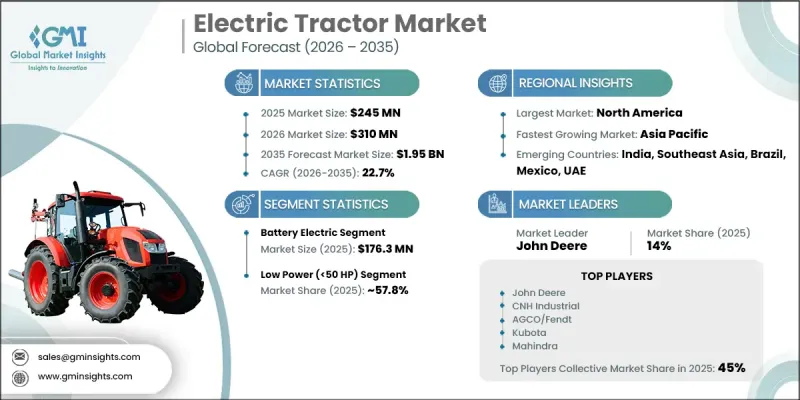
The market is gaining strong momentum as agriculture increasingly shifts toward electrification to reduce emissions, lower operational costs, and improve long-term sustainability. Growing regulatory pressure to curb greenhouse gas emissions from off-road agricultural machinery is significantly accelerating adoption across key farming regions. Governments are also supporting this transition through financial incentives such as subsidies, tax benefits, and affordable financing programs, making electric tractors more commercially viable for farmers. At the same time, rapid advancements in battery systems and electric drivetrains are reshaping performance expectations. Improvements in energy density, charging speed, and battery lifespan are enabling longer operational cycles and broader use across farming applications. Declining battery costs are further reducing acquisition expenses and improving the total cost of ownership. Enhancements in power electronics are also improving torque delivery, allowing electric tractors to handle demanding agricultural workloads. With fewer mechanical components than conventional diesel models, these tractors require less maintenance and offer higher operational efficiency. As technology continues to mature, electric tractors are increasingly being recognized as practical, productivity-focused agricultural machines rather than experimental alternatives.
| Market Scope | |
|---|---|
| Start Year | 2025 |
| Forecast Year | 2026-2035 |
| Start Value | $245 Million |
| Forecast Value | $1.95 Billion |
| CAGR | 22.7% |
The battery electric tractors segment generated USD 176.3 million in 2025. Across propulsion types, the segment includes battery electric, hybrid electric, and fuel cell electric tractors, each designed to meet different operational needs. Battery electric models lead due to their more developed technology base and stronger commercial readiness compared to other configurations. Their simplified architecture supports lower maintenance requirements, reduced system complexity, and more predictable ownership costs. These systems are particularly effective for short- to medium-duration farming activities, aligning well with current battery performance limitations, especially in low- and mid-power agricultural use cases.
The low power segment, defined as tractors below 50 HP, held a share of 57.8% in 2025. This category leads due to its strong compatibility with electric drivetrain capabilities, as low-power tractors are typically used for lighter agricultural tasks such as spraying, cultivation, hauling, and field maintenance. These operations require shorter runtime cycles and moderate torque output, making them well-suited to current battery capacities and charging infrastructure constraints. Demand is particularly strong in small farms, orchards, vineyards, and fragmented landholdings where maneuverability and precision are more important than high pulling power. Lower purchase costs and simplified charging requirements further support widespread adoption among cost-sensitive users.
U.S. Electric Tractor Market accounted for 76% share in 2025, generating USD 81.3 million. The country's leadership position is supported by a strong agricultural machinery ecosystem, high investment capacity, and early adoption of advanced farming technologies. Farmers are increasingly turning toward electric tractors due to rising fuel expenses, labor shortages, and the need to improve operational efficiency. Supportive federal and state-level incentive programs aimed at promoting zero-emission equipment are also accelerating adoption, particularly in regions with stricter sustainability targets.
Major companies operating in the Global Electric Tractor Market include CNH Industrial, AGCO Corporation, John Deere (Deere & Company), Mahindra & Mahindra, Kubota Corporation, CLAAS, Massey Ferguson Limited, Yanmar Holdings Co., Ltd., Escorts Kubota Limited, Deutz-Fahr (SDF Group), Farmtrac (Escorts Group), Monarch Tractor, Solectrac, NAIO Technologies, AutoNxt Automation Pvt. Ltd., Cellestial E-Mobility, Alke, Lely Group, Motivo Engineering, and Ztractor. Companies in the Electric Tractor Market are focusing on strengthening competitiveness through continuous product innovation and advancement in battery and drivetrain technologies. Significant investments in R&D are enabling improvements in energy efficiency, torque performance, and charging speed. Manufacturers are also expanding production capabilities to scale output and reduce unit costs. Strategic collaborations with battery suppliers and technology firms help accelerate innovation cycles and improve supply chain stability. Many players are introducing flexible financing models and leasing options to increase affordability for farmers. Expansion into emerging agricultural markets is further supporting revenue diversification.
Table of Contents
Chapter 1 Methodology and Scope
- 1.1 Market scope and definition
- 1.2 Research design
- 1.2.1 Research approach
- 1.2.2 Data collection methods
- 1.3 Data mining sources
- 1.3.1 Global
- 1.3.2 Regional/Country
- 1.4 Base estimates and calculations
- 1.4.1 Base year calculation
- 1.4.2 Key trends for market estimation
- 1.5 Primary research and validation
- 1.5.1 Primary sources
- 1.6 Forecast model
- 1.7 Research assumptions and limitations
Chapter 2 Executive Summary
- 2.1 Industry 360° synopsis
- 2.2 Key market trends
- 2.2.1 Regional
- 2.2.2 Propulsion type
- 2.2.3 Battery
- 2.2.4 Power
- 2.2.5 Application
- 2.2.6 Distribution channel
Chapter 3 Industry Insights
- 3.1 Industry ecosystem analysis
- 3.1.1 Supplier landscape
- 3.1.2 Profit margin
- 3.1.3 Value addition at each stage
- 3.1.4 Factor affecting the value chain
- 3.2 Industry impact forces
- 3.2.1 Growth drivers
- 3.2.1.1 Environmental regulations and policy support
- 3.2.1.2 Technological advancements and battery cost reduction
- 3.2.1.3 Operating cost efficiency and farm economics
- 3.2.2 Industry pitfalls & challenges
- 3.2.2.1 High initial acquisition cost
- 3.2.2.2 Charging infrastructure and operational limitations
- 3.2.3 Opportunities
- 3.2.3.1 Integration with smart and precision farming systems
- 3.2.3.2 Growing demand from small and specialty farming segments
- 3.2.4 Growth potential analysis
- 3.2.5 Future market trends
- 3.2.6 Technology and innovation landscape
- 3.2.6.1 Current technological trends
- 3.2.6.2 Emerging technologies
- 3.2.7 Pricing Analysis (driven by primary research)
- 3.2.7.1 Historical price trend analysis
- 3.2.7.2 Regional Price Variations
- 3.2.7.3 Price Comparison: electric vs diesel tractors
- 3.2.7.4 Price elasticity & consumer sensitivity
- 3.2.8 Regulatory Framework
- 3.2.8.1 Emission standards & agricultural equipment regulations
- 3.2.8.2 Government subsidies & incentive programs
- 3.2.8.3 Safety & certification requirements
- 3.2.8.4 Import/export regulations & trade policies
- 3.2.8.5 Rural electrification policies
- 3.2.8.6 Carbon credit & sustainability mandates
- 3.2.9 Porter's five forces analysis
- 3.2.10 PESTEL analysis
- 3.2.11 Consumer behavior analysis
- 3.2.11.1 Purchasing patterns
- 3.2.11.2 Preference analysis
- 3.2.11.3 Regional variations in consumer behavior
- 3.2.11.4 Impact of e-commerce on buying decisions
- 3.2.12 Trade data analysis - HS Code: 8701.24 (new) (driven by paid database)
- 3.2.12.1 Import/export volume & value trends
- 3.2.12.2 Key trade corridors & tariff impact
- 3.2.12.3 Trade flow analysis by region
- 3.2.12.4 HS code classification & trade documentation
- 3.2.13 Impact of AI & Generative AI on the Market
- 3.2.13.1 AI-driven disruption of existing business models
- 3.2.13.2 GenAI use cases & adoption roadmap by segment
- 3.2.13.3 Precision agriculture integration (AI-enabled field optimization)
- 3.2.13.4 Predictive maintenance & fleet management applications
- 3.2.13.5 Risks, limitations & regulatory considerations
- 3.2.1 Growth drivers
Chapter 4 Competitive Landscape, 2025
- 4.1 Introduction
- 4.2 Company market share analysis
- 4.2.1 By region
- 4.2.1.1 North America
- 4.2.1.2 Europe
- 4.2.1.3 Asia Pacific
- 4.2.1.4 Latin America
- 4.2.1.5 Middle East and Africa
- 4.2.1 By region
- 4.3 Competitive analysis of major market players
- 4.4 Competitive positioning matrix
- 4.5 Key developments
- 4.5.1 Mergers & acquisitions
- 4.5.2 Partnerships & collaborations
- 4.5.3 New product launches
- 4.5.4 Expansion plans
Chapter 5 Market Estimates and Forecast, By Propulsion Type, 2022 - 2035 (USD Million) (Thousand Units)
- 5.1 Key trends
- 5.2 Battery electric
- 5.3 Hybrid electric
- 5.4 Fuel cell electric
Chapter 6 Market Estimates and Forecast, By Battery, 2022 - 2035 (USD Million) (Thousand Units)
- 6.1 Key trends
- 6.2 Lithium-ion
- 6.3 Lead-Acid
- 6.4 Others (solid-state, sodium-ion, etc.)
Chapter 7 Market Estimates and Forecast, By Power, 2022 - 2035 (USD Million) (Thousand Units)
- 7.1 Key trends
- 7.2 Low power (<50 HP)
- 7.3 Medium power (50-100 HP)
- 7.4 High power (>100 HP)
Chapter 8 Market Estimates and Forecast, By Application, 2022 - 2035 (USD Million) (Thousand Units)
- 8.1 Key trends
- 8.2 Agriculture
- 8.2.1 Field operations
- 8.2.2 Orchard & vineyard operations
- 8.2.3 Livestock & dairy farm applications
- 8.2.4 Others
- 8.3 Utility
- 8.3.1 Landscaping & grounds maintenance
- 8.3.2 Golf courses & sports fields
- 8.3.3 Municipal & public spaces
- 8.4 Industrial
- 8.4.1 Construction site operations
- 8.4.2 Material handling & logistics
- 8.4.3 Municipal services & waste management
- 8.4.4 Airport & port operations
Chapter 9 Market Estimates and Forecast, By Distribution Channel, 2022 - 2035 (USD Million) (Thousand Units)
- 9.1 Key trends
- 9.2 Direct sales
- 9.3 Indirect sales
Chapter 10 Market Estimates and Forecast, By Region, 2022 - 2035 (USD Million) (Thousand Units)
- 10.1 Key trends
- 10.2 North America
- 10.2.1 U.S.
- 10.2.2 Canada
- 10.3 Europe
- 10.3.1 Germany
- 10.3.2 UK
- 10.3.3 France
- 10.3.4 Italy
- 10.3.5 Spain
- 10.4 Asia Pacific
- 10.4.1 China
- 10.4.2 Japan
- 10.4.3 India
- 10.4.4 Australia
- 10.4.5 South Korea
- 10.5 Latin America
- 10.5.1 Brazil
- 10.5.2 Mexico
- 10.5.3 Argentina
- 10.6 Middle East and Africa
- 10.6.1 South Africa
- 10.6.2 Saudi Arabia
- 10.6.3 UAE
Chapter 11 Company Profiles
- 11.1 AGCO Corporation
- 11.2 Alke
- 11.3 AutoNxt Automation Pvt. Ltd.
- 11.4 Cellestial E-Mobility
- 11.5 CLAAS
- 11.6 CNH Industrial
- 11.7 Deutz-Fahr (SDF Group)
- 11.8 Escorts Kubota Limited
- 11.9 Farmtrac (Escorts Group)
- 11.10 John Deere (Deere & Company)
- 11.11 Kubota Corporation
- 11.12 Lely Group
- 11.13 Mahindra & Mahindra
- 11.14 Massey Ferguson Limited
- 11.15 Monarch Tractor
- 11.16 Motivo Engineering
- 11.17 NAIO Technologies
- 11.18 Solectrac
- 11.19 Yanmar Holdings Co., Ltd.
- 11.20 Ztractor

