
PUBLISHER: Global Market Insights Inc. | PRODUCT CODE: 2027546

PUBLISHER: Global Market Insights Inc. | PRODUCT CODE: 2027546
Vacuum Pressure Swing Adsorption Market Opportunity, Growth Drivers, Industry Trend Analysis, and Forecast 2026 - 2035
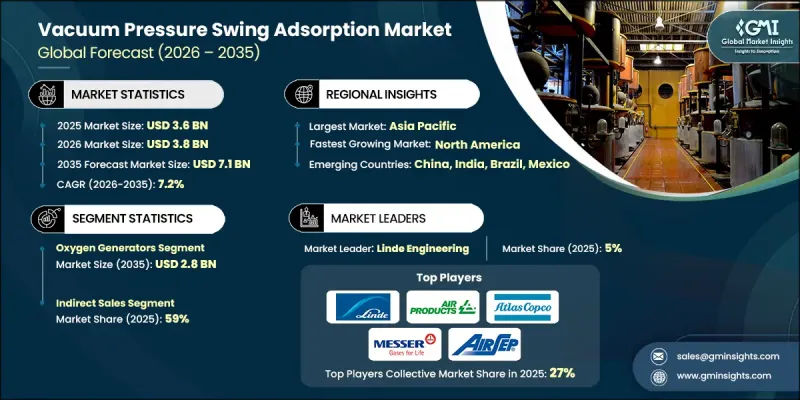
The Global Vacuum Pressure Swing Adsorption Market was valued at USD 3.6 billion in 2025 and is estimated to grow at a CAGR of 7.2% to reach USD 7.1 billion by 2035.
The global vacuum pressure swing adsorption industry is gaining strong momentum as industries increasingly prioritize energy efficiency and sustainable operations. Rising demand for advanced gas separation technologies is driving adoption, supported by growing investments, collaborations, and consolidation activities among leading players. Continuous advancements in adsorbent materials and system configurations are enhancing overall system performance and operational flexibility. Traditional gas production techniques are gradually becoming less favorable as industries seek more energy-efficient and environmentally responsible solutions. VPSA systems are emerging as a preferred alternative due to their ability to operate with lower energy consumption while supporting cleaner production processes. The integration of automated plant designs is further accelerating market growth, enabling improved operational efficiency and reduced mechanical strain. As industries continue to transition toward sustainable infrastructure and optimized resource utilization, VPSA technology is becoming increasingly critical in supporting modern industrial gas generation requirements across global markets.
| Market Scope | |
|---|---|
| Start Year | 2025 |
| Forecast Year | 2026-2035 |
| Start Value | $3.6 Billion |
| Forecast Value | $7.1 Billion |
| CAGR | 7.2% |
The oxygen generators segment accounted for 39.2% share in 2025 and is projected to reach USD 2.8 billion by 2035. This segment continues to dominate as industries favor reliable and high-purity gas generation systems that ensure consistent performance. Strong adsorption efficiency plays a key role in maintaining steady flow rates while reducing overall energy consumption, aligning with cost-efficiency goals and sustainability objectives.
In 2025, the indirect sales segment held a share of 59%, generating USD 2.1 billion. This distribution approach remains widely preferred due to the value it offers in terms of localized technical support, installation services, and access to distribution networks that enhance customer confidence and product accessibility.
U.S. Vacuum Pressure Swing Adsorption Market is growing at a CAGR of 7.5% through 2035, driven by ongoing industrial advancements and a well-established infrastructure base. Demand for efficient gas management solutions continues to rise as industries modernize operations and prioritize energy optimization. VPSA systems are widely utilized across industrial environments to ensure consistent access to high-purity gases, supporting large-scale operational requirements and infrastructure development across the region.
Key companies operating in the Global Vacuum Pressure Swing Adsorption Market include Linde Engineering (Linde plc), Air Products and Chemicals, Atlas Copco AB, Messer Group GmbH, Adsorption Research Inc., NOVAIR (Novair Medical), CAIRE Inc., AirSep Corporation, Oxymat A/S, Valmet Corporation, PKU Pioneer, Chenrui Air Separation, PCI Gases, Precision Medical, and Praxair Technology. Companies in the Vacuum Pressure Swing Adsorption Market are adopting a variety of strategic initiatives to strengthen their competitive position and expand market reach. A primary focus is on continuous innovation in system design and adsorbent technologies to improve efficiency and performance. Organizations are investing in research and development to enhance product capabilities and meet evolving industrial requirements. Strategic partnerships and collaborations are being pursued to expand technological expertise and global presence. Capacity expansion and regional diversification are also key strategies aimed at capturing demand in high-growth markets. In addition, companies are strengthening their distribution networks to improve customer access and after-sales support.
Table of Contents
Chapter 1 Methodology and Scope
- 1.1 Market scope and definition
- 1.2 Research design
- 1.2.1 Research approach
- 1.2.2 Data collection methods
- 1.3 Data mining sources
- 1.3.1 Global
- 1.3.2 Regional/Country
- 1.4 Base estimates and calculations
- 1.4.1 Base year calculation
- 1.4.2 Key trends for market estimation
- 1.5 Primary research and validation
- 1.5.1 Primary sources
- 1.6 Forecast model
- 1.7 Research assumptions and limitations
Chapter 2 Executive Summary
- 2.1 Industry 360° synopsis
- 2.2 Key market trends
- 2.2.1 Regional
- 2.2.2 Product type
- 2.2.3 Operation mode
- 2.2.4 Capacity
- 2.2.5 End-use industry
- 2.2.6 Distribution channel
Chapter 3 Industry Insights
- 3.1 Industry ecosystem analysis
- 3.1.1 Supplier landscape
- 3.1.2 Profit margin
- 3.1.3 Value addition at each stage
- 3.1.4 Factor affecting the value chain
- 3.2 Industry impact forces
- 3.2.1 Growth drivers
- 3.2.1.1 Rising energy costs and efficiency mandates
- 3.2.1.2 Growth in industrial modernization and medical oxygen needs
- 3.2.1.3 Emphasis on environmental sustainability and carbon control
- 3.2.2 Industry pitfalls & challenges
- 3.2.2.1 Logistics and voluminous installation costs
- 3.2.2.2 Adsorbent degradation and structural wear
- 3.2.3 Opportunities
- 3.2.3.1 IoT integration and smart monitoring technology
- 3.2.3.2 Expansion of the automated modular market
- 3.2.1 Growth drivers
- 3.3 Growth potential analysis
- 3.4 Future market trends
- 3.5 Technology and innovation landscape
- 3.5.1 Current technological trends
- 3.5.2 Emerging technologies
- 3.6 Price trends
- 3.6.1 Historical price trend analysis (driven by primary research)
- 3.6.2 Pricing strategy by player type (premium/value/cost-plus) (driven by primary research)
- 3.6.3 Total cost of ownership analysis (CAPEX vs OPEX vs delivered gas)
- 3.7 Regulatory landscape
- 3.7.1 Standards and compliance requirements
- 3.7.2 Regional regulatory frameworks
- 3.7.3 Certification standards
- 3.8 Porter’s analysis
- 3.9 PESTEL analysis
- 3.10 Trade data analysis (driven by paid database)
- 3.10.1 Import/export volume & value trends
- 3.10.2 Key trade corridors & tariff impact
- 3.10.3 Regional trade balances & self-sufficiency levels
- 3.11 Impact of AI & generative AI on the market
- 3.11.1 AI-driven disruption of existing business models
- 3.11.2 GenAI use cases & adoption roadmap by segment
- 3.11.3 Risks, limitations & regulatory considerations
Chapter 4 Competitive Landscape, 2025
- 4.1 Introduction
- 4.2 Company market share analysis
- 4.2.1 By region
- 4.2.1.1 North America
- 4.2.1.2 Europe
- 4.2.1.3 Asia Pacific
- 4.2.1.4 Latin America
- 4.2.1.5 Middle East and Africa
- 4.2.1 By region
- 4.3 Company matrix analysis
- 4.4 Competitive analysis of major market players
- 4.5 Competitive positioning matrix
- 4.6 Key developments
- 4.6.1 Mergers & acquisitions
- 4.6.2 Partnerships & collaborations
- 4.6.3 New product launches
- 4.6.4 Expansion plans
Chapter 5 Market Estimates & Forecast, By Product Type, 2022 - 2035 (USD Billion) (Thousand Units)
- 5.1 Key trends
- 5.2 Oxygen generators
- 5.3 Nitrogen generators
- 5.4 Hydrogen generators
- 5.5 Carbon dioxide (CO2) generators
- 5.6 Others (Argon, Helium)
Chapter 6 Market Estimates & Forecast, By Operation, 2022 - 2035 (USD Billion) (Thousand Units)
- 6.1 Key trends
- 6.2 Semi-automatic
- 6.3 Automatic
Chapter 7 Market Estimates & Forecast, By Capacity, 2022 - 2035 (USD Billion) (Thousand Units)
- 7.1 Key trends
- 7.2 Up to 50 Nm³/h
- 7.3 50 Nm³/h and 500 Nm³/h
- 7.4 Above 500 Nm³/h
Chapter 8 Market Estimates & Forecast, By End-Use, 2022 - 2035 (USD Billion) (Thousand Units)
- 8.1 Key trends
- 8.2 Healthcare
- 8.3 Industrial
- 8.4 Chemical
- 8.5 Environmental
- 8.6 Oil & gas
- 8.7 Energy & power
- 8.8 Others (food & beverages, metallurgy, etc.)
Chapter 9 Market Estimates & Forecast, By Distribution Channel, 2022 - 2035 (USD Billion) (Thousand Units)
- 9.1 Key trends
- 9.2 Direct
- 9.3 Indirect
Chapter 10 Market Estimates and Forecast, By Region, 2022 - 2035 (USD Billion) (Thousand Units)
- 10.1 Key trends
- 10.2 North America
- 10.2.1 U.S.
- 10.2.2 Canada
- 10.3 Europe
- 10.3.1 Germany
- 10.3.2 UK
- 10.3.3 France
- 10.3.4 Italy
- 10.3.5 Spain
- 10.4 Asia Pacific
- 10.4.1 China
- 10.4.2 Japan
- 10.4.3 India
- 10.4.4 Australia
- 10.4.5 South Korea
- 10.5 Latin America
- 10.5.1 Brazil
- 10.5.2 Mexico
- 10.5.3 Argentina
- 10.6 Middle East and Africa
- 10.6.1 South Africa
- 10.6.2 Saudi Arabia
- 10.6.3 UAE
Chapter 11 Company Profiles
- 11.1 Adsorption Research Inc.
- 11.2 Air Products and Chemicals
- 11.3 AirSep Corporation
- 11.4 Atlas Copco AB
- 11.5 CAIRE Inc.
- 11.6 Chenrui Air Separation
- 11.7 Linde Engineering (Linde plc)
- 11.8 Messer Group GmbH
- 11.9 NOVAIR (Novair Medical)
- 11.10 Oxymat A/S
- 11.11 PCI Gases
- 11.12 PKU Pioneer
- 11.13 Praxair Technology
- 11.14 Precision Medical
- 11.15 Valmet Corporation

