PUBLISHER: Global Market Insights Inc. | PRODUCT CODE: 2027552

PUBLISHER: Global Market Insights Inc. | PRODUCT CODE: 2027552
Mechanical Watch Market Opportunity, Growth Drivers, Industry Trend Analysis, and Forecast 2026 - 2035
The Global Mechanical Watch Market was valued at USD 79 billion in 2025 and is estimated to grow at a CAGR of 5% to reach USD 127.6 billion by 2035.
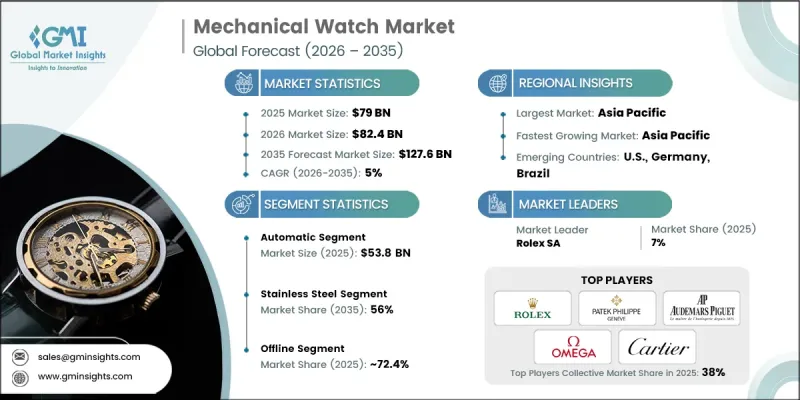
The rising appreciation for traditional watchmaking craftsmanship and the increasing demand for luxury timepieces among affluent consumers worldwide are driving market growth. Strategic mergers, acquisitions, and collaborations among leading brands are further expanding heritage collections, improving production capabilities, and strengthening global market presence. Consolidation in the sector has spurred technological advancements in movement engineering, enabling high-precision mechanical watches that combine traditional techniques with innovative features. These developments are particularly valued in luxury retail and fashion markets, where exclusivity, superior design, and craftsmanship determine consumer preference. Overall, the market's growth is fueled by the desire for prestigious, technically advanced timepieces that reflect personal style and long-term investment value.
| Market Scope | |
|---|---|
| Start Year | 2025 |
| Forecast Year | 2026-2035 |
| Start Value | $79 Billion |
| Forecast Value | $127.6 Billion |
| CAGR | 5% |
Traditional mechanical watches are increasingly being upgraded with sophisticated complications such as perpetual calendars, tourbillons, and chronographs, which enhance precision and performance. These advanced timepieces drive market expansion by offering exceptional craftsmanship, exclusivity, and collectible value. High-performance watches cater to consumers who prioritize technical excellence, aesthetics, and durability. The integration of innovative complications has become a key differentiator, elevating brand status while boosting demand for premium mechanical watches across global luxury markets.
The automatic segment accounted for USD 53.8 billion in 2025 and is projected to reach USD 88.5 billion by 2035. Automatic watches, which self-wind through natural wrist movement, offer convenience by eliminating the need for manual winding, making them highly desirable among consumers seeking low-maintenance luxury timepieces. Advanced rotor-driven winding systems maintain consistent power delivery, ensuring accurate timekeeping and reliable operation of complications such as date displays. Modern automatic watches incorporate bi-directional rotors and precision ball-bearing systems to improve efficiency, stability, and durability, making them ideal for daily wear and active lifestyles. These innovations underscore the segment's importance in technological advancement and consumer adoption within the market.
The offline channels segment held a 72.4% share in 2025 and is expected to hold 72.8% share by 2035. The tactile and personalized experience offered by authorized boutiques and retail stores remains critical for luxury purchases. Customers value the ability to examine craftsmanship, try on watches, and access authentication, warranty, and after-sales services. As consumer behavior evolves, brands are increasingly adopting omnichannel strategies, blending online discovery with offline purchase experiences. Appointment-based consultations, virtual previews, and hybrid retail initiatives are becoming common, helping brands maintain engagement while meeting evolving consumer expectations for luxury watch acquisition.
United States Mechanical Watch Market held a 78% share in 2025, driven by high disposable income, a robust collector community, and widespread authorized retail networks in major urban centers. Growth is further supported by the rising popularity of vintage watch collecting, the expansion of luxury e-commerce platforms, and investments in experiential retail, including brand heritage centers and interactive showcases. Consumers in the region increasingly seek high-quality automatic and manual-wind watches that combine luxury, performance, and collectibility, sustaining demand across both new and heritage timepiece collections.
Key players in the Global Mechanical Watch Market include Blancpain SA, TAG Heuer SA, IWC International Watch Co. AG, Rolex SA, Omega SA, Montres Breguet SA, Cartier International SNC, Audemars Piguet Holding SA, Patek Philippe SA Geneve, A. Lange & Sohne GmbH, Jaeger-LeCoultre SA, Vacheron Constantin SA, Seiko Group Corporation, Officine Panerai SA, and Girard-Perregaux SA. Companies in the Mechanical Watch Market strengthen their presence by investing in high-precision movement technology, including innovative complications and long-term durability improvements. Brands pursue strategic partnerships and acquisitions to expand their heritage collections and enhance manufacturing capabilities. Geographic expansion into emerging luxury markets and the development of omnichannel retail strategies increase market visibility and accessibility. Firms emphasize brand storytelling, heritage marketing, and experiential retail initiatives to foster consumer loyalty. Additionally, limited editions, bespoke designs, and collectible releases reinforce exclusivity and value perception.
Table of Contents
Chapter 1 Methodology and Scope
- 1.1 Market scope and definition
- 1.2 Research design
- 1.2.1 Research approach
- 1.2.2 Data collection methods
- 1.3 Data mining sources
- 1.3.1 Global
- 1.3.2 Regional/Country
- 1.4 Base estimates and calculations
- 1.4.1 Base year calculation
- 1.4.2 Key trends for market estimation
- 1.5 Primary research (Driven by Primary Research)
- 1.5.1 Industry Expert Interviews
- 1.5.2 Manufacturer & Brand Surveys
- 1.5.3 Retailer & Distributor Insights
- 1.6 Secondary Research
- 1.6.1 Paid Sources
- 1.6.2 Public Sources
- 1.7 Forecast model
- 1.8 Research assumptions and limitations
Chapter 2 Executive Summary
- 2.1 Industry 360° synopsis
- 2.2 Key market trends
- 2.2.1 Regional
- 2.2.2 Movement Type
- 2.2.3 Strap Material
- 2.2.4 Case Size
- 2.2.5 Shape
- 2.2.6 Consumer Group
- 2.2.7 Price
- 2.2.8 Distribution Channel
- 2.3 CXO perspectives: Strategic imperatives
- 2.3.1 Key decision points for industry executives
- 2.3.2 Critical success factors for market players
- 2.4 Future outlook and strategic recommendations
Chapter 3 Industry Insights
- 3.1 Industry ecosystem analysis
- 3.1.1 Supplier landscape
- 3.1.2 Profit margin
- 3.1.3 Value addition at each stage
- 3.1.4 Factor affecting the value chain
- 3.2 Industry impact forces
- 3.2.1 Growth drivers
- 3.2.1.1 Rising affluence & luxury consumption
- 3.2.1.2 Heritage appreciation & artisan craftsmanship
- 3.2.1.3 Investment value & wealth preservation
- 3.2.2 Industry pitfalls & challenges
- 3.2.2.1 Competition from smartwatches & wearable technology
- 3.2.2.2 Skilled labor shortage & production constraints
- 3.2.3 Opportunities
- 3.2.3.1 Certified pre-owned & secondary market expansion
- 3.2.3.2 Customization & personalization services
- 3.2.1 Growth drivers
- 3.3 Growth potential analysis
- 3.4 Future market trends
- 3.5 Technology and innovation landscape
- 3.5.1 Current technological trends
- 3.5.2 Emerging technologies
- 3.6 Price trends
- 3.6.1 By region
- 3.6.2 By Movement type
- 3.7 Regulatory landscape
- 3.7.1 Standards and compliance requirements
- 3.7.2 Regional regulatory frameworks
- 3.7.3 Certification standards
- 3.8 Trade Data Analysis (Driven by Primary Research)
- 3.8.1 Import/Export Volume & Value Trends (Driven by Primary Research) (2022-2025)
- 3.8.2 Key Trade Corridors & Tariff Impact (Driven by Primary Research)
- 3.9 Porter’s analysis
- 3.10 PESTEL analysis
- 3.11 Impact of AI & Generative AI on the Market
- 3.11.1 AI-Driven Disruption of Traditional Retail Models
- 3.11.2 GenAI Use Cases (Virtual Try-on, Personalization, Authentication)
- 3.12 Distribution Infrastructure & Channel Penetration Landscape (Driven by Primary Research)
- 3.12.1 Channel Coverage by Region & Format (Mono-brand vs. Multi-brand) (Driven by Primary Research)
- 3.12.2 E-commerce Infrastructure Gaps & Omnichannel Integration (Driven by Primary Research)
Chapter 4 Competitive Landscape, 2025
- 4.1 Introduction
- 4.2 Company market share analysis
- 4.2.1 By region
- 4.2.1.1 North America
- 4.2.1.2 Europe
- 4.2.1.3 Asia Pacific
- 4.2.1.4 Latin America
- 4.2.1.5 Middle East and Africa
- 4.2.1 By region
- 4.3 Company matrix analysis
- 4.4 Competitive analysis of major market players
- 4.5 Competitive positioning matrix
- 4.6 Key developments
- 4.6.1 Mergers & acquisitions
- 4.6.2 Partnerships & collaborations
- 4.6.3 New product launches
- 4.6.4 Expansion plans
Chapter 5 Market Estimates & Forecast, By Movement Type, 2022 - 2035 (USD Billion) (Million Units)
- 5.1 Key trends
- 5.2 Automatic
- 5.3 Manual
Chapter 6 Market Estimates & Forecast, By Strap Material, 2022 - 2035(USD Billion) (Million Units)
- 6.1 Key trends
- 6.2 Leather
- 6.3 Stainless Steel
- 6.4 Nylon
- 6.5 Others (Rubber etc.)
Chapter 7 Market Estimates & Forecast, By Case Size, 2022 - 2035 (USD Billion) (Million Units)
- 7.1 Key trends
- 7.2 Up to 35 mm
- 7.3 35 mm - 40 mm
- 7.4 40 mm - 45 mm
- 7.5 Above 45 mm
Chapter 8 Market Estimates & Forecast, By Shape, 2022 - 2035 (USD Billion) (Million Units)
- 8.1 Key trends
- 8.2 Rectangular
- 8.3 Round
- 8.4 Square
Chapter 9 Market Estimates & Forecast, By Consumer Group, 2022 - 2035 (USD Billion) (Million Units)
- 9.1 Key trends
- 9.2 Men
- 9.3 Women
- 9.4 Unisex
Chapter 10 Market Estimates & Forecast, By Application, 2022 - 2035 (USD Billion) (Million Units)
- 10.1 Key trends
- 10.2 Low
- 10.3 Medium
- 10.4 High/Premium
Chapter 11 Market Estimates & Forecast, By Distribution Channel, 2022 - 2035 (USD Billion) (Million Units)
- 11.1 Key trends
- 11.2 Online
- 11.2.1 E-commerce Websites
- 11.2.2 Company-owned Websites
- 11.3 Offline
- 11.3.1 Mega Retail Stores
- 11.3.2 Specialty Stores
- 11.3.3 Others (Independent Stores, etc.)
Chapter 12 Market Estimates and Forecast, By Region, 2022 - 2035 (USD Billion) (Million Units)
- 12.1 Key trends
- 12.2 North America
- 12.2.1 U.S.
- 12.2.2 Canada
- 12.3 Europe
- 12.3.1 Germany
- 12.3.2 UK
- 12.3.3 France
- 12.3.4 Italy
- 12.3.5 Spain
- 12.4 Asia Pacific
- 12.4.1 China
- 12.4.2 Japan
- 12.4.3 India
- 12.4.4 Australia
- 12.4.5 South Korea
- 12.5 Latin America
- 12.5.1 Brazil
- 12.5.2 Mexico
- 12.5.3 Argentina
- 12.6 Middle East and Africa
- 12.6.1 South Africa
- 12.6.2 Saudi Arabia
- 12.6.3 UAE
Chapter 13 Company Profiles
- 13.1 A. Lange & Sohne GmbH
- 13.2 Audemars Piguet Holding SA
- 13.3 Blancpain SA
- 13.4 Cartier International SNC
- 13.5 Girard-Perregaux SA
- 13.6 IWC International Watch Co. AG
- 13.7 Jaeger-LeCoultre SA
- 13.8 Montres Breguet SA
- 13.9 Officine Panerai SA
- 13.10 Omega SA
- 13.11 Patek Philippe SA Geneve
- 13.12 Rolex SA
- 13.13 Seiko Group Corporation
- 13.14 TAG Heuer SA
- 13.15 Vacheron Constantin SA

