PUBLISHER: Global Market Insights Inc. | PRODUCT CODE: 2038305

PUBLISHER: Global Market Insights Inc. | PRODUCT CODE: 2038305
Asia-Pacific Mechanical Watch Market Opportunity, Growth Drivers, Industry Trend Analysis, and Forecast 2026 - 2035
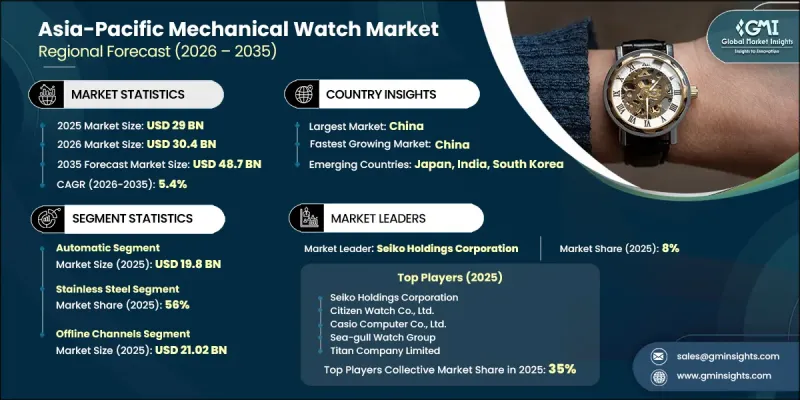
Asia-Pacific Mechanical Watch Market was valued at USD 29 billion in 2025 and is estimated to grow at a CAGR of 5.4% to reach USD 48.7 billion by 2035.
Growth is driven by increasing demand for craftsmanship-focused timepieces alongside modern innovations that enhance usability and performance. Consumers across the region are showing stronger interest in mechanical watches that combine heritage appeal with contemporary engineering. The growing popularity of automatic movements is encouraging manufacturers to refine internal components, improve durability, and offer visually engaging designs. At the same time, digital retail channels are reshaping how brands interact with buyers by delivering immersive and informative purchasing experiences. Public sector initiatives are also supporting industry development through manufacturing incentives and skill-building programs in horology. Demand remains particularly strong in key markets where a growing middle and upper class is fueling premiumization and long-term value perception in mechanical watches.
| Market Scope | |
|---|---|
| Start Year | 2025 |
| Forecast Year | 2026-2035 |
| Start Value | $29 Billion |
| Forecast Value | $48.7 Billion |
| CAGR | 5.4% |
The automatic movements segment accounted for 68.1% share and reached USD 19.8 billion in 2025. These mechanisms are widely preferred due to their ease of use, as they eliminate the need for manual winding while maintaining the essence of mechanical engineering. Their appeal lies in offering a balance between traditional craftsmanship and everyday practicality. Continuous advancements have led to improved efficiency, longer power reserves, and refined internal architecture, further strengthening their dominance in the market.
The stainless steel straps segment held a 56% share in 2025, totaling USD 16.27 billion. Their widespread adoption is linked to their resilience, adaptability, and polished aesthetic that suits a variety of occasions. These straps are often associated with high-end designs and are valued for their longevity and resistance to environmental wear. Technological improvements in production processes have enhanced comfort, finishing quality, and structural integrity, contributing to sustained demand.
China Mechanical Watch Market held a 33% share in 2025, reaching USD 9.6 billion and an anticipated CAGR of 5.6% through 2035. The country's leadership is supported by a large base of affluent consumers, a strong cultural connection to watchmaking, and increasing demand for premium timepieces. Buyers are becoming more knowledgeable, demonstrating deeper interest in both domestic craftsmanship and internationally recognized brands. The evolving consumer mindset continues to elevate the importance of design, heritage, and mechanical sophistication.
Key companies active in the Asia-Pacific Mechanical Watch Market include Beijing Watch Factory, Casio Computer Co., Ltd., Citizen Watch Co., Ltd., FIYTA Group, Grand Seiko, HMT Watches Limited, Memorigin, Minase Watch, Orient Watch Co., Peacock Watch, Rossini Watch, Sea-gull Watch Group, Seiko Holdings Corporation, Shanghai Watch Co., and Titan Company Limited. Companies operating in the Asia-Pacific Mechanical Watch Market are focusing on product innovation, brand storytelling, and digital expansion to strengthen their competitive position. They are investing in advanced movement technologies, improving precision, and enhancing durability to meet evolving consumer expectations. Many players are emphasizing heritage and craftsmanship to differentiate their offerings and build emotional connections with buyers. Strategic partnerships, limited-edition releases, and localized marketing approaches are also being used to attract diverse consumer segments. Additionally, firms are expanding their presence through e-commerce platforms and immersive digital tools to improve accessibility and customer engagement while optimizing supply chains and manufacturing efficiency.
Table of Contents
Chapter 1 Methodology and Scope
- 1.1 Market scope and definition
- 1.2 Research design
- 1.2.1 Research approach
- 1.2.2 Data collection methods
- 1.3 Data mining sources
- 1.3.1 Global
- 1.3.2 Regional/Country
- 1.4 Base estimates and calculations
- 1.4.1 Base year calculation
- 1.4.2 Key trends for market estimation
- 1.5 Primary research and validation
- 1.5.1 Primary sources
- 1.6 Forecast model
- 1.7 Research assumptions and limitations
Chapter 2 Executive Summary
- 2.1 Industry 360° synopsis
- 2.2 Key market trends
- 2.2.1 Movement Type
- 2.2.2 Strap Material
- 2.2.3 Case Size
- 2.2.4 Shape
- 2.2.5 Consumer Group
- 2.2.6 Price
- 2.2.7 Distribution Channel
Chapter 3 Industry Insights
- 3.1 Industry ecosystem analysis
- 3.1.1 Supplier landscape
- 3.1.2 Profit margin
- 3.1.3 Value addition at each stage
- 3.1.4 Factor affecting the value chain
- 3.2 Industry impact forces
- 3.2.1 Growth drivers
- 3.2.1.1 Growing affluence and luxury consumption in emerging markets
- 3.2.1.2 Rising appreciation for traditional craftsmanship and heritage watchmaking
- 3.2.1.3 Innovation in movement technology and extended power reserves
- 3.2.2 Industry pitfalls & challenges
- 3.2.2.1 Competition from smartwatches and digital alternatives
- 3.2.2.2 Perception gap between Swiss and Asian watchmaking quality
- 3.2.3 Opportunities
- 3.2.3.1 Expansion of domestic luxury consumption and brand pride
- 3.2.3.2 Integration of modern materials and traditional craftsmanship
- 3.2.1 Growth drivers
- 3.3 Growth potential analysis
- 3.4 Future market trends
- 3.5 Technology and innovation landscape
- 3.5.1 Current technological trends
- 3.5.2 Emerging technologies
- 3.6 Price trends
- 3.6.1 By Country
- 3.6.2 By Product
- 3.7 Regulatory landscape
- 3.7.1 Standards and compliance requirements
- 3.7.2 Regional regulatory frameworks
- 3.7.3 Certification standards
- 3.8 Trade Data Analysis (Driven by Primary Research)
- 3.8.1 Import/Export Volume & Value Trends (2022-2025) (Driven by Primary Research)
- 3.8.2 Key Trade Corridors & Tariff Impact (Driven by Primary Research)
- 3.9 Porter's analysis
- 3.10 PESTEL analysis
- 3.11 Impact of AI & Generative AI on the Market
- 3.11.1 AI-Driven Disruption of Traditional Retail Models
- 3.11.2 GenAI Use Cases (Virtual Try-on, Personalization, Authentication)
- 3.12 Distribution Infrastructure & Channel Penetration Landscape (Driven by Primary Research)
- 3.12.1 Channel Coverage by Region & Format (Mono-brand vs. Multi-brand) (Driven by Primary Research)
- 3.12.2 E-commerce Infrastructure Gaps & Omnichannel Integration (Driven by Primary Research)
Chapter 4 Competitive Landscape, 2025
- 4.1 Introduction
- 4.2 Company market share analysis
- 4.3 Company matrix analysis
- 4.4 Competitive analysis of major market players
- 4.5 Competitive positioning matrix
- 4.6 Key developments
- 4.6.1 Mergers & acquisitions
- 4.6.2 Partnerships & collaborations
- 4.6.3 New product launches
- 4.6.4 Expansion plans
Chapter 5 Market Estimates & Forecast, By Movement Type, 2022 - 2035 (USD Billion) (Million Units)
- 5.1 Key trends
- 5.2 Automatic
- 5.3 Manual
Chapter 6 Market Estimates & Forecast, By Strap Material, 2022 - 2035(USD Billion) (Million Units)
- 6.1 Key trends
- 6.2 Leather
- 6.3 Stainless Steel
- 6.4 Nylon
- 6.5 Others (Rubber etc.)
Chapter 7 Market Estimates & Forecast, By Case Size, 2022 - 2035 (USD Billion) (Million Units)
- 7.1 Key trends
- 7.2 Up to 35 mm
- 7.3 35 mm - 40 mm
- 7.4 40 mm - 45 mm
- 7.5 Above 45 mm
Chapter 8 Market Estimates & Forecast, By Shape, 2022 - 2035 (USD Billion) (Million Units)
- 8.1 Key trends
- 8.2 Rectangular
- 8.3 Round
- 8.4 Square
Chapter 9 Market Estimates & Forecast, By Consumer Group, 2022 - 2035 (USD Billion) (Million Units)
- 9.1 Key trends
- 9.2 Men
- 9.3 Women
- 9.4 Unisex
Chapter 10 Market Estimates & Forecast, By Application, 2022 - 2035 (USD Billion) (Million Units)
- 10.1 Key trends
- 10.2 Low
- 10.3 Medium
- 10.4 High/Premium
Chapter 11 Market Estimates & Forecast, By Distribution Channel, 2022 - 2035 (USD Billion) (Million Units)
- 11.1 Key trends
- 11.2 Online
- 11.2.1 E-commerce Websites
- 11.2.2 Company-owned Websites
- 11.3 Offline
- 11.3.1 Mega Retail Stores
- 11.3.2 Specialty Stores
- 11.3.3 Others (Independent Stores, etc.)
Chapter 12 Market Estimates and Forecast, By Region, 2022 - 2035 (USD Billion) (Thousand Units)
- 12.1 Key trends
- 12.2 Asia Pacific
- 12.2.1 China
- 12.2.2 Japan
- 12.2.3 India
- 12.2.4 Australia
- 12.2.5 South Korea
Chapter 13 Company Profiles
- 13.1 Beijing Watch Factory
- 13.2 Casio Computer Co., Ltd.
- 13.3 Citizen Watch Co., Ltd.
- 13.4 FIYTA Group
- 13.5 Grand Seiko
- 13.6 HMT Watches Limited
- 13.7 Memorigin
- 13.8 Minase Watch
- 13.9 Orient Watch Co.
- 13.10 Peacock Watch
- 13.11 Rossini Watch
- 13.12 Sea-gull Watch Group
- 13.13 Seiko Holdings Corporation
- 13.14 Shanghai Watch Co.
- 13.15 Titan Company Limited

