PUBLISHER: Global Market Insights Inc. | PRODUCT CODE: 2027558

PUBLISHER: Global Market Insights Inc. | PRODUCT CODE: 2027558
Glamping Market Opportunity, Growth Drivers, Industry Trend Analysis, and Forecast 2026 - 2035
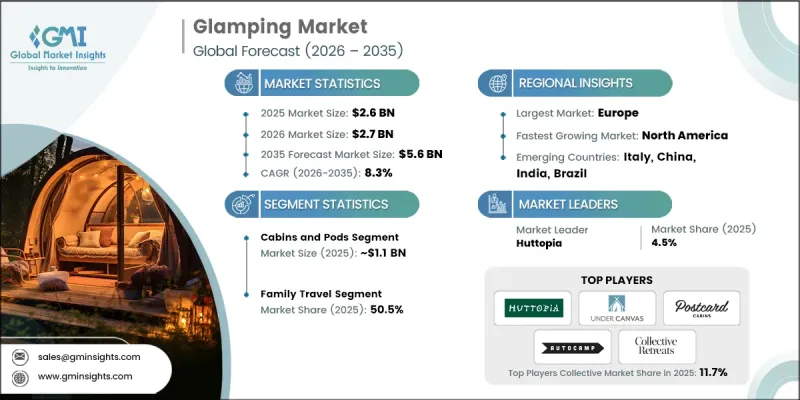
The Global Glamping Market was valued at USD 2.6 billion in 2025 and is estimated to grow at a CAGR of 8.3% to reach USD 5.6 billion by 2035.
The market growth is driven by rising consumer demand for eco-friendly and sustainable travel experiences. Travelers increasingly prefer accommodations that minimize environmental impact while offering unique outdoor experiences. Governments, hospitality associations, and sustainability initiatives, including programs supporting responsible tourism and eco-conscious outdoor lodging, are encouraging the development of glamping sites. Regulations and guidelines, such as those promoting minimal environmental impact and responsible outdoor use, have further supported industry expansion. Sustainable energy solutions like solar-powered tents and eco-friendly accommodations crafted from recycled or renewable materials are gaining traction, providing travelers with immersive nature experiences without compromising comfort, while meeting the growing demand for environmentally responsible tourism.
| Market Scope | |
|---|---|
| Start Year | 2025 |
| Forecast Year | 2026-2035 |
| Start Value | $2.6 Billion |
| Forecast Value | $5.6 Billion |
| CAGR | 8.3% |
The cabins and pods segment accounted for USD 1.1 billion in 2025 and is expected to reach USD 2.5 billion by 2035. These accommodations combine modern amenities with natural surroundings, offering insulated walls, climate control, and full bathroom facilities, making them ideal for families and couples. Cabins and pods allow operators to provide customizable and flexible lodging options, catering to various budgets and preferences, and increasing overall market appeal.
The family travel segment held a 50.5% share in 2025. Families are increasingly seeking outdoor experiences that blend adventure with comfort, allowing quality time in nature without sacrificing convenience or safety. The growing popularity of glamping among families reflects the demand for premium yet accessible experiences, offering a comfortable alternative to traditional camping while providing ample opportunities for outdoor recreation.
U.S. Glamping Market captured 80.5% share in 2025. Market growth in the region is fueled by Millennials and Gen Z travelers who prioritize authentic, experience-driven stays over material possessions. This demographic seeks "Instagrammable" outdoor accommodations like luxury tents and fully equipped pods. Additionally, institutional investments, partnerships, and integration of glamping brands into loyalty programs have professionalized the sector, expanding its reach and making glamping more mainstream and accessible.
Key players operating in the Global Glamping Market include AutoCamp, Westgate River Ranch, Beckons Collection, Camp Denali, Collective Retreats, Conestoga Ranch, Firelight Camps, Huttopia, Paperbark Camp, Paws Up, Postcard Cabins, Tanja Lagoon Camp, Terramor Outdoor Resort, Under Canvas, and Wigwam Holidays. Key strategies adopted by companies in the Glamping Market include expanding their portfolio of eco-friendly and customizable lodging options, leveraging technology to enhance the guest experience, and forming strategic alliances with hospitality networks to increase visibility and access to loyal customer bases. Operators focus on developing premium yet sustainable accommodations to appeal to Millennials and Gen Z travelers while maintaining flexibility for family-oriented and mid-range offerings. Marketing campaigns emphasize experiential travel and social media engagement, and companies invest in operational efficiency through modular and scalable lodging solutions. Strategic partnerships with tourism boards, loyalty programs, and travel platforms also strengthen market presence and enhance brand recognition across competitive regions.
Table of Contents
Chapter 1 Methodology & Scope
- 1.1 Research approach
- 1.2 Quality Commitments
- 1.3 GMI AI policy & data integrity commitment
- 1.3.1 Source consistency protocol
- 1.4 Research Trail & Confidence Scoring
- 1.4.1 Research Trail Components
- 1.4.2 Scoring Components
- 1.5 Data Collection
- 1.5.1 Partial list of primary sources
- 1.6 Data mining sources
- 1.7 Paid sources
- 1.7.1 Sources, by region
- 1.8 Base estimates and calculations
- 1.8.1 Base year calculation for any one approach
- 1.9 Forecast model
- 1.9.1 Quantified market impact analysis
- 1.9.1.1 Mathematical impact of growth parameters on forecast
- 1.9.1 Quantified market impact analysis
- 1.10 Research transparency addendum
- 1.10.1 Source attribution framework
- 1.10.2 Quality assurance metrics
- 1.10.3 Our commitment to trust
Chapter 2 Executive Summary
- 2.1 Industry 360° synopsis
- 2.2 Key market trends
- 2.2.1 Regional
- 2.2.2 Accommodation type
- 2.2.3 Booking model
- 2.2.4 Price
- 2.2.5 Application
Chapter 3 Industry Insights
- 3.1 Industry ecosystem analysis
- 3.1.1 Supplier landscape
- 3.1.2 Profit margin
- 3.1.3 Value addition at each stage
- 3.1.4 Factor affecting the value chain
- 3.2 Industry impact forces
- 3.2.1 Growth drivers
- 3.2.1.1 Rising demand for luxury outdoor experiences
- 3.2.1.2 Increasing popularity of sustainable and eco-friendly tourism
- 3.2.1.3 Growth in disposable income and travel spending
- 3.2.2 Industry pitfalls & challenges
- 3.2.2.1 High initial investment and maintenance costs
- 3.2.2.2 Seasonal demand fluctuations affecting revenue stability
- 3.2.3 Opportunities
- 3.2.3.1 Premium eco-luxury retreats in underserved natural destinations
- 3.2.3.2 Experiential, theme-based glamping concepts
- 3.2.1 Growth drivers
- 3.3 Growth potential analysis
- 3.4 Future market trends
- 3.5 Technology and innovation landscape
- 3.5.1 Current technological trends
- 3.5.2 Emerging technologies
- 3.6 Regulatory landscape
- 3.6.1 Standards and compliance requirements
- 3.6.2 Regional regulatory frameworks
- 3.6.3 Certification standards
- 3.7 Impact of AI & generative AI on the market
- 3.7.1 AI-driven disruption of existing business models
- 3.7.2 Gen AI use cases & adoption roadmap by segment
- 3.7.3 Risks, limitations & regulatory considerations
- 3.8 Pricing analysis (driven by primary research)
- 3.8.1 Historical price trend analysis (driven by primary research)
- 3.8.2 Pricing strategy by player type (premium / value / cost-plus) (driven by primary research)
- 3.8.3 Regional price variations
- 3.8.4 Impact of raw material costs on pricing
- 3.9 Porter’s analysis
- 3.10 PESTEL analysis
Chapter 4 Competitive Landscape, 2025
- 4.1 Introduction
- 4.2 Company market share analysis
- 4.2.1 By region
- 4.2.1.1 North America
- 4.2.1.2 Europe
- 4.2.1.3 Asia Pacific
- 4.2.1.4 Latin America
- 4.2.1.5 Middle East and Africa
- 4.2.1 By region
- 4.3 Company matrix analysis
- 4.4 Competitive analysis of major market players
- 4.5 Competitive positioning matrix
- 4.6 Key developments
- 4.6.1 Mergers & acquisitions
- 4.6.2 Partnerships & collaborations
- 4.6.3 New product launches
- 4.6.4 Expansion plans
Chapter 5 Market Estimates & Forecast, By Product type, 2022-2035 (USD Billion)
- 5.1 Key trends
- 5.2 Cabins and pods
- 5.3 Tents
- 5.4 Yurts
- 5.5 Treehouses
- 5.6 Airstreams
- 5.7 Others
Chapter 6 Market Estimates & Forecast, By Booking Model, 2022-2035 (USD Billion)
- 6.1 Key trends
- 6.2 Direct booking
- 6.3 OTA & platform booking
- 6.4 Tour operator packages
Chapter 7 Market Estimates & Forecast, By Price, 2022-2035 (USD Billion)
- 7.1 Key trends
- 7.2 Low
- 7.3 Medium
- 7.4 High
Chapter 8 Market Estimates & Forecast, By Application, 2022-2035 (USD Billion)
- 8.1 Key trends
- 8.2 Family travel
- 8.3 Couples' getaways
- 8.4 Solo travel
- 8.5 Wellness retreats
- 8.6 Others
Chapter 9 Market Estimates & Forecast, By Distribution Channel, 2022-2035 (USD Billion)
- 9.1 Key trends
- 9.2 Online
- 9.2.1 E-Commerce
- 9.2.2 Company website
- 9.3 Offline
- 9.3.1 Supermarkets/Hypermarkets
- 9.3.2 Specialty Stores
- 9.3.3 Others (Individual stores, Departmental stores, etc.)
Chapter 10 Market Estimates & Forecast, By Region, 2022-2035 (USD Billion)
- 10.1 Key trends
- 10.2 North America
- 10.2.1 U.S.
- 10.2.2 Canada
- 10.3 Europe
- 10.3.1 Germany
- 10.3.2 France
- 10.3.3 UK
- 10.3.4 Italy
- 10.3.5 Spain
- 10.4 Asia Pacific
- 10.4.1 China
- 10.4.2 India
- 10.4.3 Japan
- 10.4.4 South Korea
- 10.4.5 Australia
- 10.5 Latin America
- 10.5.1 Brazil
- 10.5.2 Mexico
- 10.5.3 Argentina
- 10.6 MEA
- 10.6.1 South Africa
- 10.6.2 Saudi Arabia
- 10.6.3 UAE
Chapter 11 Company Profiles
- 11.1 AutoCamp
- 11.2 Beckons Collection
- 11.3 Camp Denali
- 11.4 Collective Retreats
- 11.5 Conestoga Ranch
- 11.6 Firelight Camps
- 11.7 Huttopia
- 11.8 Paperbark Camp
- 11.9 Paws Up
- 11.10 Postcard Cabins
- 11.11 Tanja Lagoon Camp
- 11.12 Terramor Outdoor Resort
- 11.13 Under Canvas
- 11.14 Westgate River Ranch
- 11.15 Wigwam Holidays

