PUBLISHER: Global Market Insights Inc. | PRODUCT CODE: 2027561

PUBLISHER: Global Market Insights Inc. | PRODUCT CODE: 2027561
Thionyl Chloride Market Opportunity, Growth Drivers, Industry Trend Analysis, and Forecast 2026 - 2035
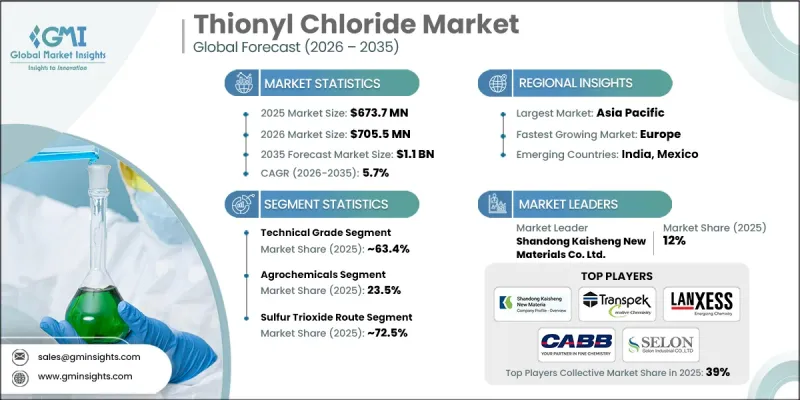
The Global Thionyl Chloride Market was valued at USD 673.7 million in 2025 and is estimated to grow at a CAGR of 5.7% to reach USD 1.1 billion by 2035.
The global thionyl chloride industry is expanding steadily as demand increases across chemical synthesis and industrial manufacturing applications. Thionyl chloride is widely recognized as a highly reactive inorganic compound used extensively in chlorination and dehydration reactions. Its role in producing key intermediates and active chemical substances makes it an essential input across multiple downstream industries. The compound is extensively utilized in pharmaceutical and agrochemical production as well as dye manufacturing, where it supports the synthesis of a wide range of chemical products. In addition, its importance has increased due to its application in energy storage systems, particularly lithium-based battery technologies that require high-performance chemical inputs. Market expansion is being driven by rising demand from industrial sectors, growing adoption in energy storage applications, and increasing chemical production activities in emerging economies. Continuous improvements in chemical processing technologies and advancements in battery systems are further supporting broader adoption and creating new application opportunities across global markets.
| Market Scope | |
|---|---|
| Start Year | 2025 |
| Forecast Year | 2026-2035 |
| Start Value | $673.7 Million |
| Forecast Value | $1.1 Billion |
| CAGR | 5.7% |
The technical grade segment accounted for 63.4% share in 2025 and is expected to grow at a CAGR of 5.8% through 2035. This segment remains dominant due to its widespread use in industrial chemical production, including agrochemical formulations, dyes and pigments, and organic synthesis processes. Its cost efficiency and suitability for large-scale manufacturing continue to support strong demand across multiple industries.
The sulfur trioxide route held a share of 72.5% in 2025 and is projected to grow at a CAGR of 5.8% through 2035. This production method is preferred due to its high process efficiency, consistent product purity, and scalability for large-volume industrial output. It aligns well with the quality requirements of pharmaceutical and agrochemical manufacturers, making it a widely adopted production route. Other production pathways remain relevant for specialized applications where process flexibility and customized chemical behavior are prioritized over production volume.
North America Thionyl Chloride Market accounted for 32.5% share in 2025, reflecting its strong industrial base and regulatory-driven chemical manufacturing environment. The region continues to serve as a key hub for pharmaceutical, agrochemical, and specialty chemical production. Growing investment in advanced chemical processes and expanding end-use industries are supporting sustained demand across the region.
Key companies operating in the Global Thionyl Chloride Market include Lanxess AG, CABB Group, Sumitomo Seika Chemicals Co. Ltd., Sigma Aldrich Co. LLC (Merck), Transpek Industries Ltd., Aurora Fine Chemicals LLC, Jiangxi Selon Industrial Co. Ltd., Angene International Limited, Changzhou Xudong Chemical, and Shandong Kaisheng New Materials Co. Ltd. Companies in the Thionyl Chloride Market are focusing on strategic initiatives to strengthen their market position and expand global reach. A key priority is investment in advanced production technologies to improve efficiency, product purity, and cost optimization. Firms are enhancing research and development capabilities to support innovation in chemical synthesis and expand application potential. Strategic collaborations and long-term supply agreements are being used to secure raw material availability and strengthen customer relationships. Expansion of production facilities in high-demand regions is also supporting capacity growth and operational efficiency. In addition, companies are diversifying their product portfolios to meet evolving industrial requirements across pharmaceuticals, agrochemicals, and specialty chemicals. Mergers and acquisitions are further enabling access to new technologies, markets, and distribution networks, supporting long-term competitiveness.
Table of Contents
Chapter 1 Methodology & Scope
- 1.1 Market scope and definition
- 1.2 Research design
- 1.2.1 Research approach
- 1.2.2 Data collection methods
- 1.3 Data mining sources
- 1.3.1 Global
- 1.3.2 Regional/Country
- 1.4 Base estimates and calculations
- 1.4.1 Base year calculation
- 1.4.2 Key trends for market estimation
- 1.5 Primary research and validation
- 1.5.1 Primary sources
- 1.6 Forecast model
- 1.7 Research assumptions and limitations
Chapter 2 Executive Summary
- 2.1 Industry 360° synopsis
- 2.2 Key market trends
- 2.2.1 Regional
- 2.2.2 Grade
- 2.2.3 Application
- 2.2.4 Production process
- 2.3 TAM Analysis, 2026-2035
- 2.4 CXO perspectives: Strategic imperatives
- 2.4.1 Executive decision points
- 2.4.2 Critical success factors
- 2.5 Future Outlook and Strategic Recommendations
Chapter 3 Industry Insights
- 3.1 Industry ecosystem analysis
- 3.1.1 Supplier landscape
- 3.1.2 Profit margin
- 3.1.3 Value addition at each stage
- 3.1.4 Factor affecting the value chain
- 3.1.5 Disruptions
- 3.2 Industry impact forces
- 3.2.1 Growth drivers
- 3.2.1.1 Rising demand for agrochemical intermediates
- 3.2.1.2 Pharmaceutical industry growth & API production
- 3.2.1.3 Expansion of lithium-thionyl chloride battery applications
- 3.2.2 Industry pitfalls and challenges
- 3.2.2.1 High toxicity & safety handling concerns
- 3.2.2.2 Stringent environmental regulations
- 3.2.3 Market opportunities
- 3.2.3.1 Emerging applications in electronics & semiconductors
- 3.2.3.2 Green chemistry & sustainable production routes
- 3.2.1 Growth drivers
- 3.3 Growth potential analysis
- 3.4 Regulatory landscape
- 3.4.1 North America
- 3.4.2 Europe
- 3.4.3 Asia Pacific
- 3.4.4 Latin America
- 3.4.5 Middle East & Africa
- 3.5 Porter’s analysis
- 3.6 PESTEL analysis
- 3.7 Price trends
- 3.7.1 By region
- 3.7.2 By grade
- 3.8 Future market trends
- 3.9 Technology and Innovation landscape
- 3.9.1 Current technological trends
- 3.9.2 Emerging technologies
- 3.10 Patent Landscape
- 3.11 Trade statistics (HS code)
- 3.11.1 Major importing countries
- 3.11.2 Major exporting countries
- 3.12 Sustainability and environmental aspects
- 3.12.1 Sustainable practices
- 3.12.2 Waste reduction strategies
- 3.12.3 Energy efficiency in production
- 3.12.4 Eco-friendly initiatives
- 3.13 Carbon footprint consideration
Chapter 4 Competitive Landscape, 2025
- 4.1 Introduction
- 4.2 Company market share analysis
- 4.2.1 By region
- 4.2.1.1 North America
- 4.2.1.2 Europe
- 4.2.1.3 Asia Pacific
- 4.2.1.4 LATAM
- 4.2.1.5 MEA
- 4.2.1 By region
- 4.3 Company matrix analysis
- 4.4 Competitive analysis of major market players
- 4.5 Competitive positioning matrix
- 4.6 Key developments
- 4.6.1 Mergers & acquisitions
- 4.6.2 Partnerships & collaborations
- 4.6.3 New Product Launches
- 4.6.4 Expansion Plans
Chapter 5 Market Estimates and Forecast, By Grade, 2022-2035 (USD Million) (Kilo Tons)
- 5.1 Key trends
- 5.2 Technical Grade
- 5.3 Pharmaceutical Grade
Chapter 6 Market Estimates and Forecast, By Application, 2022-2035 (USD Million) (Kilo Tons)
- 6.1 Key trends
- 6.2 Agrochemicals
- 6.2.1 Pesticide intermediates
- 6.2.2 Herbicide production
- 6.2.3 Other
- 6.3 Pharmaceuticals
- 6.3.1 Active pharmaceutical ingredients (APIs)
- 6.3.2 Pharmaceutical intermediates
- 6.3.3 Other
- 6.4 Dyes & pigments
- 6.4.1 Textile dyes
- 6.4.2 Industrial pigments
- 6.4.3 Others
- 6.5 Organic synthesis
- 6.5.1 Acyl chloride production
- 6.5.2 Sulfonyl chloride manufacturing
- 6.5.3 General reagent applications
- 6.5.4 Others
- 6.6 Batteries
- 6.7 Others
Chapter 7 Market Estimates and Forecast, By Production Process, 2022-2035 (USD Million) (Kilo Tons)
- 7.1 Key trends
- 7.2 Sulfur Trioxide Route
- 7.3 Sulfur Dioxide Route
- 7.4 Other Routes
Chapter 8 Market Estimates and Forecast, By Region, 2022-2035 (USD Million) (Kilo Tons)
- 8.1 Key trends
- 8.2 North America
- 8.2.1 U.S.
- 8.2.2 Canada
- 8.3 Europe
- 8.3.1 Germany
- 8.3.2 UK
- 8.3.3 France
- 8.3.4 Spain
- 8.3.5 Italy
- 8.3.6 Rest of Europe
- 8.4 Asia Pacific
- 8.4.1 China
- 8.4.2 India
- 8.4.3 Japan
- 8.4.4 Australia
- 8.4.5 South Korea
- 8.4.6 Rest of Asia Pacific
- 8.5 Latin America
- 8.5.1 Brazil
- 8.5.2 Mexico
- 8.5.3 Argentina
- 8.5.4 Rest of Latin America
- 8.6 Middle East and Africa
- 8.6.1 Saudi Arabia
- 8.6.2 South Africa
- 8.6.3 UAE
- 8.6.4 Rest of Middle East and Africa
Chapter 9 Company Profiles
- 9.1 Angene International Limited
- 9.2 Aurora Fine Chemicals LLC
- 9.3 CABB Group
- 9.4 Jiangxi Selon Industrial Co. Ltd.
- 9.5 Lanxess AG
- 9.6 Shandong Kaisheng New Materials Co. Ltd.
- 9.7 Sigma Aldrich Co. LLC (Merck)
- 9.8 Transpek Industries Ltd.
- 9.9 Sumitomo Seika Chemicals Co. Ltd.
- 9.10 Changzhou Xudong Chemical

