PUBLISHER: Global Market Insights Inc. | PRODUCT CODE: 2027563

PUBLISHER: Global Market Insights Inc. | PRODUCT CODE: 2027563
Fresh Food Packaging Market Opportunity, Growth Drivers, Industry Trend Analysis, and Forecast 2026 - 2035
The Global Fresh Food Packaging Market was valued at USD 132.1 billion in 2025 and is estimated to grow at a CAGR of 7.4% to reach USD 268.4 billion by 2035.
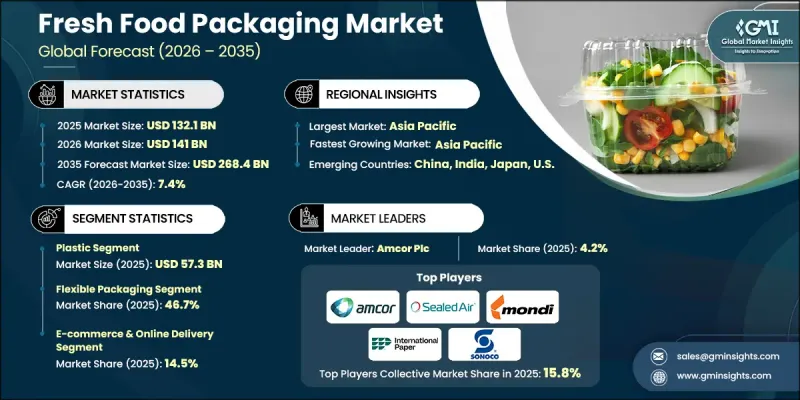
Market growth is strongly influenced by shifting consumer lifestyles, particularly in urban regions where time efficiency and convenience have become key priorities. This shift is driving higher demand for ready-to-eat and easy-to-carry fresh food products that fit into fast-paced daily routines involving work, travel, and social activities. As a result, packaging is no longer limited to product protection but is increasingly playing a crucial role in enhancing convenience, portability, and usability. Food manufacturers are adapting by adopting advanced packaging solutions that support longer shelf life, easier handling, and improved product presentation. Continuous innovation in packaging design is further reshaping industry standards, with companies focusing on functional and sustainable formats. At the same time, rising consumer awareness around freshness, hygiene, and food safety is accelerating the adoption of advanced packaging technologies. Increasing investments in sustainable materials and efficient supply chain systems are also supporting market expansion across global regions.
| Market Scope | |
|---|---|
| Start Year | 2025 |
| Forecast Year | 2026-2035 |
| Start Value | $132.1 Billion |
| Forecast Value | $268.4 Billion |
| CAGR | 7.4% |
The flexible packaging segment accounted for 46.7% share in 2025. This segment continues to lead due to its lightweight structure, cost efficiency, and reduced material usage in packaging applications. Flexible formats are widely used for fresh and prepared food products as they offer strong protection, extended shelf life, and lower transportation costs. Growing emphasis on sustainability is further encouraging the adoption of recyclable mono-material structures and advanced laminates, which are strengthening the role of flexible packaging across the food supply chain.
The e-commerce and online delivery segment held a 14.5% share in 2025. The rapid expansion of digital grocery shopping and food delivery services is significantly influencing packaging requirements. Increasing demand for protective, durable, and moisture-resistant packaging solutions is being driven by the need to maintain product integrity across extended and complex distribution channels. As online food retail continues to expand, packaging solutions that ensure freshness, safety, and convenience during transit are becoming increasingly important.
North America Fresh Food Packaging Market accounted for 31.1% share in 2025. The region is characterized by strong innovation capabilities, advanced supply chain systems, and a well-developed cold chain infrastructure. High consumption of fresh produce, meat products, and ready-to-eat meals is supporting steady demand for advanced packaging solutions. Increasing consumer preference for fresh and minimally processed foods is also encouraging the use of packaging systems that extend shelf life while maintaining quality and safety standards. Continuous technological advancements and sustainability initiatives are further strengthening market growth in the region.
Key companies operating in the Global Fresh Food Packaging Market include Amcor Plc, Anchor Packaging Inc., Coveris Holdings S.A., Crown Holdings Inc., DS Smith Plc, Flair Flexible Packaging Corporation, Genpak, LLC, Graphic Packaging International (Holding Co.), Huhtamaki Oyj, International Paper Company, Mondi PLC, PPC Flexible Packaging LLC, ProAmpac LLC, Reynolds Group Holdings Ltd., Sealed Air Corporation, Sonoco Products Company, Tetra Pak International, WestRock Company, and Winpak Ltd. Companies in the Fresh Food Packaging Market are strengthening their market position through innovation in sustainable materials, product design advancements, and expansion of production capabilities. They are increasingly focusing on developing eco-friendly and recyclable packaging solutions to meet regulatory requirements and rising environmental concerns. Investments in smart packaging technologies that enhance shelf life monitoring and product traceability are also gaining traction. Many players are expanding partnerships with food manufacturers and retailers to develop customized packaging formats tailored to specific product needs. Optimization of supply chains and adoption of lightweight, cost-efficient materials are further supporting operational efficiency.
Table of Contents
Chapter 1 Methodology and Scope
- 1.1 Market scope and definition
- 1.2 Research design
- 1.2.1 Research approach
- 1.2.2 Data collection methods
- 1.3 Data mining sources
- 1.3.1 Global
- 1.3.2 Regional/Country
- 1.4 Base estimates and calculations
- 1.4.1 Base year calculation
- 1.4.2 Key trends for market estimation
- 1.5 Primary research and validation
- 1.5.1 Primary sources
- 1.6 Forecast model
- 1.7 Research assumptions and limitations
Chapter 2 Executive Summary
- 2.1 Industry 360° synopsis, 2022 - 2035
- 2.2 Key market trends
- 2.2.1 Material type trends
- 2.2.2 Packaging format trends
- 2.2.3 Application trends
- 2.2.4 End-user trends
- 2.2.5 Regional trends
- 2.3 TAM Analysis, 2026-2035
- 2.4 CXO perspectives: Strategic imperatives
Chapter 3 Industry Insights
- 3.1 Industry ecosystem analysis
- 3.1.1 Supplier Landscape
- 3.1.2 Profit Margin
- 3.1.3 Cost structure
- 3.1.4 Value addition at each stage
- 3.1.5 Factor affecting the value chain
- 3.1.6 Disruptions
- 3.2 Industry impact forces
- 3.2.1 Growth drivers
- 3.2.1.1 Rising consumer demand for food safety and quality
- 3.2.1.2 Stringent regulatory standards
- 3.2.1.3 Rising consumer preference for convenience and on-the-go consumption
- 3.2.1.4 Innovations in eco-friendly packaging solutions
- 3.2.1.5 Emphasis on efficient supply chain management
- 3.2.2 Industry pitfalls and challenges
- 3.2.2.1 Challenges in scaling sustainable packaging solutions
- 3.2.2.2 Cost implications of implementing new packaging technologies
- 3.2.3 Market opportunities
- 3.2.3.1 Growth of smart and intelligent packaging technologies
- 3.2.3.2 Increasing adoption of plant-based and alternative materials
- 3.2.1 Growth drivers
- 3.3 Growth potential analysis
- 3.4 Regulatory landscape
- 3.4.1 North America
- 3.4.2 Europe
- 3.4.3 Asia Pacific
- 3.4.4 Latin America
- 3.4.5 Middle East & Africa
- 3.5 Porter's analysis
- 3.6 PESTEL analysis
- 3.7 Technology and Innovation landscape
- 3.7.1 Current technological trends
- 3.7.2 Emerging technologies
- 3.8 Price trends
- 3.8.1 By region
- 3.8.2 By product
- 3.9 Pricing Strategies
- 3.10 Emerging Business Models
- 3.11 Compliance Requirements
Chapter 4 Competitive Landscape, 2025
- 4.1 Introduction
- 4.2 Company market share analysis
- 4.2.1 By region
- 4.2.1.1 North America
- 4.2.1.2 Europe
- 4.2.1.3 Asia Pacific
- 4.2.1.4 Latin America
- 4.2.1.5 Middle East & Africa
- 4.2.2 Market concentration analysis
- 4.2.1 By region
- 4.3 Competitive benchmarking of key players
- 4.3.1 Financial performance comparison
- 4.3.1.1 Revenue
- 4.3.1.2 Profit margin
- 4.3.1.3 R&D
- 4.3.2 Product portfolio comparison
- 4.3.2.1 Product range breadth
- 4.3.2.2 Technology
- 4.3.2.3 Innovation
- 4.3.3 Geographic presence comparison
- 4.3.3.1 Global footprint analysis
- 4.3.3.2 Service network coverage
- 4.3.3.3 Market penetration by region
- 4.3.4 Competitive positioning matrix
- 4.3.4.1 Leaders
- 4.3.4.2 Challengers
- 4.3.4.3 Followers
- 4.3.4.4 Niche players
- 4.3.1 Financial performance comparison
- 4.4 Key developments
- 4.4.1 Mergers and acquisitions
- 4.4.2 Partnerships and collaborations
- 4.4.3 Technological advancements
- 4.4.4 Expansion and investment strategies
- 4.4.5 Digital transformation initiatives
- 4.5 Emerging/ startup competitors landscape
Chapter 5 Market Estimates and Forecast, By Material Type, 2022 - 2035 (USD Million)
- 5.1 Key trends
- 5.2 Plastic
- 5.2.1 Polyethylene (PE)
- 5.2.2 Polypropylene (PP)
- 5.2.3 Polyethylene terephthalate (PET)
- 5.2.4 Polystyrene (PS)
- 5.2.5 Polyvinyl chloride (PVC)
- 5.2.6 Others
- 5.3 Paper & paperboard
- 5.3.1 Corrugated board
- 5.3.2 Folding carton
- 5.3.3 Paper bags
- 5.3.4 Others
- 5.4 Metal
- 5.4.1 Aluminum
- 5.4.2 Steel cans
- 5.4.3 Others
- 5.5 Others
Chapter 6 Market Estimates and Forecast, By Packaging Format, 2022 - 2035 (USD Million)
- 6.1 Key trends
- 6.2 Rigid packaging
- 6.2.1 Trays & plates
- 6.2.2 Clamshells & containers
- 6.2.3 Boxes & cartons
- 6.2.4 Bottles & jars
- 6.2.5 Cans
- 6.2.6 Others
- 6.3 Flexible packaging
- 6.3.1 Films & wraps
- 6.3.2 Bags & pouches
- 6.3.3 Sleeves
- 6.3.4 Others
Chapter 7 Market Estimates and Forecast, By Application, 2022 - 2035 (USD Million)
- 7.1 Key trends
- 7.2 Fruits & vegetables
- 7.3 Meat & poultry
- 7.3.1 Fresh red meat
- 7.3.2 Fresh poultry
- 7.3.3 Processed meat
- 7.3.4 Others
- 7.4 Seafood
- 7.5 Dairy products
- 7.5.1 Fluid milk & cream
- 7.5.2 Yogurt & fermented milk
- 7.5.3 Cheese
- 7.5.4 Others
- 7.6 Bakery & confectionery
- 7.6.1 Breads & rolls
- 7.6.2 Cakes & pastries
- 7.6.3 Fresh cookies/chocolates
- 7.6.4 Others
- 7.7 Ready-to-eat (RTE) foods
- 7.7.1 Salads & fruit bowls
- 7.7.2 Sandwiches & wraps
- 7.7.3 Fresh meal kits/ready meals
- 7.7.4 Others
Chapter 8 Market Estimates and Forecast, By End-User, 2022 - 2035 (USD Million)
- 8.1 Key trends
- 8.2 Retail
- 8.2.1 Supermarkets & hypermarkets
- 8.2.2 Convenience stores
- 8.2.3 Specialty food stores
- 8.3 Food service
- 8.3.1 Full-service restaurants
- 8.3.2 Quick service restaurants (QSR)
- 8.3.3 Others
- 8.4 E-commerce & online delivery
- 8.5 Institutional
- 8.5.1 Hospitals & healthcare
- 8.5.2 Schools & universities
- 8.5.3 Military
- 8.5.4 Others
Chapter 9 Market Estimates and Forecast, By Region, 2022 - 2035 (USD Million)
- 9.1 Key trends
- 9.2 North America
- 9.2.1 U.S.
- 9.2.2 Canada
- 9.3 Europe
- 9.3.1 Germany
- 9.3.2 UK
- 9.3.3 France
- 9.3.4 Spain
- 9.3.5 Italy
- 9.3.6 Netherlands
- 9.3.7 Rest of Europe
- 9.4 Asia Pacific
- 9.4.1 China
- 9.4.2 India
- 9.4.3 Japan
- 9.4.4 Australia
- 9.4.5 South Korea
- 9.4.6 Rest of Asia Pacific
- 9.5 Latin America
- 9.5.1 Brazil
- 9.5.2 Mexico
- 9.5.3 Argentina
- 9.5.4 Rest of Latin America
- 9.6 Middle East and Africa
- 9.6.1 South Africa
- 9.6.2 Saudi Arabia
- 9.6.3 UAE
- 9.6.4 Rest of MEA
Chapter 10 Company Profiles
- 10.1 Global Key Players
- 10.1.1 Amcor Plc
- 10.1.2 Crown Holdings Inc.
- 10.1.3 DS Smith Plc
- 10.1.4 Huhtamaki Oyj
- 10.1.5 International Paper Company
- 10.1.6 Mondi PLC
- 10.1.7 Sealed Air Corporation
- 10.1.8 Sonoco Products Company
- 10.1.9 Tetra Pak International
- 10.1.10 WestRock Company
- 10.2 Regional key players
- 10.2.1 Anchor Packaging Inc.
- 10.2.2 Coveris Holdings S.A.
- 10.2.3 Flair Flexible Packaging Corporation
- 10.2.4 Genpak, LLC
- 10.2.5 Graphic Packaging International (Holding Co.)
- 10.3 Niche Players/Disruptors
- 10.3.1 PPC Flexible Packaging LLC
- 10.3.2 ProAmpac LLC
- 10.3.3 Reynolds Group Holdings Ltd.
- 10.3.4 Winpak Ltd.

