PUBLISHER: Global Market Insights Inc. | PRODUCT CODE: 2027567

PUBLISHER: Global Market Insights Inc. | PRODUCT CODE: 2027567
Vacuum Grease Market Opportunity, Growth Drivers, Industry Trend Analysis, and Forecast 2026 - 2035
The Global Vacuum Grease Market was valued at USD 160.2 million in 2025 and is estimated to grow at a CAGR of 6.3% to reach USD 294.6 million by 2035.
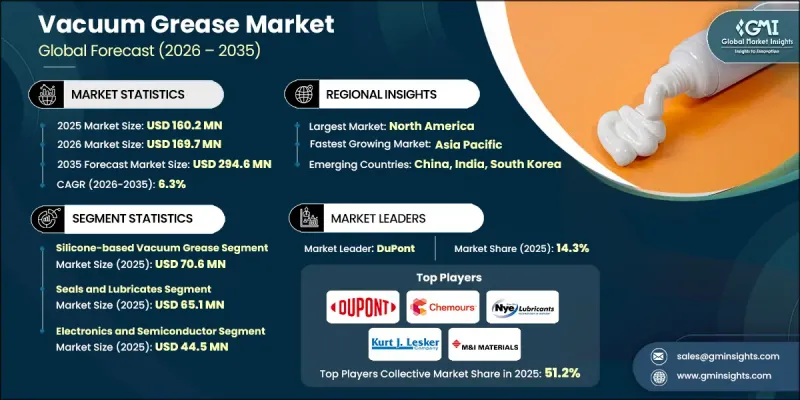
The global vacuum grease industry is witnessing steady expansion as demand increases for high-performance lubricants designed for critical and controlled environments. Vacuum grease is formulated using highly refined base oils combined with specialized thickening agents to ensure superior purity and performance. Its low vapor pressure and chemical stability make it highly effective for sealing and lubrication in systems where maintaining controlled conditions is essential. Industries that rely on precision operations continue to adopt vacuum grease due to its ability to withstand extreme temperatures, resist oxidation, and maintain structural integrity over time. The material's non-reactive properties make it suitable for sensitive processes where contamination must be avoided. Continuous advancements in formulation technologies and manufacturing processes are further enhancing product performance, enabling broader adoption across industrial and technical applications. As industries evolve toward higher precision and efficiency standards, vacuum grease remains a critical component in supporting reliable system performance.
| Market Scope | |
|---|---|
| Start Year | 2025 |
| Forecast Year | 2026-2035 |
| Start Value | $160.2 Million |
| Forecast Value | $294.6 Million |
| CAGR | 6.3% |
The silicone-based vacuum grease segment accounted for USD 70.6 million in 2025, owing to its excellent thermal stability and low volatility characteristics. This segment continues to gain traction as it meets the requirements of applications that demand consistent performance across wide temperature ranges. Ongoing advancements in formulation techniques are improving chemical inertness and enabling its use in highly controlled environments. In comparison, hydrocarbon-based vacuum grease is recognized for its cost efficiency and suitability for standard applications requiring reliable sealing and lubrication performance.
The seals and lubricants segment generated USD 65.1 million in 2025, driven by the need for reliable sealing performance and friction reduction in precision systems. Vacuum grease plays a crucial role in maintaining airtight conditions and enhancing operational efficiency in vacuum and pressure-based systems. Increasing demand for durable sealing solutions continues to support segment growth. Additionally, lubrication applications requiring long-term stability and resistance to harsh conditions are contributing to the rising use of specialized grease formulations.
North America Vacuum Grease Market is projected to grow from USD 49.9 million in 2025 to USD 86.5 million by 2035, driven by increasing demand for high-purity materials and the adoption of advanced manufacturing technologies. The presence of strong industrial and research infrastructure is supporting innovation and product development. Rising demand for specialized lubricants is further contributing to market expansion as industries continue to prioritize efficiency and precision in operations.
Key companies operating in the Global Vacuum Grease Market include DuPont, Chemours, Merck, Nye Lubricants, Santolubes LLC, Kurt J Lesker, Inland Vacuum, CDH, Eastern Petroleum, M&I Materials, and Mosil Lubricant. Companies in the Vacuum Grease Market are focusing on strategic initiatives to strengthen their competitive position and expand market presence. Investment in research and development remains a primary strategy, enabling the creation of advanced formulations with improved thermal stability and chemical resistance. Organizations are also enhancing manufacturing processes to ensure consistent product quality and efficiency. Strategic collaborations and partnerships are being pursued to expand technological expertise and market reach. Companies are increasing their production capacities to meet growing demand across industries. In addition, expanding distribution networks and strengthening customer support services are helping improve accessibility and brand loyalty. Mergers and acquisitions are further supporting growth by allowing companies to access new markets, technologies, and customer segments.
Table of Contents
Chapter 1 Methodology & Scope
- 1.1 Market scope and definition
- 1.2 Research design
- 1.2.1 Research approach
- 1.2.2 Data collection methods
- 1.3 Data mining sources
- 1.3.1 Global
- 1.3.2 Regional/Country
- 1.4 Base estimates and calculations
- 1.4.1 Base year calculation
- 1.4.2 Key trends for market estimation
- 1.5 Primary research and validation
- 1.5.1 Primary sources
- 1.6 Forecast model
- 1.7 Research assumptions and limitations
Chapter 2 Executive Summary
- 2.1 Industry 360° synopsis
- 2.2 Key market trends
- 2.2.1 Product
- 2.2.2 Application
- 2.2.3 End use industry
- 2.2.4 Regional
- 2.3 TAM Analysis, 2026-2035
- 2.4 CXO perspectives: Strategic imperatives
Chapter 3 Industry Insights
- 3.1 Industry ecosystem analysis
- 3.1.1 Supplier landscape
- 3.1.2 Profit margin
- 3.1.3 Value addition at each stage
- 3.1.4 Factor affecting the value chain
- 3.1.5 Disruptions
- 3.2 Industry impact forces
- 3.2.1 Growth drivers
- 3.2.2 Industry pitfalls and challenges
- 3.2.3 Market opportunities
- 3.3 Growth potential analysis
- 3.4 Regulatory landscape
- 3.4.1 North America
- 3.4.2 Europe
- 3.4.3 Asia Pacific
- 3.4.4 Latin America
- 3.4.5 Middle East & Africa
- 3.5 Porter's analysis
- 3.6 PESTEL analysis
- 3.7 Price trends
- 3.7.1 By region
- 3.7.2 By type
- 3.8 Future market trends
- 3.9 Technology and Innovation landscape
- 3.9.1 Current technological trends
- 3.9.2 Emerging technologies
- 3.10 Patent Landscape
- 3.11 Trade statistics (HS code)
- 3.11.1 Major importing countries
- 3.11.2 Major exporting countries
- 3.12 Sustainability and environmental aspects
- 3.12.1 Sustainable practices
- 3.12.2 Waste reduction strategies
- 3.12.3 Energy efficiency in production
- 3.12.4 Eco-friendly initiatives
- 3.13 Carbon footprint consideration
Chapter 4 Competitive Landscape, 2025
- 4.1 Introduction
- 4.2 Company market share analysis
- 4.2.1 By region
- 4.2.1.1 North America
- 4.2.1.2 Europe
- 4.2.1.3 Asia Pacific
- 4.2.1.4 LATAM
- 4.2.1.5 MEA
- 4.2.1 By region
- 4.3 Competitive analysis of major market players
- 4.4 Competitive positioning matrix
- 4.5 Key developments
- 4.5.1 Mergers & acquisitions
- 4.5.2 Partnerships & collaborations
- 4.5.3 New Product Launches
- 4.5.4 Expansion Plans
Chapter 5 Market Estimates and Forecast, By Product, 2022-2035 (USD Billion) (Kilo Tons)
- 5.1 Key trends
- 5.2 Silicone-based vacuum grease
- 5.3 Hydrocarbon-based vacuum grease
- 5.4 Fluorinated-based vacuum grease
Chapter 6 Market Estimates and Forecast, By Application, 2022-2035 (USD Billion) (Kilo Tons)
- 6.1 Key trends
- 6.2 Seals and lubricates
- 6.3 Sealing vacuum and pressure systems
- 6.4 Lubricating plug valves
- 6.5 Others (fire extinguisher valves, ceramic plug cocks, etc.)
Chapter 7 Market Estimates and Forecast, By End Use Industry, 2022-2035 (USD Billion) (Kilo Tons)
- 7.1 Key trends
- 7.2 Electronics and Semiconductor
- 7.3 Automotive
- 7.4 Pharmaceutical
- 7.5 Aerospace
- 7.6 Others
Chapter 8 Market Estimates and Forecast, By Region, 2022-2035 (USD Billion) (Kilo Tons)
- 8.1 Key trends
- 8.2 North America
- 8.2.1 U.S.
- 8.2.2 Canada
- 8.3 Europe
- 8.3.1 Germany
- 8.3.2 UK
- 8.3.3 France
- 8.3.4 Spain
- 8.3.5 Italy
- 8.3.6 Rest of Europe
- 8.4 Asia Pacific
- 8.4.1 China
- 8.4.2 India
- 8.4.3 Japan
- 8.4.4 Australia
- 8.4.5 South Korea
- 8.4.6 Rest of Asia Pacific
- 8.5 Latin America
- 8.5.1 Brazil
- 8.5.2 Mexico
- 8.5.3 Argentina
- 8.5.4 Rest of Latin America
- 8.6 Middle East and Africa
- 8.6.1 Saudi Arabia
- 8.6.2 South Africa
- 8.6.3 UAE
- 8.6.4 Rest of Middle East and Africa
Chapter 9 Company Profiles
- 9.1 CDH
- 9.2 Chemours
- 9.3 DuPont
- 9.4 Eastern Petroleum
- 9.5 Inland Vacuum
- 9.6 Kurt J Lesker
- 9.7 M&I Materials
- 9.8 Merck
- 9.9 Mosil Lubricant
- 9.10 Nye Lubricants
- 9.11 Santolubes LLC

