PUBLISHER: Global Market Insights Inc. | PRODUCT CODE: 2027568

PUBLISHER: Global Market Insights Inc. | PRODUCT CODE: 2027568
Smartwatch Market Opportunity, Growth Drivers, Industry Trend Analysis, and Forecast 2026 - 2035
The Global Smartwatch Market was valued at USD 48.4 billion in 2025 and is estimated to grow at a CAGR of 7% to reach USD 95.2 billion by 2035.
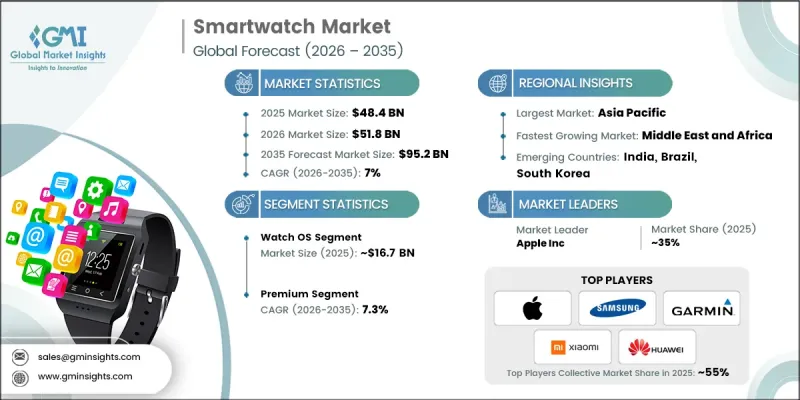
The market expansion is fueled by the seamless integration of smartwatches with smartphones, allowing users to receive notifications for health metrics, sleep patterns, and other critical updates directly on their wrists. This convenience enhances productivity and supports hands-free communication, particularly during workouts or outdoor activities where smartphone usage is impractical. Smartwatches connect primarily through Bluetooth or cellular networks, with Wi-Fi-enabled models providing additional internet access. The rising consumer focus on health and wellness drives adoption, as modern smartwatches feature heart rate monitoring, sleep tracking, step counting, and workout management. Advanced sensors, including accelerometers and photoplethysmography (PPG), capture accurate health and activity data. These insights are processed either on the device or via paired smartphones, empowering users with real-time health feedback and promoting proactive lifestyle management.
| Market Scope | |
|---|---|
| Start Year | 2025 |
| Forecast Year | 2026-2035 |
| Start Value | $48.4 Billion |
| Forecast Value | $95.2 Billion |
| CAGR | 7% |
The watch OS segment accounted for USD 16.7 billion in 2025 and is forecasted to grow at a CAGR of 6.2% from 2026 to 2035. The platform benefits from seamless integration within Apple's ecosystem, supporting continuity, handoff, iCloud, and universal clipboard features. Its success is further strengthened by FDA-cleared health monitoring functionalities, including ECG, irregular rhythm detection, and blood oxygen measurement. Integration with the Health app allows users to analyze, track, and share health data with healthcare providers. Fitness tracking is enhanced by multiple workout modes and the Fitness+ service, making Watch OS a comprehensive wellness and fitness solution.
The premium segment held 45.6% share in 2025 and is expected to grow at a CAGR of 7.3% through 2035. Premium smartwatches integrate cutting-edge technologies, including advanced health sensors, high-resolution displays, powerful processors, expanded storage, and exclusive features. These devices emphasize manufacturers' technological expertise and brand identity. Health monitoring capabilities in this segment include blood pressure measurement, advanced ECG analysis, body composition tracking, and skin temperature detection. Sophisticated algorithms transform sensor data into actionable insights, offering holistic health management. While these capabilities currently differentiate premium offerings, similar features are expected to filter into mid-range devices over time.
U.S. Smartwatch Market captured USD 10.9 billion in 2025. Consumer adoption is driven by marketing campaigns, technology-focused media, and peer influence. Replacement demand and feature-driven upgrades support market growth. Rising interest in preventive care, fitness, and health tracking encourages smartwatch usage, supplemented by integration into health insurance programs, corporate wellness schemes, and medical monitoring initiatives. FDA approval of health-focused features enhances credibility and A
Major players in the Global Smartwatch Market include Huawei, Garmin, Samsung, Xiaomi, Amazfit, Realme, Polar, Fire-Boltt, Apple Inc., ASUS, Honor Device Co Ltd, OnePlus, Noise, Google, and Coros. Companies in the Smartwatch Market strengthen their foothold by investing heavily in research and development to introduce innovative health and fitness features, ensuring competitive differentiation. Strategic partnerships with smartphone manufacturers, healthcare providers, and fitness platforms enhance ecosystem integration and user experience. Marketing campaigns target both lifestyle and health-conscious consumers, emphasizing durability, design, and technological sophistication. Firms expand distribution channels globally, including online and retail platforms, while offering software updates and customer support services to maintain brand loyalty. Additionally, companies optimize manufacturing efficiency to reduce production costs and introduce multiple product tiers, addressing diverse consumer segments and boosting overall market penetration.
Table of Contents
Chapter 1 Methodology & Scope
- 1.1 Market scope and definition
- 1.2 Research design
- 1.2.1 Research approach
- 1.2.2 Data collection methods
- 1.3 Data mining sources
- 1.3.1 Global
- 1.3.2 Regional/Country
- 1.4 Base estimates and calculations
- 1.4.1 Base year calculation
- 1.4.2 Key trends for market estimation
- 1.5 Primary research and validation
- 1.5.1 Primary sources
- 1.6 Forecast model
- 1.7 Research assumptions and limitations
Chapter 2 Executive Summary
- 2.1 Industry 360° synopsis
- 2.2 Key market trends
- 2.2.1 Regional
- 2.2.2 Type
- 2.2.3 Operating system
- 2.2.4 Display type
- 2.2.5 Price range
- 2.2.6 Application
- 2.2.7 Distribution channel
Chapter 3 Industry Insights
- 3.1 Industry ecosystem analysis
- 3.1.1 Supplier landscape
- 3.1.2 Profit margin
- 3.1.3 Value addition at each stage
- 3.1.4 Factor affecting the value chain
- 3.2 Industry impact forces
- 3.2.1 Growth drivers
- 3.2.1.1 Rising health consciousness & preventive healthcare adoption
- 3.2.1.2 Technological advancements in sensor miniaturization and processing power
- 3.2.1.3 Expansion of 5G and LTE-enabled standalone functionality
- 3.2.2 Industry pitfalls & challenges
- 3.2.2.1 Limited battery life & frequent charging requirements
- 3.2.2.2 High price points and value perception barriers
- 3.2.1 Growth drivers
- 3.3 Growth potential analysis
- 3.4 Future market trends
- 3.5 Technology and innovation landscape
- 3.5.1 Current technological trends
- 3.5.2 Emerging technologies
- 3.6 Price trends
- 3.6.1 By region
- 3.6.2 By type
- 3.7 Regulatory landscape
- 3.7.1 Standards and compliance requirements
- 3.7.2 Regional regulatory frameworks
- 3.7.3 Certification standards
- 3.8 Porter’s analysis
- 3.9 PESTEL analysis
- 3.10 Consumer behavior analysis
- 3.10.1 Purchasing patterns
- 3.10.2 Preference analysis
- 3.10.3 Regional variations in consumer behavior
Chapter 4 Competitive Landscape, 2025
- 4.1 Introduction
- 4.2 Company market share analysis
- 4.2.1 By Region
- 4.2.1.1 North America
- 4.2.1.2 Europe
- 4.2.1.3 Asia Pacific
- 4.2.1.4 Latin America
- 4.2.1.5 Middle East & Africa
- 4.2.1 By Region
- 4.3 Company matrix analysis
- 4.4 Competitive analysis of major market players
- 4.5 Competitive positioning matrix
- 4.6 Key developments
- 4.6.1 Mergers & acquisitions
- 4.6.2 Partnerships & collaborations
- 4.6.3 New product launches
- 4.6.4 Expansion plans
Chapter 5 Market Estimates & Forecast, By Type, 2022 - 2035, (USD Billion) (Units)
- 5.1 Key trends
- 5.2 Standalone
- 5.3 Extension
Chapter 6 Market Estimates & Forecast, By Operating System, 2022 - 2035, (USD Billion) (Units)
- 6.1 Key trends
- 6.2 Wear OS
- 6.3 Watch OS
- 6.4 HarmonyOS
- 6.5 Others
Chapter 7 Market Estimates & Forecast, By Display Type, 2022 - 2035, (USD Billion) (Units)
- 7.1 Key trends
- 7.2 OLED
- 7.3 LCD
Chapter 8 Market Estimates & Forecast, By Price Range, 2022 - 2035, (USD Billion) (Units)
- 8.1 Key trends
- 8.2 Budget
- 8.3 Mid-range
- 8.4 Premium
Chapter 9 Market Estimates & Forecast, By Application, 2022 - 2035, (USD Billion) (Units)
- 9.1 Key trends
- 9.2 Sports & Fitness
- 9.3 Healthcare
- 9.4 Communication
- 9.5 Media & Entertainment
- 9.6 Others
Chapter 10 Market Estimates & Forecast, By Distribution Channel, 2022 - 2035, (USD Billion) (Units)
- 10.1 Key trends
- 10.2 Online
- 10.2.1 E-commerce websites
- 10.2.2 Company websites
- 10.3 Offline
- 10.3.1 Hypermarket/Supermarket
- 10.3.2 Specialty stores
- 10.3.3 Others
Chapter 11 Market Estimates & Forecast, By Region, 2022 - 2035, (USD Billion) (Units)
- 11.1 Key trends
- 11.2 North America
- 11.2.1 U.S.
- 11.2.2 Canada
- 11.3 Europe
- 11.3.1 Germany
- 11.3.2 UK
- 11.3.3 France
- 11.3.4 Italy
- 11.3.5 Spain
- 11.4 Asia Pacific
- 11.4.1 China
- 11.4.2 India
- 11.4.3 Japan
- 11.4.4 South Korea
- 11.4.5 Australia
- 11.5 Latin America
- 11.5.1 Brazil
- 11.5.2 Mexico
- 11.5.3 Argentina
- 11.6 MEA
- 11.6.1 Saudi Arabia
- 11.6.2 UAE
- 11.6.3 South Africa
Chapter 12 Company Profiles
- 12.1 Amazfit
- 12.2 Apple Inc
- 12.3 ASUS
- 12.4 Coros
- 12.5 Fire-Boltt
- 12.6 Garmin
- 12.7 Google
- 12.8 Honor Device Co Ltd
- 12.9 Huawei
- 12.10 Noise
- 12.11 OnePlus
- 12.12 Polar
- 12.13 Realme
- 12.14 Samsung
- 12.15 Xiaomi

