PUBLISHER: Global Market Insights Inc. | PRODUCT CODE: 2027573

PUBLISHER: Global Market Insights Inc. | PRODUCT CODE: 2027573
Animal Feed Trace Mineral Market Opportunity, Growth Drivers, Industry Trend Analysis, and Forecast 2025 - 2035
The Global Animal Feed Trace Mineral Market was valued at USD 641.5 million in 2025 and is estimated to grow at a CAGR of 6.4% to reach USD 1.2 billion by 2035.
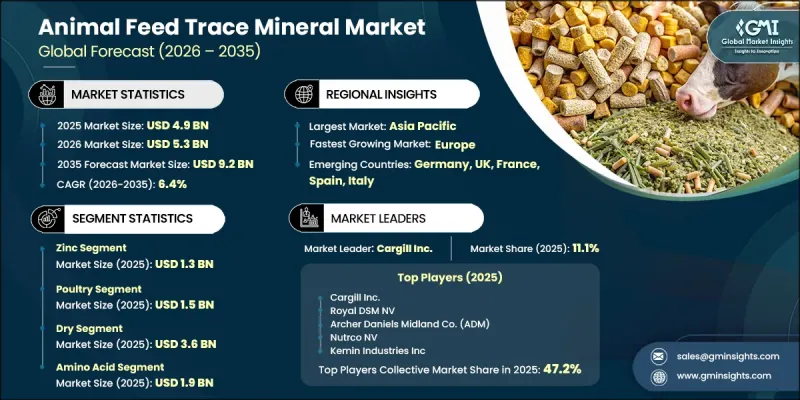
The market is steadily advancing as livestock producers increasingly recognize the importance of micronutrient supplementation in animal health and productivity. Trace minerals such as zinc, copper, iron, manganese, selenium, and iodine play a vital role in supporting metabolic functions, immune response, reproductive performance, and overall growth in livestock. These nutrients are required in very small quantities, yet they significantly influence feed efficiency and animal well-being. Feed manufacturers incorporate trace minerals to compensate for nutrient gaps in conventional feed sources and to ensure balanced nutrition across different stages of animal development. Growing adoption of precision nutrition practices is improving how minerals are formulated and delivered, leading to better absorption and utilization in animals. Technological advancements in mineral chelation and organic mineral forms are further enhancing bioavailability and performance outcomes. As livestock production systems become more intensive and performance-driven, demand for optimized mineral supplementation continues to rise, supporting consistent productivity and improved herd health across global agricultural operations.
The zinc segment reached USD 170 million in 2025 owing to its widespread use in supporting immune health, gut function, and skin integrity in livestock. Demand for iron is closely linked to its role in oxygen transport and early-stage animal development, while copper usage continues to expand as producers focus on controlled supplementation strategies that support growth efficiency and environmental compliance.
The poultry segment captured USD 198.9 million in 2025. This dominance is driven by the sector's intensive production systems, rapid growth cycles, and higher sensitivity to mineral deficiencies. Feed formulations for poultry are increasingly optimized to improve immunity, bone strength, egg production, and feed conversion efficiency, particularly as production systems move toward reduced antibiotic usage and more balanced nutritional approaches.
North America Animal Feed Trace Mineral Market is projected to grow from USD 208.5 million in 2025 to USD 394.2 million in 2035. Growth in the region is supported by widespread adoption of intensive livestock farming practices and increasing emphasis on precision nutrition and sustainable production systems. Rising demand for organic and chelated mineral formulations is reshaping feed strategies across poultry, swine, dairy, and beef production. Regulatory pressures, including stricter environmental standards and reduced antibiotic use in livestock, are further encouraging the use of advanced mineral solutions. Technological innovation in feed formulation is also supporting improved efficiency and productivity in the region.
Major companies operating in the Global Animal Feed Trace Mineral Market include Cargill Inc., Archer Daniels Midland Co., DSM Firmenich, Novus International Inc., Kemin Industries Inc., Zinpro Corp., Biochem, Tanke International Group, Mercer Milling Co. Inc., Nutreco NV, and Pancosma SA. Companies operating in the Animal Feed Trace Mineral Market are focusing on expanding their product portfolios with advanced organic and chelated mineral solutions that improve bioavailability and animal performance. Strategic investments in research and development are supporting the creation of precision nutrition products tailored to specific livestock needs. Many players are strengthening their global distribution networks through partnerships with feed manufacturers and agricultural suppliers. Capacity expansion initiatives are being implemented to meet rising demand from intensive livestock production systems. Companies are also prioritizing sustainability-driven innovation to align with stricter environmental regulations and evolving industry standards.
Table of Contents
Chapter 1 Methodology & Scope
- 1.1 Market scope and definition
- 1.2 Research design
- 1.2.1 Research approach
- 1.2.2 Data collection methods
- 1.3 Data mining sources
- 1.3.1 Global
- 1.3.2 Regional/Country
- 1.4 Base estimates and calculations
- 1.4.1 Base year calculation
- 1.4.2 Key trends for market estimation
- 1.5 Primary research and validation
- 1.5.1 Primary sources
- 1.6 Forecast model
- 1.7 Research assumptions and limitations
Chapter 2 Executive Summary
- 2.1 Industry 360° synopsis
- 2.2 Key market trends
- 2.2.1 Type
- 2.2.2 Livestock
- 2.2.3 Form
- 2.2.4 Chelate Type
- 2.2.5 Regional
- 2.3 TAM Analysis, 2026-2035
- 2.4 CXO perspectives: Strategic imperatives
- 2.5 Future outlook and strategic recommendations
Chapter 3 Industry Insights
- 3.1 Industry ecosystem analysis
- 3.1.1 Supplier landscape
- 3.1.2 Profit margin
- 3.1.3 Value addition at each stage
- 3.1.4 Factor affecting the value chain
- 3.1.5 Disruptions
- 3.2 Industry impact forces
- 3.2.1 Growth drivers
- 3.2.1.1 Rising global demand for animal protein and efficiency
- 3.2.1.2 Shift toward organic and bioavailable trace minerals
- 3.2.1.3 Expansion of intensive livestock and aquaculture production
- 3.2.2 Pitfalls/challenge
- 3.2.2.1 Volatile raw material prices impacting production costs
- 3.2.2.2 Stringent regulatory limits on mineral inclusion levels
- 3.2.3 Opportunities
- 3.2.3.1 Growing adoption of precision and digital nutrition systems
- 3.2.3.2 Rising demand for sustainable and residue-free animal products
- 3.2.1 Growth drivers
- 3.3 Growth potential analysis
- 3.4 Regulatory landscape
- 3.4.1 North America
- 3.4.2 Europe
- 3.4.3 Asia Pacific
- 3.4.4 Latin America
- 3.4.5 Middle East & Africa
- 3.5 Porter’s analysis
- 3.6 PESTEL analysis
- 3.7 Technology and innovation landscape
- 3.7.1 Current technological trends
- 3.7.2 Emerging technologies
- 3.8 Price trends
- 3.8.1 By region
- 3.8.2 By type
- 3.9 Future market trends
- 3.10 Technology and innovation landscape
- 3.10.1 Current technological trends
- 3.10.2 Emerging technologies
- 3.11 Patent landscape
- 3.12 Trade statistics (HS code)
- 3.12.1 Major importing countries
- 3.12.2 Major exporting countries
- 3.13 Sustainability and environmental aspects
- 3.13.1 Sustainable practices
- 3.13.2 Waste reduction strategies
- 3.13.3 Energy efficiency in production
- 3.13.4 Eco-friendly initiatives
- 3.14 Carbon footprint consideration
Chapter 4 Competitive Landscape, 2025
- 4.1 Introduction
- 4.2 Company market share analysis
- 4.2.1 By region
- 4.2.1.1 North America
- 4.2.1.2 Europe
- 4.2.1.3 Asia Pacific
- 4.2.1.4 LATAM
- 4.2.1.5 MEA
- 4.2.1 By region
- 4.3 Company matrix analysis
- 4.4 Competitive analysis of major market players
- 4.5 Competitive positioning matrix
- 4.6 Key developments
- 4.6.1 Mergers & acquisitions
- 4.6.2 Partnerships & collaborations
- 4.6.3 New product launches
- 4.6.4 Expansion plans
Chapter 5 Market Estimates and Forecast, By Type, 2022-2035 (USD Million) (Kilo Tons)
- 5.1 Key trends
- 5.2 Zinc
- 5.3 Iron
- 5.4 Copper
- 5.5 Selenium
- 5.6 Cobalt
- 5.7 Chromium
- 5.8 Others (manganese, iodine, etc.)
Chapter 6 Market Estimates and Forecast, By Livestock, 2022-2035 (USD Million) (Kilo Tons)
- 6.1 Key trends
- 6.2 Poultry
- 6.3 Swine
- 6.4 Ruminants
- 6.5 Aquaculture
- 6.6 Equine
- 6.7 Others (pets, small animals)
Chapter 7 Market Estimates and Forecast, By Form, 2022-2035 (USD Million) (Kilo Tons)
- 7.1 Key trends
- 7.2 Dry
- 7.3 Liquid
Chapter 8 Market Estimates and Forecast, By Chelate Type, 2022-2035 (USD Million) (Kilo Tons)
- 8.1 Key trends
- 8.2 Amino acids
- 8.3 Proteinates
- 8.4 Polysaccharides
- 8.5 Others
Chapter 9 Market Estimates and Forecast, By Region, 2022-2035 (USD Million) (Kilo Tons)
- 9.1 Key trends
- 9.2 North America
- 9.2.1 U.S.
- 9.2.2 Canada
- 9.3 Europe
- 9.3.1 Germany
- 9.3.2 UK
- 9.3.3 France
- 9.3.4 Spain
- 9.3.5 Italy
- 9.3.6 Rest of Europe
- 9.4 Asia Pacific
- 9.4.1 China
- 9.4.2 India
- 9.4.3 Japan
- 9.4.4 Australia
- 9.4.5 South Korea
- 9.4.6 Rest of Asia Pacific
- 9.5 Latin America
- 9.5.1 Brazil
- 9.5.2 Mexico
- 9.5.3 Argentina
- 9.5.4 Rest of Latin America
- 9.6 Middle East and Africa
- 9.6.1 Saudi Arabia
- 9.6.2 South Africa
- 9.6.3 UAE
- 9.6.4 Rest of Middle East and Africa
Chapter 10 Company Profiles
- 10.1 Archer Daniels Midland Co.
- 10.2 Biochem
- 10.3 Tanke International Group
- 10.4 Cargill Inc.
- 10.5 Kemin Industries Inc.
- 10.6 Mercer Milling Co. Inc.
- 10.7 Novus International Inc.
- 10.8 Nutrco NV
- 10.9 Pancosma SA
- 10.10 DSM-Firmenich
- 10.11 Zinpro Corp.

