PUBLISHER: Global Market Insights Inc. | PRODUCT CODE: 2027577

PUBLISHER: Global Market Insights Inc. | PRODUCT CODE: 2027577
Endometriosis Treatment Market Opportunity, Growth Drivers, Industry Trend Analysis, and Forecast 2026 - 2035
The Global Endometriosis Treatment Market was valued at USD 1.9 billion in 2025 and is estimated to grow at a CAGR of 13.4% to reach USD 6.5 billion by 2035.
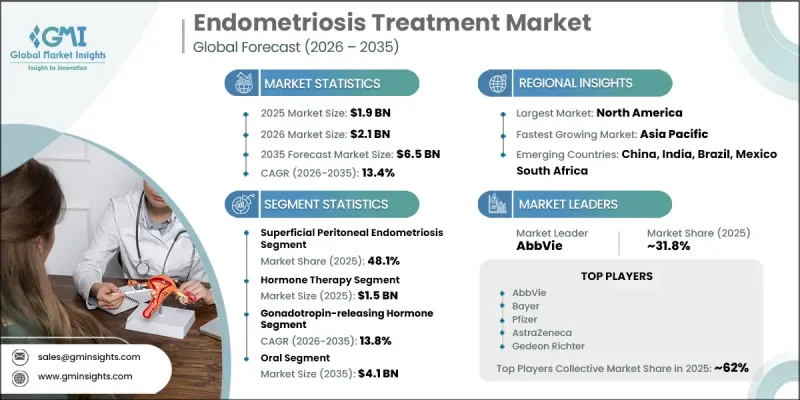
The market is expanding as the need for effective management of endometriosis continues to rise across healthcare systems worldwide. Endometriosis treatment focuses on reducing pain, controlling abnormal tissue growth, and supporting fertility outcomes through a combination of medical and supportive care approaches. Therapeutic strategies primarily involve pharmacological interventions designed to regulate hormonal activity and minimize inflammation. The condition, characterized by the presence of tissue similar to the uterine lining outside the uterus, leads to persistent discomfort and reproductive complications, increasing demand for timely and effective care. Market growth is being supported by rising disease prevalence and improved awareness driven by healthcare initiatives. Additionally, there is a growing preference for less invasive and more patient-focused treatment options that prioritize convenience and long-term symptom control. Advancements in therapeutic development and increasing emphasis on improving the quality of life are further shaping the evolution of the global endometriosis treatment market.
| Market Scope | |
|---|---|
| Start Year | 2025 |
| Forecast Year | 2026-2035 |
| Start Value | $1.9 Billion |
| Forecast Value | $6.5 Billion |
| CAGR | 13.4% |
The superficial peritoneal endometriosis segment accounted for 48.1% share in 2025. This form of the condition is more frequently identified due to its occurrence on accessible anatomical surfaces, allowing earlier detection and intervention. The availability of multiple treatment pathways, including pharmacological management and hormone-based therapies, supports wider adoption and contributes to segment dominance.
The gonadotropin-releasing hormone segment is anticipated to grow at a CAGR of 13.8% throughout 2035. This segment maintains a strong position due to its effectiveness in regulating hormonal activity and reducing symptom severity. Treatments within this category are widely utilized across different patient groups and continue to benefit from ongoing advancements that enhance efficacy while improving tolerability.
North America Endometriosis Treatment Market held a share of 42.8% in 2025, supported by advanced healthcare infrastructure, strong diagnostic capabilities, and increasing use of fertility-preserving treatment approaches. The region continues to lead due to a well-established clinical research environment and active involvement of pharmaceutical companies in developing improved therapeutic solutions, which further strengthens market growth.
Key companies operating in the Global Endometriosis Treatment Market include Pfizer, AbbVie, Bayer, AstraZeneca, Sanofi, Teva Pharmaceutical, Gedeon Richter, Kissei Pharmaceutical, Debiopharm, and Zydus. Companies in the Endometriosis Treatment Market are focusing on strengthening their competitive position through innovation and strategic expansion. Significant investments are being directed toward research and development to introduce advanced therapies with improved efficacy and reduced side effects. Strategic collaborations and partnerships are helping organizations expand their product pipelines and accelerate clinical development. Companies are also working on enhancing patient access through improved distribution networks and targeted awareness initiatives. Portfolio diversification and the development of personalized treatment approaches are becoming key priorities. Additionally, firms are aligning with regulatory advancements and leveraging digital health tools to improve diagnosis, monitoring, and patient engagement, thereby reinforcing their market presence and long-term growth potential.
Table of Contents
Chapter 1 Methodology and Scope
- 1.1 Market scope and definition
- 1.2 Research approach
- 1.3 Quality commitments
- 1.3.1 GMI AI policy and data integrity commitment
- 1.3.1.1 Source consistency protocol
- 1.3.1 GMI AI policy and data integrity commitment
- 1.4 Research trail and confidence scoring
- 1.4.1 Research trail components
- 1.4.2 Scoring components
- 1.5 Data collection
- 1.5.1 Partial list of primary sources
- 1.6 Data mining sources
- 1.6.1 Paid sources
- 1.6.1.1 Sources, by region
- 1.6.1 Paid sources
- 1.7 Base estimates and calculations
- 1.7.1 Revenue share analysis
- 1.7.2 Base year calculation
- 1.8 Forecast model
- 1.9 Research transparency addendum
- 1.9.1 Source attribution framework
- 1.9.2 Quality assurance metrics
- 1.9.3 Our commitment to trust
Chapter 2 Executive Summary
- 2.1 Industry 360° synopsis
- 2.1.1 Key market trends
- 2.1.2 Regional trends
- 2.1.3 Disease type trends
- 2.1.4 Treatment type trends
- 2.1.5 Drug class trends
- 2.1.6 Route of administration trends
- 2.1.7 Distribution channel trends
- 2.2 CXO perspectives: Strategic imperatives
Chapter 3 Industry Insights
- 3.1 Industry ecosystem analysis
- 3.2 Industry impact forces
- 3.2.1 Growth drivers
- 3.2.1.1 Rising prevalence and awareness of endometriosis
- 3.2.1.2 Advancements in diagnostic techniques
- 3.2.1.3 Increased government funding and initiatives
- 3.2.2 Industry pitfalls and challenges
- 3.2.2.1 High cost of advanced treatments
- 3.2.3 Market opportunities
- 3.2.3.1 Development of non-hormonal therapies
- 3.2.3.2 Expansion in emerging markets
- 3.2.1 Growth drivers
- 3.3 Growth potential analysis
- 3.4 Regulatory landscape (Driven by Primary Research)
- 3.4.1 North America
- 3.4.1.1 U.S.
- 3.4.1.2 Canada
- 3.4.2 Europe
- 3.4.3 Asia Pacific
- 3.4.1 North America
- 3.5 Technological advancements (Driven by Primary Research)
- 3.5.1 Current technological trends
- 3.5.2 Emerging technologies
- 3.6 Future market trends
- 3.7 Pipeline analysis (Driven by Primary Research)
- 3.8 Pricing analysis (Driven by Primary Research)
- 3.9 Impact of AI and Gen AI on the market (Driven by Primary Research)
- 3.10 Porter's analysis
- 3.11 PESTEL analysis
Chapter 4 Competitive Landscape, 2025
- 4.1 Introduction
- 4.2 Company market share analysis
- 4.3 Company matrix analysis
- 4.4 Competitive analysis of major market players
- 4.5 Competitive positioning matrix
- 4.6 Key developments
- 4.6.1 Mergers & acquisitions
- 4.6.2 Partnerships & collaborations
- 4.6.3 New product launches
- 4.6.4 Expansion plans
Chapter 5 Market Estimates and Forecast, By Disease Type, 2022 - 2035 ($ Mn)
- 5.1 Key trends
- 5.2 Superficial peritoneal endometriosis
- 5.3 Ovarian endometriomas
- 5.4 Deep infiltrating endometriosis
- 5.5 Other disease types
Chapter 6 Market Estimates and Forecast, By Treatment Type, 2022 - 2035 ($ Mn)
- 6.1 Key trends
- 6.2 Hormone therapy
- 6.3 Pain medication
Chapter 7 Market Estimates and Forecast, By Drug Class, 2022 - 2035 ($ Mn)
- 7.1 Key trends
- 7.2 Gonadotropin-releasing hormone
- 7.3 NSAIDs
- 7.4 Oral contraceptive
- 7.5 Other drug classes
Chapter 8 Market Estimates and Forecast, By Route of Administration, 2022 - 2035 ($ Mn)
- 8.1 Key trends
- 8.2 Oral
- 8.3 Injectable
- 8.4 Other routes of administration
Chapter 9 Market Estimates and Forecast, By Distribution Channel, 2022 - 2035 ($ Mn)
- 9.1 Key trends
- 9.2 Hospital pharmacies
- 9.3 Retail pharmacies
- 9.4 Online pharmacies
Chapter 10 Market Estimates and Forecast, By Region, 2022 - 2035 ($ Mn)
- 10.1 Key trends
- 10.2 North America
- 10.2.1 U.S.
- 10.2.2 Canada
- 10.3 Europe
- 10.3.1 Germany
- 10.3.2 UK
- 10.3.3 France
- 10.3.4 Spain
- 10.3.5 Italy
- 10.3.6 Netherlands
- 10.4 Asia Pacific
- 10.4.1 Japan
- 10.4.2 China
- 10.4.3 India
- 10.4.4 Australia
- 10.4.5 South Korea
- 10.5 Latin America
- 10.5.1 Brazil
- 10.5.2 Mexico
- 10.5.3 Argentina
- 10.6 Middle East and Africa
- 10.6.1 South Africa
- 10.6.2 Saudi Arabia
- 10.6.3 UAE
Chapter 11 Company Profiles
- 11.1 AbbVie
- 11.2 AstraZeneca
- 11.3 Bayer
- 11.4 Debiopharm
- 11.5 Gedeon Richter
- 11.6 Kissei Pharmaceutical
- 11.7 Pfizer
- 11.8 Sanofi
- 11.9 Teva Pharmaceutical
- 11.10 Zydus

