PUBLISHER: Global Market Insights Inc. | PRODUCT CODE: 2027591

PUBLISHER: Global Market Insights Inc. | PRODUCT CODE: 2027591
Swine Feed Market Opportunity, Growth Drivers, Industry Trend Analysis, and Forecast 2026 - 2035
The Global Swine Feed Market was valued at USD 112.9 billion in 2025 and is estimated to grow at a CAGR of 4.5% to reach USD 175.7 billion by 2035.
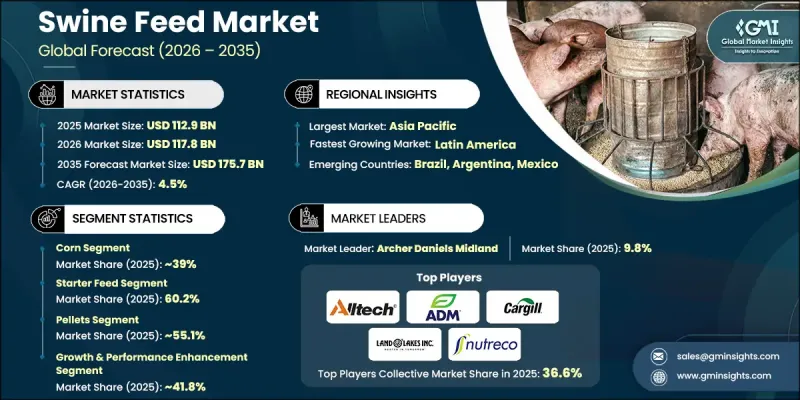
The global swine feed industry is experiencing steady expansion driven by rising pork consumption worldwide and continuous improvements in livestock nutrition science. Demand for scientifically balanced feed formulations is increasing as producers focus on improving animal growth performance, feed efficiency, and overall herd health outcomes. Modern feed solutions are increasingly designed with functional ingredients that support digestion, immunity, and nutrient absorption while also optimizing production costs. Additives such as enzymes, amino acids, and probiotics are becoming integral to advanced feed formulations, helping enhance metabolic efficiency and disease resistance in swine populations. Sustainability considerations are also shaping the market, with growing emphasis on environmentally responsible sourcing and reduced ecological impact in livestock production systems. Precision feeding technologies and digital monitoring tools are further transforming farm operations by enabling more accurate nutrient management across different growth stages. These advancements are improving productivity and profitability for farmers while ensuring consistent meat quality. As a result, the market is evolving toward highly customized and performance-oriented feed solutions that support both economic and environmental objectives across global pork production systems.
| Market Scope | |
|---|---|
| Start Year | 2025 |
| Forecast Year | 2026-2035 |
| Start Value | $112.9 Billion |
| Forecast Value | $175.7 Billion |
| CAGR | 4.5% |
The corn segment accounted for 39% share in 2025 and is expected to grow at a CAGR of 4.3% through 2035. It remains the most widely used raw material in swine feed production due to its high energy density and cost efficiency, making it a foundational ingredient in global livestock nutrition strategies. Its broad availability and nutritional profile continue to support its strong dominance across commercial feed formulations.
The starter feed segment held a 60.2% share in 2025 and is projected to grow at a CAGR of 4.7% from 2026 to 2035. This segment has gained strong traction as producers increasingly recognize the importance of early-stage nutrition in improving piglet survival rates and long-term growth performance. Starter formulations are specifically designed to support early development, enhancing digestive efficiency and strengthening immune response during critical growth phases.
North America Swine Feed Market accounted for 21.9% share in 2025. The region benefits from advanced farming technologies, high levels of mechanization, and strict regulatory oversight that ensures feed quality and safety standards. Established pork production systems support consistent demand for high-performance feed solutions. Increasing consumer preference for sustainably produced and premium pork products is also encouraging the use of specialized and natural feed ingredients. The integration of precision feeding systems and automation is further improving operational efficiency, while ongoing research and development efforts are driving innovation in functional feed products designed to enhance immunity, growth, and reproductive performance.
Key companies operating in the Swine Feed Market include Cargill Inc., Nutreco N.V., Archer Daniels Midland (ADM) Company, Alltech Inc., Charoen Pokphand Foods PCL (CPF), New Hope Group, De Heus Animal Nutrition, Guangdong Haid Group, Forfarmers N.V., Land O'Lakes Inc., Kent Nutrition Group, and Godrej Agrovet Limited. Companies in the Swine Feed Market are adopting a range of strategic initiatives to strengthen their competitive positioning and expand market reach. A primary focus is on research and development to create advanced feed formulations that improve growth efficiency, immunity, and feed conversion ratios. Manufacturers are increasingly integrating functional ingredients such as probiotics, enzymes, and amino acids to enhance nutritional value and animal performance. Strategic partnerships with raw material suppliers and livestock producers are being used to ensure supply chain stability and product consistency. Companies are also expanding production capacities and modernizing manufacturing facilities to meet rising global demand. Digital technologies and precision feeding systems are being adopted to optimize nutrient delivery and reduce feed wastage. In addition, businesses are investing in sustainability initiatives and natural ingredient sourcing to align with environmental expectations and evolving consumer preferences. Mergers and acquisitions are further helping companies expand geographic presence and strengthen their product portfolios.
Table of Contents
Chapter 1 Methodology & Scope
- 1.1 Market scope and definition
- 1.2 Research design
- 1.2.1 Research approach
- 1.2.2 Data collection methods
- 1.3 Data mining sources
- 1.3.1 Global
- 1.3.2 Regional/Country
- 1.4 Base estimates and calculations
- 1.4.1 Base year calculation
- 1.4.2 Key trends for market estimation
- 1.5 Primary research and validation
- 1.5.1 Primary sources
- 1.6 Forecast model
- 1.7 Research assumptions and limitations
Chapter 2 Executive Summary
- 2.1 Industry 360° synopsis
- 2.2 Key market trends
- 2.2.1 Regional
- 2.2.2 Ingredient
- 2.2.3 Type
- 2.2.4 Form
- 2.2.5 Function
- 2.3 TAM Analysis, 2026-2035
- 2.4 CXO perspectives: Strategic imperatives
- 2.4.1 Executive decision points
Chapter 3 Industry Insights
- 3.1 Industry ecosystem analysis
- 3.1.1 Supplier landscape
- 3.1.2 Profit margin
- 3.1.3 Value addition at each stage
- 3.1.4 Factor affecting the value chain
- 3.1.5 Disruptions
- 3.2 Industry impact forces
- 3.2.1 Growth drivers
- 3.2.2 Industry pitfalls and challenges
- 3.2.3 Market opportunities
- 3.3 Growth potential analysis
- 3.4 Regulatory landscape
- 3.4.1 North America
- 3.4.2 Europe
- 3.4.3 Asia Pacific
- 3.4.4 Latin America
- 3.4.5 Middle East & Africa
- 3.5 Porter’s analysis
- 3.6 PESTEL analysis
- 3.7 Price trends
- 3.7.1 By region
- 3.7.2 By type
- 3.8 Future market trends
- 3.9 Technology and Innovation landscape
- 3.9.1 Current technological trends
- 3.9.2 Emerging technologies
- 3.10 Patent Landscape
- 3.11 Trade statistics (HS code)
- 3.11.1 Major importing countries
- 3.11.2 Major exporting countries
- 3.12 Sustainability and environmental aspects
- 3.12.1 Sustainable practices
- 3.12.2 Waste reduction strategies
- 3.12.3 Energy efficiency in production
- 3.12.4 Eco-friendly initiatives
- 3.13 Carbon footprint consideration
Chapter 4 Competitive Landscape, 2025
- 4.1 Introduction
- 4.2 Company market share analysis
- 4.2.1 By region
- 4.2.1.1 North America
- 4.2.1.2 Europe
- 4.2.1.3 Asia Pacific
- 4.2.1.4 LATAM
- 4.2.1.5 MEA
- 4.2.1 By region
- 4.3 Company matrix analysis
- 4.4 Competitive analysis of major market players
- 4.5 Competitive positioning matrix
- 4.6 Key developments
- 4.6.1 Mergers & acquisitions
- 4.6.2 Partnerships & collaborations
- 4.6.3 New Product Launches
- 4.6.4 Expansion Plans
Chapter 5 Market Estimates and Forecast, By Ingredient, 2022-2035 (USD Billion) (Kilo Tons)
- 5.1 Key trends
- 5.2 Corn
- 5.3 Soyabean meal
- 5.4 Oats
- 5.5 Rice bran
- 5.6 Cassava
- 5.7 Vegetables
- 5.8 Sorghum
- 5.9 Wheat
- 5.10 Other
Chapter 6 Market Estimates and Forecast, By Type, 2022-2035 (USD Billion) (Kilo Tons)
- 6.1 Key trends
- 6.2 Starter feed
- 6.3 Grower feed
- 6.4 Finisher feed
- 6.5 Sow feed
Chapter 7 Market Estimates and Forecast, By Form, 2022-2035 (USD Billion) (Kilo Tons)
- 7.1 Key trends
- 7.2 Pellets
- 7.3 Mash
- 7.4 Crumbles
- 7.5 Others
Chapter 8 Market Estimates and Forecast, By Function, 2022-2035 (USD Billion) (Kilo Tons)
- 8.1 Key trends
- 8.2 Growth & performance enhancement
- 8.3 Immunity & disease prevention
- 8.4 Reproduction & breeding support
- 8.5 Lactation & milk production
- 8.6 Maintenance & general nutrition
Chapter 9 Market Estimates and Forecast, By Region, 2022-2035 (USD Billion) (Kilo Tons)
- 9.1 Key trends
- 9.2 North America
- 9.2.1 U.S.
- 9.2.2 Canada
- 9.3 Europe
- 9.3.1 Germany
- 9.3.2 UK
- 9.3.3 France
- 9.3.4 Spain
- 9.3.5 Italy
- 9.3.6 Rest of Europe
- 9.4 Asia Pacific
- 9.4.1 China
- 9.4.2 India
- 9.4.3 Japan
- 9.4.4 Australia
- 9.4.5 South Korea
- 9.4.6 Rest of Asia Pacific
- 9.5 Latin America
- 9.5.1 Brazil
- 9.5.2 Mexico
- 9.5.3 Argentina
- 9.5.4 Rest of Latin America
- 9.6 Middle East and Africa
- 9.6.1 Saudi Arabia
- 9.6.2 South Africa
- 9.6.3 UAE
- 9.6.4 Rest of Middle East and Africa
Chapter 10 Company Profiles
- 10.1 Alltech Inc.
- 10.2 Archer Daniels Midland (ADM) Company
- 10.3 Cargill Inc.
- 10.4 Charoen Pokphand Foods PCL (CPF)
- 10.5 De Heus Animal Nutrition
- 10.6 Forfarmers N.V.
- 10.7 Godrej Agrovet Limited
- 10.8 Guangdong Haid Group
- 10.9 Kent Nutrition Group
- 10.10 Land O'Lakes Inc.
- 10.11 New Hope Group
- 10.12 Nutreco N.V.

