
PUBLISHER: Global Market Insights Inc. | PRODUCT CODE: 2027597

PUBLISHER: Global Market Insights Inc. | PRODUCT CODE: 2027597
Green Fertilizer Market Opportunity, Growth Drivers, Industry Trend Analysis, and Forecast 2026 - 2035
The Global Green Fertilizer Market was valued at USD 2.7 billion in 2025 and is estimated to grow at a CAGR of 4.1% to reach USD 4 billion by 2035.
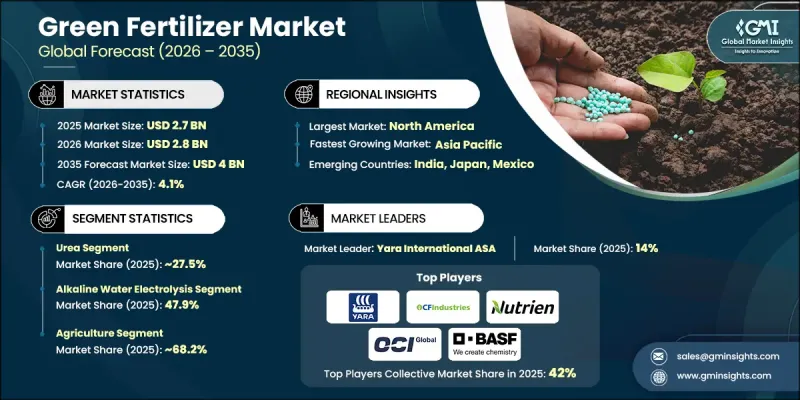
The market has evolved into a vital component of sustainable agriculture, promoting soil health, environmental protection, and long-term productivity. Green fertilizers are no longer just alternatives to conventional fertilizers; they have become core inputs for regenerative agriculture, helping farmers reduce chemical usage while meeting evolving environmental standards. The market is shaped by two main drivers: regulatory changes in food production and rising demand for sustainably grown crops. Innovations in biological, organic, and mineral-based fertilizers enhance nutrient delivery across diverse crop systems, ensuring better yields. Market dynamics differ regionally, with modernizing agricultural regions adopting nutrient-efficient solutions and mature regulatory areas emphasizing cleaner input development. In developing markets, green fertilizers boost soil resilience and sustain long-term land productivity.
| Market Scope | |
|---|---|
| Start Year | 2025 |
| Forecast Year | 2026-2035 |
| Start Value | $2.7 Billion |
| Forecast Value | $4 Billion |
| CAGR | 4.1% |
The urea segment accounted for 27.5% share in 2025 and is projected to grow at a CAGR of 6.8% by 2035. Renewable urea is gaining prominence as farmers increasingly prioritize formulations that reduce environmental impact while maintaining crop performance. Its versatility and nutrient efficiency make it a cornerstone of sustainable fertilizer strategies.
The agriculture segment held a 68.2% share in 2025 and is expected to grow at a CAGR of 3.9% through 2035. Green fertilizers improve soil fertility, enhance crop resilience, and support climate-aligned farming practices. They play a strategic role beyond nutrient supply, enabling farmers to adopt regenerative and eco-efficient techniques while meeting sustainability targets across the food value chain. Farmers increasingly rely on these fertilizers to maintain soil health and ensure productivity over extended periods.
North America Green Fertilizer Market held a 30.3% share in 2025. The region is a hub for innovation in sustainable fertilizers, driven by strong carbon-reduction policies, renewable energy infrastructure, and the development of clean-hydrogen capabilities. North America benefits from a supportive regulatory framework, advanced research facilities, and growing adoption of low-emission agricultural practices, creating a favorable environment for green fertilizer growth.
Key players in the Global Green Fertilizer Market include Nutrien Ltd., CF Industries Holdings, Inc., Yara International ASA, Tata Chemicals Ltd., BASF SE, Fertiberia S.A., Dyno Nobel, Haldor Topsoe A/S, OCI N.V., Siemens Energy AG, Nel Hydrogen, thyssenkrupp Uhde, and Profert. Companies in the Green Fertilizer Market strengthen their position by investing in advanced production technologies, such as renewable urea synthesis and bio-based nutrient solutions, to improve product efficiency and sustainability. Strategic collaborations with agricultural cooperatives, research institutes, and governmental organizations enable access to new markets and regulatory insights. Firms expand geographically to emerging agricultural regions while maintaining compliance with environmental standards. Innovation in product development, such as hybrid bio-mineral blends and eco-friendly formulations, helps differentiate brands. Companies also optimize supply chains, implement precision logistics, and promote farmer education programs to increase adoption, ensure consistent availability, and reinforce long-term market leadership.
Table of Contents
Chapter 1 Methodology & Scope
- 1.1 Market scope and definition
- 1.2 Research design
- 1.2.1 Research approach
- 1.2.2 Data collection methods
- 1.3 Data mining sources
- 1.3.1 Global
- 1.3.2 Regional/Country
- 1.4 Base estimates and calculations
- 1.4.1 Base year calculation
- 1.4.2 Key trends for market estimation
- 1.5 Primary research and validation
- 1.5.1 Primary sources
- 1.6 Forecast model
- 1.7 Research assumptions and limitations
Chapter 2 Executive Summary
- 2.1 Industry 360° synopsis
- 2.2 Key market trends
- 2.2.1 Regional
- 2.2.2 Fertilizer Type
- 2.2.3 Technology
- 2.2.4 Application
- 2.3 TAM Analysis, 2026-2035
- 2.4 CXO perspectives: Strategic imperatives
- 2.4.1 Executive decision points
- 2.4.2 Critical success factors
- 2.5 Future Outlook and Strategic Recommendations
Chapter 3 Industry Insights
- 3.1 Industry ecosystem analysis
- 3.1.1 Supplier landscape
- 3.1.2 Profit margin
- 3.1.3 Value addition at each stage
- 3.1.4 Factor affecting the value chain
- 3.1.5 Disruptions
- 3.2 Industry impact forces
- 3.2.1 Growth drivers
- 3.2.1.1 Green fertilizers offer a more sustainable alternative, promoting healthier soil and reducing environmental impact
- 3.2.1.2 Growing organic farming
- 3.2.1.3 Increasing concerns for soil health
- 3.2.2 Industry pitfalls and challenges
- 3.2.2.1 Limited availability
- 3.2.2.2 The upfront cost is higher compared to traditional synthetic fertilizers
- 3.2.3 Market opportunities
- 3.2.3.1 Emerging carbon credit & green certificate markets
- 3.2.3.2 Retrofitting existing ammonia production facilities
- 3.2.1 Growth drivers
- 3.3 Growth potential analysis
- 3.4 Regulatory landscape
- 3.4.1 North America
- 3.4.2 Europe
- 3.4.3 Asia Pacific
- 3.4.4 Latin America
- 3.4.5 Middle East & Africa
- 3.5 Porter's analysis
- 3.6 PESTEL analysis
- 3.7 Price trends
- 3.7.1 By region
- 3.7.2 By Fertilizer type
- 3.8 Future market trends
- 3.9 Technology and Innovation landscape
- 3.9.1 Current technological trends
- 3.9.2 Emerging technologies
- 3.10 Patent Landscape
- 3.11 Trade statistics (HS code)
- 3.11.1 Major importing countries
- 3.11.2 Major exporting countries
- 3.12 Sustainability and environmental aspects
- 3.12.1 Sustainable practices
- 3.12.2 Waste reduction strategies
- 3.12.3 Energy efficiency in production
- 3.12.4 Eco-friendly initiatives
- 3.13 Carbon footprint consideration
Chapter 4 Competitive Landscape, 2025
- 4.1 Introduction
- 4.2 Company market share analysis
- 4.2.1 By region
- 4.2.1.1 North America
- 4.2.1.2 Europe
- 4.2.1.3 Asia Pacific
- 4.2.1.4 LATAM
- 4.2.1.5 MEA
- 4.2.1 By region
- 4.3 Company matrix analysis
- 4.4 Competitive analysis of major market players
- 4.5 Competitive positioning matrix
- 4.6 Key developments
- 4.6.1 Mergers & acquisitions
- 4.6.2 Partnerships & collaborations
- 4.6.3 New Product Launches
- 4.6.4 Expansion Plans
Chapter 5 Market Estimates and Forecast, By Fertilizer, 2022-2035 (USD Million) (Kilo Tons)
- 5.1 Key trends
- 5.2 Green Ammonium Nitrate (AN)
- 5.3 Green Calcium Ammonium Nitrate (CAN)
- 5.4 Green Urea
- 5.4.1 Prilled Urea
- 5.4.2 Granular Urea
- 5.4.3 Coated/Slow Release Urea
- 5.5 Others
Chapter 6 Market Estimates and Forecast, By Technology, 2022-2035 (USD Million) (Kilo Tons)
- 6.1 Key trends
- 6.2 Alkaline Water Electrolysis
- 6.3 Proton Exchange Membrane (PEM)
- 6.4 Solid Oxide Electrolysis
Chapter 7 Market Estimates and Forecast, By Application, 2022-2035 (USD Million) (Kilo Tons)
- 7.1 Key trends
- 7.2 Agriculture
- 7.2.1 Cereals & Grains
- 7.2.2 Oilseeds & Pulses
- 7.2.3 Fruits & Vegetables
- 7.2.4 Specialty & Medicinal Crops
- 7.2.5 Others
- 7.3 Horticulture
- 7.3.1 Ornamental Plants
- 7.3.2 Greenhouse Applications
- 7.3.3 Nurseries
- 7.3.4 Other
- 7.4 Forestry
- 7.4.1 Plantation
- 7.4.2 Reforestation
- 7.4.3 Agroforestry
- 7.4.4 Other
Chapter 8 Market Estimates and Forecast, By Region, 2022-2035 (USD Million) (Kilo Tons)
- 8.1 Key trends
- 8.2 North America
- 8.2.1 U.S.
- 8.2.2 Canada
- 8.3 Europe
- 8.3.1 Germany
- 8.3.2 UK
- 8.3.3 France
- 8.3.4 Spain
- 8.3.5 Italy
- 8.3.6 Rest of Europe
- 8.4 Asia Pacific
- 8.4.1 China
- 8.4.2 India
- 8.4.3 Japan
- 8.4.4 Australia
- 8.4.5 South Korea
- 8.4.6 Rest of Asia Pacific
- 8.5 Latin America
- 8.5.1 Brazil
- 8.5.2 Mexico
- 8.5.3 Argentina
- 8.5.4 Rest of Latin America
- 8.6 Middle East and Africa
- 8.6.1 Saudi Arabia
- 8.6.2 South Africa
- 8.6.3 UAE
- 8.6.4 Rest of Middle East and Africa
Chapter 9 Company Profiles
- 9.1 Yara International ASA
- 9.2 CF Industries Holdings, Inc.
- 9.3 Nutrien Ltd.
- 9.4 OCI N.V.
- 9.5 BASF SE
- 9.6 Fertiberia S.A.
- 9.7 Tata Chemicals Ltd.
- 9.8 Siemens Energy AG
- 9.9 Nel Hydrogen
- 9.10 thyssenkrupp Uhde
- 9.11 Profert
- 9.12 HIF Global
- 9.13 Haldor Topsoe A/S
- 9.14 Dyno Nobel

