
PUBLISHER: Global Market Insights Inc. | PRODUCT CODE: 2027613

PUBLISHER: Global Market Insights Inc. | PRODUCT CODE: 2027613
Sunflower Seeds Market Opportunity, Growth Drivers, Industry Trend Analysis, and Forecast 2026 - 2035
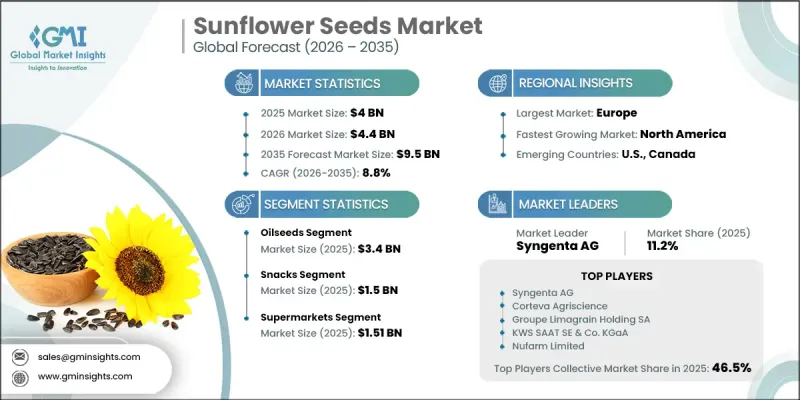
The Global Sunflower Seeds Market was valued at USD 4 billion in 2025 and is estimated to grow at a CAGR of 8.8% to reach USD 9.5 billion by 2035.
Sunflower seeds are edible kernels derived from sunflower plants and are widely recognized for their nutritional composition, including healthy fats, protein, and essential micronutrients. These seeds are enclosed within protective outer shells and are consumed in multiple forms depending on processing and consumer preference. Their versatility allows them to be used both as a direct food product and as a base ingredient in various processed applications. The market is witnessing strong momentum as consumers increasingly favor nutrient-rich, plant-based food options that support balanced diets. Additionally, evolving dietary habits and growing awareness regarding clean-label food products are influencing purchasing decisions. The product's adaptability across multiple consumption formats supports its consistent demand across diverse demographics. Improvements in processing technologies and supply chain efficiency are further enhancing product availability, quality consistency, and scalability, strengthening the overall market outlook.
| Market Scope | |
|---|---|
| Start Year | 2025 |
| Forecast Year | 2026-2035 |
| Start Value | $4 Billion |
| Forecast Value | $9.5 Billion |
| CAGR | 8.8% |
The oilseeds segment generated USD 3.4 billion in 2025, maintaining its dominant position due to ongoing advancements in processing efficiency and improved extraction techniques. Enhanced seed quality and agricultural practices contribute to consistent output levels, supporting widespread use in edible oil production. Increasing consumer inclination toward minimally refined cooking ingredients continues to reinforce the segment's significance across global markets.
The snacks segment accounted for USD 1.5 billion in 2025, supported by growing demand for natural ingredient-based food products. Sunflower seeds are increasingly incorporated into a wide range of food formats due to their ability to enhance texture and nutritional value. Their inclusion in various prepared food products reflects shifting consumer preferences toward wholesome and functional ingredients that align with modern dietary trends.
North America Sunflower Seeds Market is anticipated to grow from USD 1 billion in 2025 to USD 2.5 billion by 2035, reflecting strong regional demand. Consumption patterns are shaped by increased preference for convenient and nutritious food options, alongside sustained usage in home-based food preparation. Market expansion is further supported by stable supply chains and consistent consumer interest in seed-based food products across different consumption occasions.
Key companies operating in the Global Sunflower Seeds Market include Land O'Lakes, Syngenta AG (acquired by ChemChina), Corteva Agriscience, BASF SE, Advanta Seeds, Nufarm Limited, Limagrain, Sakata Seed America, Red River Commodities Fargo, and KWS SAAT SE & Co. KGaA. Companies in the Sunflower Seeds Market are strengthening their position by focusing on product innovation, improved seed genetics, and advanced processing technologies. They are investing in research to enhance yield quality, disease resistance, and nutritional value, ensuring consistent supply and product differentiation. Strategic collaborations with farmers and distributors help optimize supply chain efficiency and expand geographic reach. Firms are also emphasizing sustainable farming practices and environmentally responsible production methods to align with evolving regulatory standards and consumer expectations. Additionally, companies are diversifying their product portfolios by introducing value-added and ready-to-consume formats. Branding, packaging innovation, and expansion into emerging markets further support competitive positioning and long-term growth.
Table of Contents
Chapter 1 Methodology & Scope
- 1.1 Market scope and definition
- 1.2 Research design
- 1.2.1 Research approach
- 1.2.2 Data collection methods
- 1.3 Data mining sources
- 1.3.1 Global
- 1.3.2 Regional/Country
- 1.4 Base estimates and calculations
- 1.4.1 Base year calculation
- 1.4.2 Key trends for market estimation
- 1.5 Primary research and validation
- 1.5.1 Primary sources
- 1.6 Forecast model
- 1.7 Research assumptions and limitations
Chapter 2 Executive Summary
- 2.1 Industry 360° synopsis
- 2.2 Key market trends
- 2.2.1 Product Type
- 2.2.2 Application
- 2.2.3 Distribution Channel
- 2.2.4 Regional
- 2.3 TAM Analysis, 2026-2035
- 2.4 CXO perspectives: Strategic imperatives
- 2.5 Future outlook and strategic recommendations
Chapter 3 Industry Insights
- 3.1 Industry ecosystem analysis
- 3.1.1 Supplier landscape
- 3.1.2 Profit margin
- 3.1.3 Value addition at each stage
- 3.1.4 Factor affecting the value chain
- 3.1.5 Disruptions
- 3.2 Industry impact forces
- 3.2.1 Growth drivers
- 3.2.1.1 Rising preference for plant-based nutrition
- 3.2.1.2 Expanding use in everyday snacking
- 3.2.1.3 Broader applications in home cooking
- 3.2.2 Pitfalls/challenge
- 3.2.2.1 Vulnerability to climate-related crop issues
- 3.2.2.2 Fluctuating availability during seasonal shifts
- 3.2.3 Opportunities
- 3.2.3.1 Growing interest in nutrient-dense foods
- 3.2.3.2 Rising demand in bird and pet feed
- 3.2.1 Growth drivers
- 3.3 Growth potential analysis
- 3.4 Regulatory landscape
- 3.4.1 North America
- 3.4.2 Europe
- 3.4.3 Asia Pacific
- 3.4.4 Latin America
- 3.4.5 Middle East & Africa
- 3.5 Porter's analysis
- 3.6 PESTEL analysis
- 3.7 Technology and innovation landscape
- 3.7.1 Current technological trends
- 3.7.2 Emerging technologies
- 3.8 Price trends
- 3.8.1 By region
- 3.8.2 By product type
- 3.9 Future market trends
- 3.10 Technology and innovation landscape
- 3.10.1 Current technological trends
- 3.10.2 Emerging technologies
- 3.11 Patent landscape
- 3.12 Trade statistics (HS code)
- 3.12.1 Major importing countries
- 3.12.2 Major exporting countries
- 3.13 Sustainability and environmental aspects
- 3.13.1 Sustainable practices
- 3.13.2 Waste reduction strategies
- 3.13.3 Energy efficiency in production
- 3.13.4 Eco-friendly initiatives
- 3.14 Carbon footprint consideration
Chapter 4 Competitive Landscape, 2025
- 4.1 Introduction
- 4.2 Company market share analysis
- 4.2.1 By region
- 4.2.1.1 North America
- 4.2.1.2 Europe
- 4.2.1.3 Asia Pacific
- 4.2.1.4 LATAM
- 4.2.1.5 MEA
- 4.2.1 By region
- 4.3 Company matrix analysis
- 4.4 Competitive analysis of major market players
- 4.5 Competitive positioning matrix
- 4.6 Key developments
- 4.6.1 Mergers & acquisitions
- 4.6.2 Partnerships & collaborations
- 4.6.3 New product launches
- 4.6.4 Expansion plans
Chapter 5 Market Estimates and Forecast, By Product Type, 2022-2035 (USD Billion) (Kilo Tons)
- 5.1 Key trends
- 5.2 Oilseed
- 5.3 Non-oilseed
Chapter 6 Market Estimates and Forecast, By Application, 2022-2035 (USD Billion) (Kilo Tons)
- 6.1 Key trends
- 6.2 Snacks
- 6.3 Bakery products
- 6.4 Confectionery
- 6.5 Others
Chapter 7 Market Estimates and Forecast, By Distribution Channel, 2022-2035 (USD Billion) (Kilo Tons)
- 7.1 Key trends
- 7.2 Supermarkets
- 7.3 Retail shops
- 7.4 Online
- 7.5 Others
Chapter 8 Market Estimates and Forecast, By Region, 2022-2035 (USD Billion) (Kilo Tons)
- 8.1 Key trends
- 8.2 North America
- 8.2.1 U.S.
- 8.2.2 Canada
- 8.3 Europe
- 8.3.1 Germany
- 8.3.2 UK
- 8.3.3 France
- 8.3.4 Spain
- 8.3.5 Italy
- 8.3.6 Rest of Europe
- 8.4 Asia Pacific
- 8.4.1 China
- 8.4.2 India
- 8.4.3 Japan
- 8.4.4 Australia
- 8.4.5 South Korea
- 8.4.6 Rest of Asia Pacific
- 8.5 Latin America
- 8.5.1 Brazil
- 8.5.2 Mexico
- 8.5.3 Argentina
- 8.5.4 Rest of Latin America
- 8.6 Middle East and Africa
- 8.6.1 Saudi Arabia
- 8.6.2 South Africa
- 8.6.3 UAE
- 8.6.4 Rest of Middle East and Africa
Chapter 9 Company Profiles
- 9.1 Land O'Lakes
- 9.2 Syngenta AG (acquired by ChemChina)
- 9.3 Corteva Agriscience
- 9.4 BASF SE
- 9.5 Advanta Seeds
- 9.6 Nufarm Limited
- 9.7 Limagrain
- 9.8 Sakata Seed America.
- 9.9 Red River Commodities Fargo
- 9.10 KWS SAAT SE & Co. KGaA

