
PUBLISHER: Mordor Intelligence | PRODUCT CODE: 1940828

PUBLISHER: Mordor Intelligence | PRODUCT CODE: 1940828
Sunflower Seed (seed For Sowing) - Market Share Analysis, Industry Trends & Statistics, Growth Forecasts (2026 - 2031)
The sunflower seed (seed For Sowing) market was valued at USD 1.15 billion in 2025 and estimated to grow from USD 1.21 billion in 2026 to reach USD 1.59 billion by 2031, at a CAGR of 5.55% during the forecast period (2026-2031).
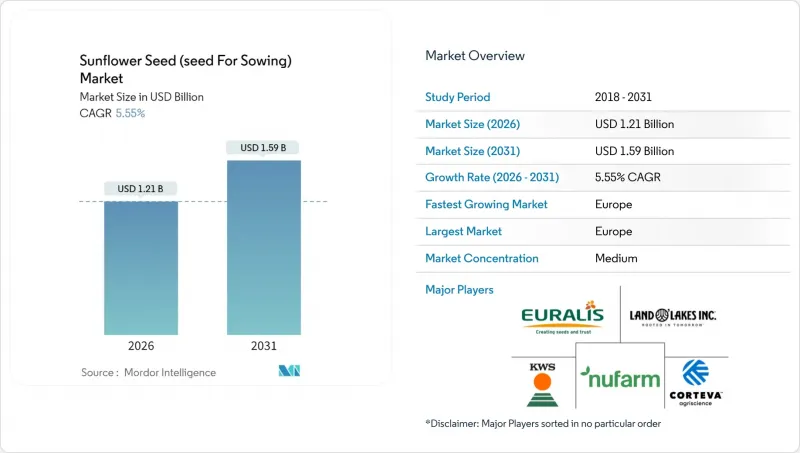
Robust demand for climate-resilient hybrids, supportive biofuel policies, and widening contract farming frameworks underpin this steady expansion. Hybrid seeds already dominate commercial planting decisions, and evergreen investments in genomic selection shorten breeding cycles, allowing companies to refresh portfolios more rapidly than ever. Simultaneously, European Union renewable energy mandates pull high-oleic varieties into biodiesel channels, while drought-prone regions across the Asia-Pacific and South America pivot acreage toward sunflowers to conserve water and diversify rotations. The convergence of these macro forces positions the sunflower seed market for resilient value creation even amid commodity price swings and phytosanitary complexities.
Global Sunflower Seed (seed For Sowing) Market Trends and Insights
Rising adoption of hybrid sunflower seed in high-yield commercial farming
Commercial farmers are increasingly shifting toward hybrid sunflower varieties due to yield advantages that can exceed 25% compared to open-pollinated alternatives, particularly under optimal growing conditions. This transition is most pronounced in large-scale operations where mechanization and precision agriculture techniques maximize hybrid performance potential. Advanced hybrid breeding programs now incorporate multi-location testing across 15-20 environments annually, enabling seed companies to develop varieties optimized for specific regional conditions and stress tolerance profiles. The economic rationale for hybrid adoption strengthens as farm consolidation increases average operation sizes, allowing fixed seed costs to be amortized across larger acreages. Regulatory influence from OECD (Organisation for Economic Co-operation and Development) seed certification schemes ensures hybrid seed quality standards, supporting farmer confidence in premium-priced varieties.
Expansion of acreage in drought-prone regions favoring sunflower over water-intensive crops
Sunflower cultivation is expanding rapidly in water-stressed agricultural zones where traditional crops face increasing production risks from climate variability. The crop's deep taproot system and efficient water use characteristics make it particularly suitable for semi-arid regions experiencing declining groundwater levels or erratic precipitation patterns. Recent agronomic research demonstrates sunflowers' water use efficiency of 15-20 kg grain per hectare-millimeter of water, significantly outperforming soybeans and corn in moisture-limited environments. This adaptation advantage is driving acreage expansion in Australia's wheat belt, Kazakhstan's steppe regions, and parts of the US Great Plains, where irrigation costs are becoming prohibitive. Government agricultural policies in drought-affected regions increasingly incentivize diversification into drought-tolerant oilseeds through subsidized seed programs and crop insurance adjustments.
Price volatility of competing oilseed crops reducing growers' seed budgets
Volatile commodity prices for competing oilseeds create uncertainty in farmer planting decisions, often leading to reduced seed budgets when crop price outlooks deteriorate. Palm oil price fluctuations, which declined 18% in early 2024 before recovering, directly impact sunflower oil demand and consequently affect farmers' willingness to invest in premium seed varieties. Soybean price cycles compound this challenge, as many farmers view soybeans and sunflowers as interchangeable rotation crops, switching based on relative price expectations. This volatility particularly affects emerging market farmers with limited financial buffers, who may defer hybrid seed purchases in favor of lower-cost alternatives during periods of price uncertainty.
Other drivers and restraints analyzed in the detailed report include:
- Government biofuel mandates increasing demand for high-oleic sunflower oil
- Growth of contract farming models with input financing for certified seed
- Complex and divergent phytosanitary rules on seed imports and field isolation
For complete list of drivers and restraints, kindly check the Table Of Contents.
Segment Analysis
Hybrid seeds commanded 90.55% of the sunflower seed (seed For Sowing) market share in 2025 and are projected to grow at a 5.62% CAGR, underscoring their entrenched lead. This share translates into the largest portion of the sunflower seed market size for any technology group. Hybrids routinely yield 20-30% more than open-pollinated varieties under mechanized management and respond better to precision nutrient placement. Companies deploy doubled haploid techniques to collapse development timelines, releasing climate-ready material ahead of shifting weather patterns.
Open-pollinated and hybrid-derivative lines find niches among smallholders who prioritize seed-saving traditions. Improved certification schemes boost their genetic purity, yet their gains seldom eclipse hybrid returns under input-intensive systems. The sunflower seed market retains space for these alternatives where affordability trumps outright yield.
The Sunflower Seed (seed for Sowing) Market Report is Segmented by Breeding Technology (Hybrids, and Open-Pollinated Varieties and Hybrid Derivatives), and Geography (Africa, Asia-Pacific, Europe, Middle East, North America, and More). The Market Forecasts are Provided in Terms of Value (USD) and Volume (Metric Tons).
Geography Analysis
Europe holds the largest slice of the sunflower seed (seed For Sowing) market, with a 47.95% share in 2025 and a 6.12% regional CAGR that surpasses the global average. Structured farm supports under the Common Agricultural Policy promote crop diversification, and renewable fuel directives guarantee pull for high-oleic varieties. Ukraine's infrastructure recovery and Romania's expansion solidify seed demand, while France, Spain, and Germany maintain near-universal hybrid adoption, banking on robust dealer networks.
Asia-Pacific emerges as the second-largest consumer with fast-rising demand. China's Inner Mongolia and Xinjiang provinces lift plantings to lessen reliance on imported palm oil. India accelerates hybrid penetration with subsidized seed kits and agronomy training. Australia's wheat belt swaps declining wheat margins for sunflower, favored by its water-efficient physiology and compatibility with mechanical harvesters.
North America, South America, Africa, and the Middle East round out the market. The United States and Canada focus on confectionery and high-oleic niches for food service. Argentina maintains processing competitiveness, exporting meal and oil with preferential tariffs, while Brazil integrates sunflowers into soybean-corn rotations for soil health. Egypt and South Africa widen sunflower portfolios to reinforce food security, although infrastructural gaps and limited certified seed access temper growth.
- Syngenta Group
- Corteva Agriscience
- Bayer AG
- Advanta Seeds (UPL Ltd.)
- KWS SAAT SE & Co. KGaA
- Groupe Limagrain
- BASF SE
- Euralis Semences
- Nufarm
- Land O' Lakes Inc.
- RAGT Group
- Longping Hi-Tech (Changsha Yuan Longping High-Tech Co.)
- DLF A/S
- Sakata Seed Corporation
- Bejo Zaden B.V.
Additional Benefits:
- The market estimate (ME) sheet in Excel format
- 3 months of analyst support
TABLE OF CONTENTS
1 INTRODUCTION
- 1.1 Study Assumptions and Market Definition
- 1.2 Scope of the Study
- 1.3 Research Methodology
2 REPORT OFFERS
3 EXECUTIVE SUMMARY AND KEY FINDINGS
4 KEY INDUSTRY TRENDS
- 4.1 Area Under Cultivation
- 4.2 Most Popular Traits
- 4.3 Breeding Techniques
- 4.4 Regulatory Framework
- 4.5 Value Chain and Distribution Channel Analysis
- 4.6 Market Drivers
- 4.6.1 Rising adoption of hybrid sunflower seed in high-yield commercial farming
- 4.6.2 Expansion of acreage in drought-prone regions favoring sunflower over water-intensive crops
- 4.6.3 Government biofuel mandates increasing demand for high-oleic sunflower oil
- 4.6.4 Growth of contract farming models with input financing for certified seed
- 4.6.5 Genomic-selection tools shortening breeding cycles for climate-resilient hybrids
- 4.6.6 Carbon-credit programs rewarding oilseed rotation with certified seed traceability
- 4.7 Market Restraints
- 4.7.1 Price volatility of competing oilseed crops reducing growers seed budgets
- 4.7.2 Complex and divergent phytosanitary rules on seed imports and field isolation
- 4.7.3 Rising incidence of broomrape races resistant to existing genetic sources
- 4.7.4 Farm-saved seed in smallholder systems limiting commercial seed penetration
5 MARKET SIZE AND GROWTH FORECASTS (VALUE AND VOLUME)
- 5.1 Breeding Technology
- 5.1.1 Hybrids
- 5.1.1.1 Non-Transgenic Hybrids
- 5.1.2 Open Pollinated Varieties and Hybrid Derivatives
- 5.1.1 Hybrids
- 5.2 Geography
- 5.2.1 Africa
- 5.2.1.1 By Breeding Technology
- 5.2.1.2 By Country
- 5.2.1.2.1 Egypt
- 5.2.1.2.2 Ethiopia
- 5.2.1.2.3 Ghana
- 5.2.1.2.4 Kenya
- 5.2.1.2.5 Nigeria
- 5.2.1.2.6 South Africa
- 5.2.1.2.7 Tanzania
- 5.2.1.2.8 Rest of Africa
- 5.2.2 Asia-Pacific
- 5.2.2.1 By Breeding Technology
- 5.2.2.2 By Country
- 5.2.2.2.1 Australia
- 5.2.2.2.2 Bangladesh
- 5.2.2.2.3 China
- 5.2.2.2.4 India
- 5.2.2.2.5 Indonesia
- 5.2.2.2.6 Myanmar
- 5.2.2.2.7 Pakistan
- 5.2.2.2.8 Thailand
- 5.2.2.2.9 Rest of Asia-Pacific
- 5.2.3 Europe
- 5.2.3.1 By Breeding Technology
- 5.2.3.2 By Country
- 5.2.3.2.1 France
- 5.2.3.2.2 Germany
- 5.2.3.2.3 Italy
- 5.2.3.2.4 Netherlands
- 5.2.3.2.5 Poland
- 5.2.3.2.6 Romania
- 5.2.3.2.7 Russia
- 5.2.3.2.8 Spain
- 5.2.3.2.9 Turkey
- 5.2.3.2.10 Ukraine
- 5.2.3.2.11 United Kingdom
- 5.2.3.2.12 Rest of Europe
- 5.2.4 Middle East
- 5.2.4.1 By Breeding Technology
- 5.2.4.2 By Country
- 5.2.4.2.1 Iran
- 5.2.4.2.2 Rest of Middle East
- 5.2.5 North America
- 5.2.5.1 By Breeding Technology
- 5.2.5.2 By Country
- 5.2.5.2.1 Canada
- 5.2.5.2.2 Mexico
- 5.2.5.2.3 United States
- 5.2.6 South America
- 5.2.6.1 By Breeding Technology
- 5.2.6.2 By Country
- 5.2.6.2.1 Argentina
- 5.2.6.2.2 Brazil
- 5.2.6.2.3 Rest of South America
- 5.2.1 Africa
6 COMPETITIVE LANDSCAPE
- 6.1 Key Strategic Moves
- 6.2 Market Share Analysis
- 6.3 Company Landscape
- 6.4 Company Profiles (Includes Global-Level Overview, Market-Level Overview, Core Segments, Financials as Available, Strategic Information, Market Rank/Share, Products and Services, and Recent Developments)
- 6.4.1 Syngenta Group
- 6.4.2 Corteva Agriscience
- 6.4.3 Bayer AG
- 6.4.4 Advanta Seeds (UPL Ltd.)
- 6.4.5 KWS SAAT SE & Co. KGaA
- 6.4.6 Groupe Limagrain
- 6.4.7 BASF SE
- 6.4.8 Euralis Semences
- 6.4.9 Nufarm
- 6.4.10 Land O' Lakes Inc.
- 6.4.11 RAGT Group
- 6.4.12 Longping Hi-Tech (Changsha Yuan Longping High-Tech Co.)
- 6.4.13 DLF A/S
- 6.4.14 Sakata Seed Corporation
- 6.4.15 Bejo Zaden B.V.
7 KEY STRATEGIC QUESTIONS FOR SEEDS CEOS

