PUBLISHER: Global Market Insights Inc. | PRODUCT CODE: 2027638

PUBLISHER: Global Market Insights Inc. | PRODUCT CODE: 2027638
Energy Harvesting Market Opportunity, Growth Drivers, Industry Trend Analysis, and Forecast 2026 - 2035
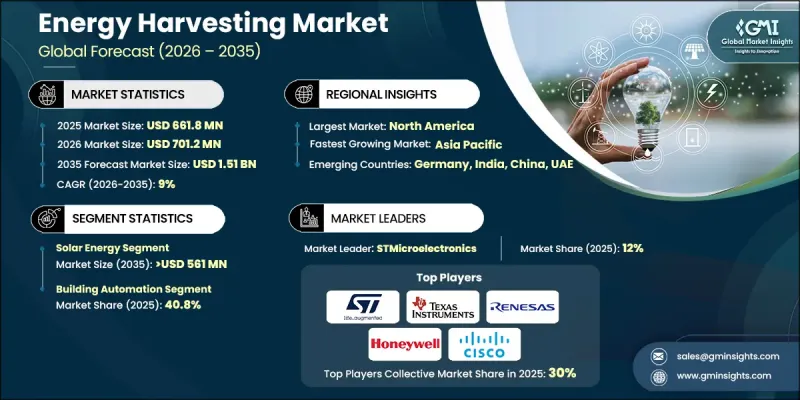
The Global Energy Harvesting Market was valued at USD 661.8 million in 2025 and is estimated to grow at a CAGR of 9% to reach USD 1.51 billion by 2035.
Market growth is driven by the rising need for sustainable and long-duration energy solutions across industrial, commercial, and consumer applications. Increasing deployment of low-power electronic devices such as remote monitoring units, IoT-based sensors, and wearable systems is further accelerating demand, as energy harvesting technologies provide efficient and cost-effective alternatives to conventional power sources. Continuous advancements in material science and conversion technologies, including thermoelectric, piezoelectric, electromagnetic, and photovoltaic systems, are improving energy conversion efficiency and expanding application scope. The growing adoption of wireless sensor networks and self-powered devices is further strengthening market penetration by enabling maintenance-free and long-lasting power generation solutions. Additionally, global regulatory emphasis on energy efficiency and sustainability is pushing industries to reduce reliance on batteries and transition toward ambient energy utilization. Rising investments in research and development are supporting the creation of compact, high-efficiency devices capable of capturing energy from environmental sources such as heat, vibration, light, and radiofrequency signals. These developments are unlocking new opportunities across automotive systems, healthcare devices, and intelligent building infrastructure, where a continuous, reliable power supply for micro-level components is increasingly essential.
| Market Scope | |
|---|---|
| Start Year | 2025 |
| Forecast Year | 2026-2035 |
| Start Value | $661.8 Million |
| Forecast Value | $1.51 Billion |
| CAGR | 9% |
The solar energy segment is expected to reach USD 561 million by 2035. Declining costs of solar panels and associated components are significantly reshaping the market landscape and driving broader technology adoption. The integration of energy storage systems is further enhancing efficiency by addressing intermittency challenges associated with solar power generation. These advancements are contributing to improved reliability and performance, supporting the wider adoption of solar-based energy harvesting solutions across diverse applications.
The building automation segment accounted for a 40.8% share in 2025 and is projected to grow at a CAGR of 9.3% through 2035. Increasing demand for energy-efficient and environmentally sustainable infrastructure is driving the integration of energy harvesting technologies into building automation systems. Advancements in harvesting technologies are positioning them as a core component of next-generation smart building ecosystems, supporting optimized energy management, reduced operational costs, and improved sustainability performance.
U.S. Energy Harvesting Market is projected to reach USD 358 million by 2035, supported by a strong national focus on sustainable construction practices and renewable energy adoption. Government-led initiatives, including incentives, tax benefits, rebates, and supportive regulatory frameworks at multiple administrative levels, are accelerating the deployment of energy harvesting technologies. Growing investments in renewable energy infrastructure are further strengthening market expansion. In addition, sustainability-driven construction activities, including both new developments and retrofitting projects, are increasingly incorporating energy harvesting systems such as solar and kinetic solutions to reduce overall energy consumption and lower carbon emissions across buildings and infrastructure networks.
The major companies operating in the Energy Harvesting Market include Texas Instruments, NXP Semiconductors, Analog Devices, STMicroelectronics, Infineon Technologies, Renesas Electronics, ABB, Cisco, Honeywell, Fujitsu, Mouser Electronics, Laird Connectivity, EnOcean, Powercast, Perpetua Power, Kinergizer, Advanced Linear Devices, Cedrat Technologies, Mide Technology, and ZF Friedrichshafen. Key strategies adopted by companies in the Energy Harvesting Market focus on accelerating innovation in ultra-low-power energy conversion technologies and expanding product portfolios across multiple harvesting modalities such as thermal, vibrational, and solar-based systems. Market players are increasing investments in research and development to enhance the efficiency, miniaturization, and integration capabilities of energy harvesting modules. Strategic partnerships with IoT, automotive, and smart infrastructure companies are strengthening application reach and ecosystem integration. Companies are also pursuing mergers and acquisitions to gain access to advanced technologies and expand their global presence. Additionally, firms are emphasizing scalable manufacturing and cost optimization to improve commercial viability.
Table of Contents
Chapter 1 Methodology & Scope
- 1.1 Research approach
- 1.2 Quality commitment
- 1.2.1 GMI AI policy & data integrity commitment
- 1.2.1.1 Source consistency protocol
- 1.2.1 GMI AI policy & data integrity commitment
- 1.3 Research Trail & Confidence Scoring
- 1.3.1 Research Trail Components
- 1.3.2 Scoring Components
- 1.4 Data Collection
- 1.4.1 Partial list of primary sources
- 1.5 Data mining sources
- 1.5.1 Paid sources
- 1.5.1.1 Sources, by region
- 1.5.1 Paid sources
- 1.6 Base estimates and calculations
- 1.6.1 Base year calculation for any one approach
- 1.7 Market estimates & forecast parameters
- 1.8 Forecast model
- 1.9 Research transparency addendum
- 1.9.1 Source attribution framework
- 1.9.2 Quality assurance metrics
- 1.9.3 Our commitment to trust
- 1.10 Market definitions
Chapter 2 Executive Summary
- 2.1 Industry synopsis, 2022 - 2035
- 2.1.1 Business trends
- 2.1.2 Source trends
- 2.1.3 Component trends
- 2.1.4 End use trends
- 2.1.5 Regional trends
Chapter 3 Industry Insights
- 3.1 Industry ecosystem analysis
- 3.1.1 Raw material availability & sourcing analysis
- 3.1.2 Supply chain resilience & risk factors
- 3.1.3 Distribution network analysis
- 3.2 Regulatory landscape
- 3.3 Industry impact forces
- 3.3.1 Growth drivers
- 3.3.1.1 Increasing technological advancement in renewable industry
- 3.3.1.2 Miniaturization and flexibility
- 3.3.2 Industry pitfalls & challenges
- 3.3.2.1 Miniaturization and flexibility
- 3.3.1 Growth drivers
- 3.4 Growth potential analysis
- 3.5 Porter's analysis
- 3.5.1 Bargaining power of suppliers
- 3.5.2 Bargaining power of buyers
- 3.5.3 Threat of new entrants
- 3.5.4 Threat of substitutes
- 3.6 PESTEL analysis
- 3.6.1 Political factors
- 3.6.2 Economic factors
- 3.6.3 Social factors
- 3.6.4 Technology factors
- 3.6.5 environmental factors
- 3.6.6 Legal factors
- 3.7 Emerging opportunities & trends
- 3.8 Digitalization & IoT integration
- 3.9 Investment analysis & future prospects
- 3.10 Impact of AI & Generative AI on the market (Core Solution)
- 3.10.1 AI-Driven production optimization (Core Solution)
- 3.10.2 Predictive maintenance & fault detection (Core Solution)
Chapter 4 Competitive Landscape, 2026
- 4.1 Introduction
- 4.2 Company market share analysis, by region, 2025
- 4.2.1 North America
- 4.2.2 Europe
- 4.2.3 Asia Pacific
- 4.2.4 Middle East & Africa
- 4.2.5 Latin America
- 4.3 Competitive positioning matrix
- 4.4 key developments
- 4.4.1 Merger & acquisitions
- 4.4.2 Partnership & collaboration
- 4.4.3 New product launches
- 4.4.4 Expansion plans & funding
Chapter 5 Market Size and Forecast, By Source, 2022 - 2035 (USD Million)
- 5.1 Key trends
- 5.2 Solar energy
- 5.3 Vibration & kinetic energy
- 5.4 Thermal energy
- 5.5 Radio Frequency (RF)
- 5.6 Others
Chapter 6 Market Size and Forecast, By Component, 2022 - 2035 (USD Million)
- 6.1 Key trends
- 6.2 Energy harvesting transducer
- 6.3 Power Management Integrated Circuits (PMIC)
- 6.4 Others
Chapter 7 Market Size and Forecast, By End use, 2022 - 2035 (USD Million)
- 7.1 Key trends
- 7.2 Wireless sensor networks
- 7.3 Consumer electronics
- 7.4 Building automation
- 7.5 Automotive
- 7.6 Others
Chapter 8 Market Size and Forecast, By Region, 2022 - 2035 (USD Million)
- 8.1 Key trends
- 8.2 North America
- 8.2.1 U.S.
- 8.2.2 Canada
- 8.3 Europe
- 8.3.1 Germany
- 8.3.2 France
- 8.3.3 UK
- 8.3.4 Spain
- 8.3.5 Italy
- 8.4 Asia Pacific
- 8.4.1 China
- 8.4.2 India
- 8.4.3 Japan
- 8.4.4 South Korea
- 8.4.5 Australia
- 8.5 Middle East & Africa
- 8.5.1 Saudi Arabia
- 8.5.2 UAE
- 8.5.3 South Africa
- 8.6 Latin America
- 8.6.1 Brazil
- 8.6.2 Argentina
Chapter 9 Company Profiles
- 9.1 ABB
- 9.2 Advanced Linear Devices
- 9.3 Analog Devices
- 9.4 Cedrat Technologies
- 9.5 Cisco
- 9.6 EnOcean
- 9.7 Fujitsu
- 9.8 Honeywell
- 9.9 Infineon Technologies
- 9.10 Kinergizer
- 9.11 Laird Connectivity
- 9.12 Mide Technology
- 9.13 Mouser Electronics
- 9.14 NXP Semiconductors
- 9.15 Perpetua Power
- 9.16 Powercast
- 9.17 Renesas Electronics
- 9.18 STMicroelectronics
- 9.19 Texas Instruments
- 9.20 ZF Friedrichshafen

