
PUBLISHER: Global Market Insights Inc. | PRODUCT CODE: 2027647

PUBLISHER: Global Market Insights Inc. | PRODUCT CODE: 2027647
Gym Equipment Market Opportunity, Growth Drivers, Industry Trend Analysis, and Forecast 2026 - 2035
The Global Gym Equipment Market was valued at USD 11.6 billion in 2025 and is estimated to grow at a CAGR of 5.2% to reach USD 18.9 billion by 2035.
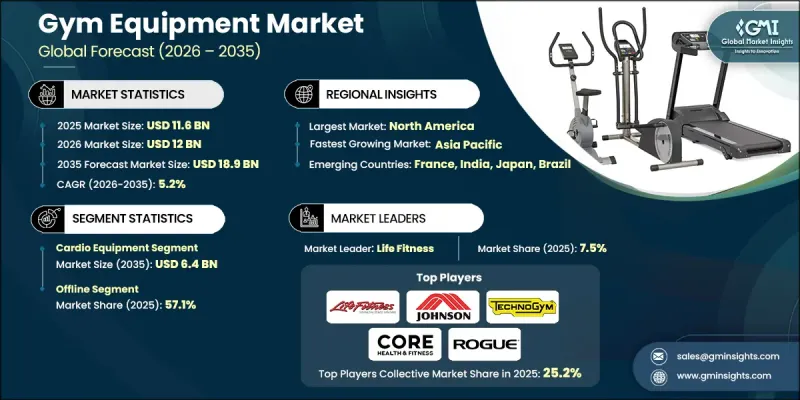
Market growth is fueled by a stronger global focus on health, fitness, and overall well-being, as individuals increasingly incorporate physical activity into their daily routines. Rising awareness about the importance of maintaining an active lifestyle is encouraging both gym memberships and investments in home fitness equipment. This shift is supported by evolving consumer preferences that prioritize convenience, flexibility, and long-term health benefits. In addition, the expansion of the fitness industry is contributing to increased demand for equipment, as new fitness centers and studios continue to emerge to cater to diverse workout preferences. Government-backed initiatives promoting physical activity are also playing a role in boosting participation levels and encouraging healthier lifestyles. Furthermore, technological advancements and the integration of smart fitness solutions are transforming how users engage with equipment, creating a more personalized and connected fitness experience. These factors collectively position the gym equipment market for steady and sustained growth over the forecast period.
| Market Scope | |
|---|---|
| Start Year | 2025 |
| Forecast Year | 2026-2035 |
| Start Value | $11.6 Billion |
| Forecast Value | $18.9 Billion |
| CAGR | 5.2% |
The cardio equipment segment generated USD 3.7 billion in 2025 and is expected to reach USD 6.4 billion by 2035. This segment represents a significant portion of the gym equipment market, driven by its widespread use in improving cardiovascular health, managing weight, and enhancing endurance. Cardio machines offer versatility and accessibility, making them suitable for users across different fitness levels. Their ability to support customized workout routines and deliver measurable fitness outcomes continues to drive their popularity among both individual consumers and commercial fitness facilities.
The offline segment accounted for 57.1% share in 2025, maintaining its leading position despite the growth of digital sales channels. Physical retail outlets remain highly relevant due to their ability to provide hands-on product experiences and personalized customer service. Consumers benefit from in-store demonstrations, expert guidance, and post-purchase support, which help them make informed decisions. Additionally, ongoing public initiatives encouraging physical fitness indirectly contribute to increased demand for equipment sold through offline channels, further reinforcing their market presence.
U.S. Gym Equipment Market accounted for 53.9% share in 2025, driven by increasing health awareness, rising demand for preventive fitness solutions, and strong adoption of active lifestyles. Consumers are increasingly investing in home fitness equipment, supported by evolving workout habits and the integration of digital fitness platforms. The expansion of commercial fitness centers and specialized studios is also contributing to market growth. Moreover, continuous advancements in smart equipment, connected systems, and data-driven training features are encouraging frequent upgrades and sustained demand across the region.
Key players operating in the Global Gym Equipment Market include Atlantis Strength, Concept2, Core Health & Fitness, Dyaco International, Eleiko, Hoist Fitness, Johnson Health Tech, Keiser Corporation, Life Fitness, Rogue Fitness, SportsArt Fitness, Steelflex (Joong Chen), Technogym, True Fitness, and Woodway. Companies in the Gym Equipment Market are strengthening their position through innovation, strategic partnerships, and expansion of product portfolios. They are investing in smart fitness technologies, including connected devices and AI-driven training features, to enhance user experience and engagement. Many players are focusing on developing multifunctional and space-efficient equipment to cater to home fitness trends. Collaborations with fitness centers, trainers, and digital platforms are helping companies expand their market reach. Additionally, brands are enhancing their distribution networks, both online and offline, to improve accessibility. Continuous research and development efforts, along with customization options and premium offerings, are enabling companies to differentiate themselves and maintain a competitive edge in the evolving fitness landscape.
Table of Contents
Chapter 1 Methodology & Scope
- 1.1 Research approach
- 1.2 Quality Commitments
- 1.3 GMI AI policy & data integrity commitment
- 1.3.1 Source consistency protocol
- 1.4 Research Trail & Confidence Scoring
- 1.4.1 Research Trail Components
- 1.4.2 Scoring Components
- 1.5 Data Collection
- 1.5.1 Partial list of primary sources
- 1.6 Data mining sources
- 1.7 Paid sources
- 1.7.1 Sources, by region
- 1.8 Base estimates and calculations
- 1.8.1 Base year calculation for any one approach
- 1.9 Forecast model
- 1.9.1 Quantified market impact analysis
- 1.9.1.1 Mathematical impact of growth parameters on forecast
- 1.9.1 Quantified market impact analysis
- 1.10 Research transparency addendum
- 1.10.1 Source attribution framework
- 1.10.2 Quality assurance metrics
- 1.10.3 Our commitment to trust
Chapter 2 Executive Summary
- 2.1 Industry 360° synopsis
- 2.2 Key market trends
- 2.2.1 Regional
- 2.2.2 Product Type
- 2.2.3 Type
- 2.2.4 Price
- 2.2.5 Category
- 2.2.6 Application
- 2.2.7 End Use
- 2.2.8 Distribution Channel
Chapter 3 Industry Insights
- 3.1 Industry ecosystem analysis
- 3.1.1 Supplier landscape
- 3.1.2 Profit margin
- 3.1.3 Value addition at each stage
- 3.1.4 Factor affecting the value chain
- 3.2 Industry impact forces
- 3.2.1 Growth drivers
- 3.2.1.1 Rising health awareness & preventive wellness focus
- 3.2.1.2 Growth of home fitness & hybrid exercise models
- 3.2.1.3 Technological advancements in smart fitness equipment
- 3.2.2 Industry pitfalls & challenges
- 3.2.2.1 Expansion across emerging markets
- 3.2.2.2 Rapid adoption of smart, connected & compact equipment
- 3.2.3 Opportunities
- 3.2.3.1 High initial cost of equipment
- 3.2.3.2 Concerns around durability, maintenance & product longevity
- 3.2.1 Growth drivers
- 3.3 Growth potential analysis
- 3.4 Future market trends
- 3.5 Technology and innovation landscape
- 3.5.1 Current technological trends
- 3.5.2 Emerging technologies
- 3.6 Regulatory landscape
- 3.6.1 Standards and compliance requirements
- 3.6.2 Regional regulatory frameworks
- 3.6.3 Certification standards
- 3.7 Trade data analysis
- 3.7.1 Import/export volume & value trends
- 3.7.2 Key trade corridors & tariff impact
- 3.8 Impact of AI & generative AI on the market
- 3.8.1 AI-driven disruption of existing business models
- 3.8.2 Gen AI use cases & adoption roadmap by segment
- 3.8.3 Risks, limitations & regulatory considerations
- 3.9 Pricing analysis (driven by primary research)
- 3.9.1 Historical price trend analysis (driven by primary research)
- 3.9.2 Pricing strategy by player type (premium / value / cost-plus) (driven by primary research)
- 3.9.3 Regional price variations
- 3.9.4 Impact of raw material costs on pricing
- 3.10 Porter's analysis
- 3.11 PESTEL analysis
- 3.12 Consumer behaviour analysis
- 3.12.1 Purchasing patterns
- 3.12.2 Preference analysis
- 3.12.3 Regional variations in consumer behaviour
- 3.12.4 Impact of e-commerce on buying decisions
Chapter 4 Competitive Landscape, 2025
- 4.1 Introduction
- 4.2 Company market share analysis
- 4.2.1 By region
- 4.2.1.1 North America
- 4.2.1.2 Europe
- 4.2.1.3 Asia Pacific
- 4.2.1.4 Latin America
- 4.2.1.5 Middle East and Africa
- 4.2.1 By region
- 4.3 Company matrix analysis
- 4.4 Competitive analysis of major market players
- 4.5 Competitive positioning matrix
- 4.6 Key developments
- 4.6.1 Mergers & acquisitions
- 4.6.2 Partnerships & collaborations
- 4.6.3 New product launches
- 4.6.4 Expansion plans
Chapter 5 Market Estimates & Forecast, By Product type, 2022-2035 (USD Billion) (Million Units)
- 5.1 Key trends
- 5.2 Cardio equipment
- 5.2.1 Treadmills
- 5.2.2 Elliptical trainers
- 5.2.3 Stationary bikes
- 5.2.4 Rowing machines
- 5.2.5 Stair climbers
- 5.2.6 Others
- 5.3 Strength training equipment
- 5.3.1 Selectorized weight machines
- 5.3.2 Free weights: dumbbells, barbells, kettlebells
- 5.3.3 Benches & racks
- 5.3.4 Cable & pulley systems
- 5.3.5 Plate loaded equipment
- 5.4 Functional training equipment
- 5.4.1 Suspension trainers
- 5.4.2 Medicine balls & slam balls
- 5.4.3 Battle ropes
- 5.4.4 Plyometric boxes
- 5.4.5 Agility & speed equipment
- 5.5 Flexibility & balance equipment
- 5.5.1 Yoga mats & props
- 5.5.2 Foam rollers
- 5.5.3 Balance boards & stability equipment
- 5.5.4 Resistance bands
- 5.5.5 Pilates equipment
- 5.6 Others
Chapter 6 Market Estimates & Forecast, By Type, 2022-2035 (USD Billion) (Million Units)
- 6.1 Key trends
- 6.2 Indoor equipment
- 6.3 Outdoor equipment
Chapter 7 Market Estimates & Forecast, By Price, 2022-2035 (USD Billion) (Million Units)
- 7.1 Key trends
- 7.2 Low
- 7.3 Medium
- 7.4 High
Chapter 8 Market Estimates & Forecast, By Category, 2022-2035 (USD Billion) (Million Units)
- 8.1 Key trends
- 8.2 Smart equipment
- 8.2.1 IoT-enabled connected devices
- 8.2.2 App-integrated equipment
- 8.2.3 AI-powered personal training systems
- 8.2.4 Virtual reality & gamification-enabled equipment
- 8.3 Conventional equipment
- 8.3.1 Mechanical/analog equipment
- 8.3.2 Basic electronic equipment
Chapter 9 Market Estimates & Forecast, By Application, 2022-2035 (USD Billion) (Million Units)
- 9.1 Key trends
- 9.2 Weight loss
- 9.3 Body building
- 9.4 Physical fitness
- 9.5 Mental fitness
- 9.6 Others
Chapter 10 Market Estimates & Forecast, By End Use, 2022-2035 (USD Billion) (Million Units)
- 10.1 Key trends
- 10.2 Household individuals
- 10.3 Fitness centers
- 10.4 Athlete/professional
Chapter 11 Market Estimates & Forecast, By Distribution Channel, 2022-2035 (USD Billion) (Million Units)
- 11.1 Key trends
- 11.2 Online
- 11.2.1 E-Commerce
- 11.2.2 Company website
- 11.3 Offline
- 11.3.1 Supermarkets/Hypermarkets
- 11.3.2 Specialty Stores
- 11.3.3 Others (Individual stores, Departmental stores, etc.)
Chapter 12 Market Estimates & Forecast, By Region, 2022-2035 (USD Billion) (Million Units)
- 12.1 Key trends
- 12.2 North America
- 12.2.1 U.S.
- 12.2.2 Canada
- 12.3 Europe
- 12.3.1 Germany
- 12.3.2 France
- 12.3.3 UK
- 12.3.4 Italy
- 12.3.5 Spain
- 12.4 Asia Pacific
- 12.4.1 China
- 12.4.2 India
- 12.4.3 Japan
- 12.4.4 South Korea
- 12.4.5 Australia
- 12.5 Latin America
- 12.5.1 Brazil
- 12.5.2 Mexico
- 12.5.3 Argentina
- 12.6 MEA
- 12.6.1 South Africa
- 12.6.2 Saudi Arabia
- 12.6.3 UAE
Chapter 13 Company Profiles
- 13.1 Atlantis Strength
- 13.2 Concept2
- 13.3 Core Health & Fitness
- 13.4 Dyaco International
- 13.5 Eleiko
- 13.6 Hoist Fitness
- 13.7 Johnson Health Tech
- 13.8 Keiser Corporation
- 13.9 Life Fitness
- 13.10 Rogue Fitness
- 13.11 SportsArt Fitness
- 13.12 Steelflex (Joong Chen)
- 13.13 Technogym
- 13.14 True Fitness
- 13.15 Woodway

