
PUBLISHER: Global Market Insights Inc. | PRODUCT CODE: 2027655

PUBLISHER: Global Market Insights Inc. | PRODUCT CODE: 2027655
Food Hydrocolloids Market Opportunity, Growth Drivers, Industry Trend Analysis, and Forecast 2026 - 2035
The Global Food Hydrocolloids Market was valued at USD 4.2 billion in 2025 and is estimated to grow at a CAGR of 4.2% to reach USD 6.3 billion by 2035.
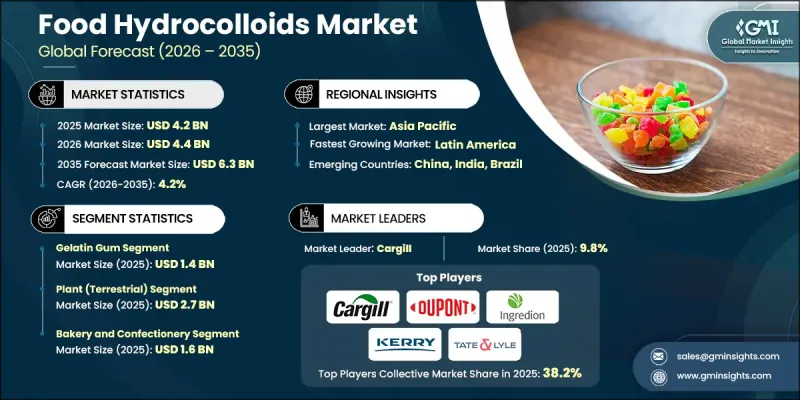
The global food hydrocolloids industry is witnessing steady growth as demand increases for functional ingredients that enhance texture, stability, and shelf life across processed food products. Food hydrocolloids are widely used as gelling, thickening, and stabilizing agents derived from plant, animal, microbial, and seaweed sources. These ingredients play a vital role in improving viscosity and structural integrity in food systems, making them essential across bakery, confectionery, dairy, and beverage applications. Their ability to maintain performance under varying thermal conditions, pH levels, and mechanical stress further strengthens their use in both ambient and chilled food products. Increasing consumer preference for clean-label ingredients is also driving demand, as hydrocolloids provide natural functionality without synthetic additives. Advancements in extraction and purification technologies are further enhancing product quality, enabling better control over molecular structure and performance characteristics. The integration of enzymatic processing and controlled hydrolysis techniques is allowing manufacturers to tailor functional properties such as gel strength and viscosity, thereby expanding application potential across modern food formulations.
| Market Scope | |
|---|---|
| Start Year | 2025 |
| Forecast Year | 2026-2035 |
| Start Value | $4.2 Billion |
| Forecast Value | $6.3 Billion |
| CAGR | 4.2% |
The gelatin gum segment accounted for USD 1.4 billion in 2025 owing to its strong gelling performance and wide applicability. This segment is highly valued for its thermoreversible properties, making it suitable for confectionery, dairy, and pharmaceutical uses. Ongoing improvements in processing techniques have enabled manufacturers to develop gelatin with customized bloom strength levels to meet diverse formulation requirements. At the same time, plant-based hydrocolloids such as pectin are gaining traction due to their suitability in low-sugar and fruit-based applications, particularly within clean-label product development.
The plant-derived segment captured USD 2.7 billion in 2025, supported by increasing demand for vegan-friendly and naturally sourced ingredients. This category continues to grow as food manufacturers align with clean-label trends and consumer preference for plant-based formulations. While animal-derived hydrocolloids remain important in certain applications, plant-based alternatives are expanding their presence across multiple food categories. Seaweed-based hydrocolloids are also witnessing strong adoption, particularly in stabilization and gel formation applications across dairy and meat product formulations.
North America Food Hydrocolloids Market is projected to grow from USD 1.2 billion in 2025 to USD 1.8 billion by 2035 driven by the rising adoption of clean-label ingredients and increased focus on natural food formulation strategies. Food manufacturers are increasingly shifting toward plant-based and transparent ingredient systems to align with consumer expectations. The growth of plant-based food products, combined with rising demand for natural stabilizers in dairy alternatives, bakery goods, and functional beverages, is further supporting market development across the region.
Key companies operating in the Global Food Hydrocolloids Market include Ingredion Incorporated, Kerry Group plc, Tate & Lyle PLC, Cargill, FMC Corporation, DuPont de Nemours, Inc., CP Kelco, Koninklijke DSM N.V., Lonza Group AG, Ashland Global Holdings Inc., Gum Technology Corporation, and TIC Gums, Inc. Companies in the Food Hydrocolloids Market are focusing on strategic initiatives to strengthen their market position and expand global reach. A key focus is investment in research and development to enhance functional performance, improve stability, and expand application versatility across food systems. Manufacturers are developing advanced extraction and modification technologies to achieve precise control over viscosity, gel strength, and texture properties. Strategic collaborations with food and beverage producers are helping companies tailor solutions to evolving formulation needs. Expansion of production capacities and modernization of processing facilities are supporting rising demand for clean-label ingredients. Companies are also prioritizing sustainability by sourcing raw materials responsibly and reducing environmental impact in production processes. Product innovation in plant-based and seaweed-derived hydrocolloids is further strengthening portfolio diversification. In addition, mergers, acquisitions, and global expansion strategies are enabling firms to improve market access, strengthen distribution networks, and enhance competitive positioning across regional markets.
Table of Contents
Chapter 1 Methodology & Scope
- 1.1 Market scope and definition
- 1.2 Research design
- 1.2.1 Research approach
- 1.2.2 Data collection methods
- 1.3 Data mining sources
- 1.3.1 Global
- 1.3.2 Regional/Country
- 1.4 Base estimates and calculations
- 1.4.1 Base year calculation
- 1.4.2 Key trends for market estimation
- 1.5 Primary research and validation
- 1.5.1 Primary sources
- 1.6 Forecast model
- 1.7 Research assumptions and limitations
Chapter 2 Executive Summary
- 2.1 Industry 360° synopsis
- 2.2 Key market trends
- 2.2.1 Type
- 2.2.2 Form
- 2.2.3 Application
- 2.2.4 Regional
- 2.3 TAM Analysis, 2026-2035
- 2.4 CXO perspectives: Strategic imperatives
Chapter 3 Industry Insights
- 3.1 Industry ecosystem analysis
- 3.1.1 Supplier landscape
- 3.1.2 Profit margin
- 3.1.3 Value addition at each stage
- 3.1.4 Factor affecting the value chain
- 3.1.5 Disruptions
- 3.2 Industry impact forces
- 3.2.1 Growth drivers
- 3.2.2 Industry pitfalls and challenges
- 3.2.3 Market opportunities
- 3.3 Growth potential analysis
- 3.4 Regulatory landscape
- 3.4.1 North America
- 3.4.2 Europe
- 3.4.3 Asia Pacific
- 3.4.4 Latin America
- 3.4.5 Middle East & Africa
- 3.5 Porter's analysis
- 3.6 PESTEL analysis
- 3.7 Price trends
- 3.7.1 By region
- 3.7.2 By type
- 3.8 Future market trends
- 3.9 Technology and Innovation landscape
- 3.9.1 Current technological trends
- 3.9.2 Emerging technologies
- 3.10 Patent Landscape
- 3.11 Trade statistics (HS code)
- 3.11.1 Major importing countries
- 3.11.2 Major exporting countries
- 3.12 Sustainability and environmental aspects
- 3.12.1 Sustainable practices
- 3.12.2 Waste reduction strategies
- 3.12.3 Energy efficiency in production
- 3.12.4 Eco-friendly initiatives
- 3.13 Carbon footprint consideration
Chapter 4 Competitive Landscape, 2025
- 4.1 Introduction
- 4.2 Company market share analysis
- 4.2.1 By region
- 4.2.1.1 North America
- 4.2.1.2 Europe
- 4.2.1.3 Asia Pacific
- 4.2.1.4 LATAM
- 4.2.1.5 MEA
- 4.2.1 By region
- 4.3 Competitive analysis of major market players
- 4.4 Competitive positioning matrix
- 4.5 Key developments
- 4.5.1 Mergers & acquisitions
- 4.5.2 Partnerships & collaborations
- 4.5.3 New Product Launches
- 4.5.4 Expansion Plans
Chapter 5 Market Estimates and Forecast, By Type, 2022-2035 (USD Billion) (Kilo Tons)
- 5.1 Key trends
- 5.2 Gelatin Gum
- 5.3 Pectin
- 5.4 Xanthan Gum
- 5.5 Guar Gum
- 5.6 Carrageenan
- 5.7 Others
Chapter 6 Market Estimates and Forecast, By Source, 2022-2035 (USD Billion) (Kilo Tons)
- 6.1 Key trends
- 6.2 Plant (Terrestrial)
- 6.3 Animal
- 6.4 Seaweed/Marine
- 6.5 Synthetic/Modified
- 6.6 Microbial
Chapter 7 Market Estimates and Forecast, By Application, 2022-2035 (USD Billion) (Kilo Tons)
- 7.1 Key trends
- 7.2 Bakery and Confectionery
- 7.3 Dairy and Frozen Products
- 7.4 Beverages
- 7.5 Meat and Seafood Products
- 7.6 Other Applications
Chapter 8 Market Estimates and Forecast, By Region, 2022-2035 (USD Billion) (Kilo Tons)
- 8.1 Key trends
- 8.2 North America
- 8.2.1 U.S.
- 8.2.2 Canada
- 8.3 Europe
- 8.3.1 Germany
- 8.3.2 UK
- 8.3.3 France
- 8.3.4 Spain
- 8.3.5 Italy
- 8.3.6 Rest of Europe
- 8.4 Asia Pacific
- 8.4.1 China
- 8.4.2 India
- 8.4.3 Japan
- 8.4.4 Australia
- 8.4.5 South Korea
- 8.4.6 Rest of Asia Pacific
- 8.5 Latin America
- 8.5.1 Brazil
- 8.5.2 Mexico
- 8.5.3 Argentina
- 8.5.4 Rest of Latin America
- 8.6 Middle East and Africa
- 8.6.1 Saudi Arabia
- 8.6.2 South Africa
- 8.6.3 UAE
- 8.6.4 Rest of Middle East and Africa
Chapter 9 Company Profiles
- 9.1 Ashland Global Holdings Inc.
- 9.2 Cargill, Incorporated
- 9.3 CP Kelco
- 9.4 DuPont de Nemours, Inc.
- 9.5 FMC Corporation
- 9.6 Gum Technology Corporation
- 9.7 Ingredion Incorporated
- 9.8 Kerry Group plc
- 9.9 Koninklijke DSM N.V.
- 9.10 Lonza Group AG
- 9.11 Tate & Lyle PLC
- 9.12 TIC Gums, Inc.

