PUBLISHER: Global Market Insights Inc. | PRODUCT CODE: 2027662

PUBLISHER: Global Market Insights Inc. | PRODUCT CODE: 2027662
Pickleball Equipment Market Opportunity, Growth Drivers, Industry Trend Analysis, and Forecast 2026 - 2035
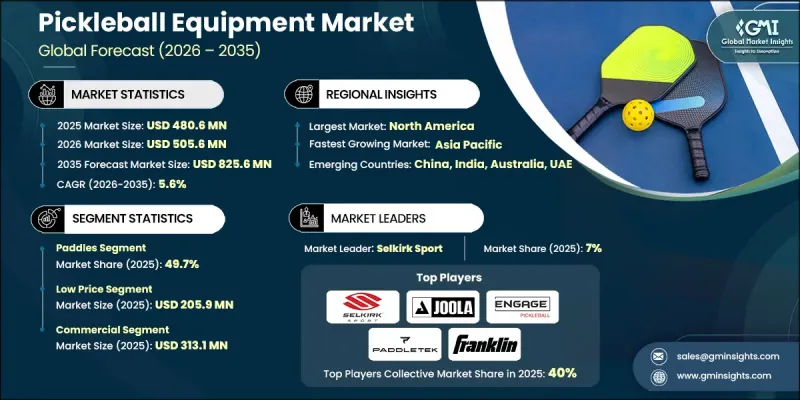
The Global Pickleball Equipment Market was valued at USD 480.6 million in 2025 and is estimated to grow at a CAGR of 5.6% to reach USD 825.6 million by 2035.
The rapid rise of pickleball as one of America's fastest-growing sports is transforming the equipment landscape. Today, paddles and balls are no longer basic items; they are evolving into technologically advanced products with enhanced materials, ergonomic designs, and performance-driven features. Manufacturers are introducing equipment that offers durability, precision, and improved playability, catering to players across all age groups and skill levels. Carbon-faced paddles, polymer cores, and reinforced edges provide superior power, control, and longevity, while balls with optimized hole patterns ensure consistent flight indoors and outdoors. Smart technologies and performance-oriented designs further enhance the experience for players seeking professional-level equipment. The sport's growing popularity continues to drive innovation, encouraging the development of equipment that aligns with evolving player expectations and competitive standards.
| Market Scope | |
|---|---|
| Start Year | 2025 |
| Forecast Year | 2026-2035 |
| Start Value | $480.6 Million |
| Forecast Value | $825.6 Million |
| CAGR | 5.6% |
The paddles segment held a 49.7% share, generating USD 239 million in 2025. These paddles are designed to support different playing styles, from power-oriented to precision-focused gameplay, making them essential for both beginners and advanced players. Their popularity is fueled by the demand for performance advantages, tournament regulation compliance, and the ability to generate enhanced spin, control, and power. Advanced features, including polymer cores and adjustable weight systems, are particularly appealing to competitive players seeking to elevate their game. Paddles continue to dominate the market due to their versatility and direct impact on performance outcomes during play.
In 2025, the low-price segment held a 43% share, valued at USD 205.9 million. Affordable equipment serves as an entry point for newcomers and recreational players, allowing them to explore the sport without significant financial commitment. While cost-effective options remain critical for accessibility, premium products help manufacturers build brand reputation and drive innovation, which eventually filters down to mid-range models. The low-price segment ensures widespread adoption and encourages first-time players, while premium equipment fuels technological advancements that raise the overall performance standards of the market.
North America Pickleball Equipment Market held a 40.9% share, generating USD 196.8 million in 2025, growing at a CAGR of 6.1% through 2035. The sport's origins in the Pacific Northwest and its rapid continental adoption have positioned North America at the forefront of product innovation. Premium paddle sales focus on advanced materials, tournament-approved specifications, and professional-grade construction. Regulatory standards, such as equipment certifications, drive the development of compliant, high-performance products. U.S. consumers favor carbon fiber paddles, textured surfaces for spin, and customizable weights, supporting robust demand for high-end models and shaping the region as a hub for technological advancements in pickleball equipment.
Major players operating in the Global Pickleball Equipment Market include Engage Pickleball, Selkirk Sport, Paddle Tek, Onix Pickleball, Franklin Sports, Gamma Sports, JOOLA, Vulcan Sporting Goods, Prince Sports, Head NV, Yonex, Six Zero Pickleball, Diadem Sports, Gearbox Sports, and ProKennex. Key strategies adopted by companies in the Pickleball Equipment Market focus on enhancing product innovation, expanding distribution channels, and strengthening brand visibility. Firms invest in research and development to create paddles and balls with advanced materials, ergonomic designs, and technology-driven performance features. Strategic collaborations with professional players, sports organizations, and tournaments help promote credibility and increase adoption. Companies are also leveraging digital marketing, e-commerce platforms, and direct-to-consumer sales to broaden reach and tap into emerging markets. Additionally, competitive pricing strategies, coupled with the launch of entry-level and premium product lines, enable brands to attract both recreational players and professionals while building long-term customer loyalty.
Table of Contents
Chapter 1 Methodology and Scope
- 1.1 Market scope and definition
- 1.2 Research design
- 1.2.1 Research approach
- 1.2.2 Data collection methods
- 1.3 Data mining sources
- 1.3.1 Global
- 1.3.2 Regional/Country
- 1.4 Base estimates and calculations
- 1.4.1 Base year calculation
- 1.4.2 Key trends for market estimation
- 1.5 Primary research and validation
- 1.5.1 Primary sources
- 1.6 Forecast model
- 1.7 Research assumptions and limitations
Chapter 2 Executive Summary
- 2.1 Industry 360° synopsis
- 2.2 Key market trends
- 2.2.1 Regional
- 2.2.2 Product Type
- 2.2.3 Price
- 2.2.4 End Use
- 2.2.5 Distribution Channel
- 2.3 CXO perspectives: Strategic imperatives
- 2.3.1 Key decision points for industry executives
- 2.3.2 Critical success factors for market players
- 2.4 Future outlook and strategic recommendations
Chapter 3 Industry Insights
- 3.1 Industry ecosystem analysis
- 3.1.1 Supplier landscape
- 3.1.2 Profit margin
- 3.1.3 Value addition at each stage
- 3.1.4 Factor affecting the value chain
- 3.2 Industry impact forces
- 3.2.1 Growth drivers
- 3.2.1.1 Rising popularity of pickleball across demographics
- 3.2.1.2 Technological advancements in paddle construction
- 3.2.1.3 Growing commercial adoption and facility development
- 3.2.2 Industry pitfalls & challenges
- 3.2.2.1 High initial cost of premium professional-grade equipment
- 3.2.2.2 Rapid product innovation cycles
- 3.2.3 Opportunities
- 3.2.3.1 Expansion of online sales channels
- 3.2.3.2 Integration of smart technology and performance tracking
- 3.2.1 Growth drivers
- 3.3 Growth potential analysis
- 3.4 Future market trends
- 3.5 Technology and innovation landscape
- 3.5.1 Current technological trends
- 3.5.2 Emerging technologies
- 3.6 Pricing Analysis (Driven by Primary Research)
- 3.6.1 Historical Price Trend Analysis (Driven by Primary Research)
- 3.6.2 Pricing Strategy by Player Type (Premium / Value / Cost-Plus) (Driven by Primary Research)
- 3.7 Patent Landscape (Driven by Primary Research)
- 3.7.1 Patent Filing Trends by Technology Area
- 3.7.2 Key Patent Holders & IP Portfolio Analysis
- 3.7.3 Geographic Distribution of Patents
- 3.7.4 Emerging Technology Patents (Smart Tools, Material Innovations)
- 3.8 Regulatory landscape
- 3.8.1 Standards and compliance requirements
- 3.8.2 Regional regulatory frameworks
- 3.8.3 Certification standards
- 3.9 Porter’s analysis
- 3.10 PESTEL analysis
- 3.11 Trade Data Analysis (Driven by Primary Research)
- 3.11.1 Import/Export Volume & Value Trends (Driven by Primary Research)
- 3.11.2 Key Trade Corridors & Tariff Impact (Driven by Primary Research)
- 3.11.3 Regional Trade Balance Analysis
- 3.12 Impact of AI & Generative AI on the Market
- 3.12.1 AI-Driven Disruption of Existing Business Models
- 3.12.2 GenAI Use Cases & Adoption Roadmap by Segment
- 3.12.3 Risks, Limitations & Regulatory Considerations
- 3.13 Distribution Infrastructure & Channel Penetration Landscape (Driven by Primary Research)
- 3.13.1 Channel Coverage by Region & Format (Modern vs. Traditional Trade) (Driven by Primary Research)
- 3.13.2 Last-Mile Infrastructure Gaps & Emerging Channel Shifts (Driven by Primary Research)
Chapter 4 Competitive Landscape, 2025
- 4.1 Introduction
- 4.2 Company market share analysis
- 4.2.1 By region
- 4.2.1.1 North America
- 4.2.1.2 Europe
- 4.2.1.3 Asia Pacific
- 4.2.1.4 Latin America
- 4.2.1.5 Middle East and Africa
- 4.2.1 By region
- 4.3 Company matrix analysis
- 4.4 Competitive analysis of major market players
- 4.5 Competitive positioning matrix
- 4.6 Key developments
- 4.6.1 Mergers & acquisitions
- 4.6.2 Partnerships & collaborations
- 4.6.3 New product launches
- 4.6.4 Expansion plans
Chapter 5 Market Estimates & Forecast, By Product Type, 2022 - 2035, (USD Million) (Thousand Units)
- 5.1 Key trends
- 5.2 Balls
- 5.3 Paddles
- 5.4 Accessories
- 5.4.1 Practice Net
- 5.4.2 Net Weights
- 5.4.3 Teaching Cart
- 5.4.4 Portable Cart
- 5.4.5 Others (Replacement Net, etc.)
- 5.5 Others (Posts)
Chapter 6 Market Estimates & Forecast, By Price, 2022 - 2035, (USD Million) (Thousand Units)
- 6.1 Key trends
- 6.2 Low
- 6.3 Medium
- 6.4 High
Chapter 7 Market Estimates & Forecast, By End User, 2022 - 2035, (USD Million) (Thousand Units)
- 7.1 Key trends
- 7.2 Individual
- 7.3 Commercial
Chapter 8 Market Estimates & Forecast, By Distribution Channel, 2022 - 2035, (USD Million) (Thousand Units)
- 8.1 Key trends
- 8.2 Online
- 8.2.1 E-Commerce
- 8.2.2 Company Site
- 8.3 Offline
- 8.3.1 Specialty Stores
- 8.3.2 Sports Retailers
- 8.3.3 Others (Departmental Stores, etc.)
Chapter 9 Market Estimates and Forecast, By Region, 2022 - 2035 (USD Million) (Thousand Units)
- 9.1 Key trends
- 9.2 North America
- 9.2.1 U.S.
- 9.2.2 Canada
- 9.3 Europe
- 9.3.1 Germany
- 9.3.2 UK
- 9.3.3 France
- 9.3.4 Italy
- 9.3.5 Spain
- 9.4 Asia Pacific
- 9.4.1 China
- 9.4.2 Japan
- 9.4.3 India
- 9.4.4 Australia
- 9.4.5 South Korea
- 9.5 Latin America
- 9.5.1 Brazil
- 9.5.2 Mexico
- 9.5.3 Argentina
- 9.6 Middle East and Africa
- 9.6.1 South Africa
- 9.6.2 Saudi Arabia
- 9.6.3 UAE
Chapter 10 Company Profiles
- 10.1 Diadem Sports
- 10.2 Engage Pickleball
- 10.3 Franklin Sports
- 10.4 Gamma Sports
- 10.5 Gearbox Sports
- 10.6 HEAD N.V.
- 10.7 JOOLA
- 10.8 Onix Pickleball
- 10.9 Paddletek
- 10.10 Prince Sports
- 10.11 ProKennex
- 10.12 Selkirk Sport
- 10.13 Six Zero Pickleball
- 10.14 Vulcan Sporting Goods
- 10.15 Yonex

