PUBLISHER: Global Market Insights Inc. | PRODUCT CODE: 2027665

PUBLISHER: Global Market Insights Inc. | PRODUCT CODE: 2027665
Hair Removal Products Market Opportunity, Growth Drivers, Industry Trend Analysis, and Forecast 2026 - 2035
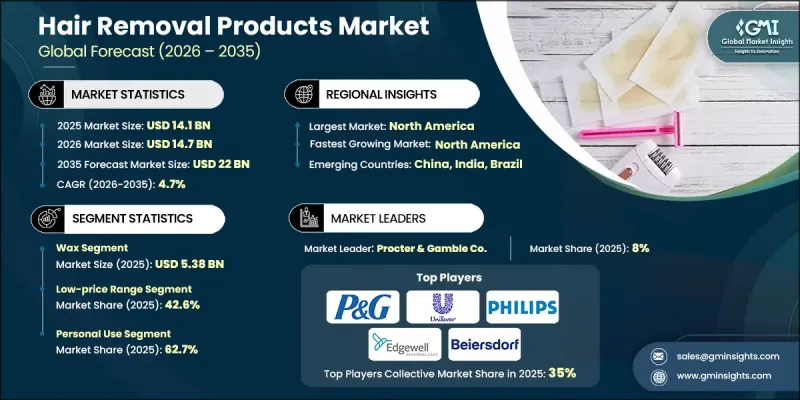
The Global Hair Removal Products Market was valued at USD 14.1 billion in 2025 and is estimated to grow at a CAGR of 4.7% to reach USD 22 billion by 2035.
The market is experiencing a significant transformation driven by technological progress, evolving consumer preferences, and a growing emphasis on personal grooming across diverse demographics. Hair removal solutions are no longer limited to basic functionality, as they have evolved into advanced, user-centric products designed for efficiency, safety, and ease of use across different skin types. Increasing awareness around skincare and grooming routines is encouraging consumers to adopt products that deliver consistent results while minimizing irritation. As innovation continues to shape the industry, manufacturers are focusing on developing solutions that combine performance with comfort, aligning with the expectations of modern consumers seeking reliable and skin-friendly grooming options.
| Market Scope | |
|---|---|
| Start Year | 2025 |
| Forecast Year | 2026-2035 |
| Start Value | $14.1 Billion |
| Forecast Value | $22 Billion |
| CAGR | 4.7% |
Technological integration plays a key role in redefining product capabilities and enhancing user experience. Advanced features such as intelligent sensors enable devices to adapt to varying skin tones and hair textures, ensuring optimal performance and safety. Connectivity with digital platforms allows users to monitor usage patterns and receive tailored recommendations, improving overall satisfaction. Additional innovations, including pain-reduction mechanisms, dermatologically tested formulations, and hypoallergenic ingredients, are increasing consumer confidence. Enhanced safety features, such as controlled operation systems, further reduce the risk of skin irritation, making these products more accessible to a broader user base.
The wax-based products segment accounted for 38.2% share in 2025, reaching a value of USD 5.38 billion. Their strong demand is attributed to long-lasting results and the ability to remove hair from the root, providing extended smoothness. Consumers continue to favor these products for their effectiveness and the availability of multiple formulations suited to different skin types and application areas. The segment benefits from the increasing preference for achieving professional-quality results in home settings, supporting sustained demand.
The low-price segment held a share of 42.6% in 2025, generating USD 6 billion. This segment remains dominant due to its affordability and accessibility for a wide range of consumers. Frequent repurchase cycles associated with everyday grooming products contribute to consistent demand. Price-sensitive markets, particularly in developing regions, further strengthen the position of this segment as consumers prioritize cost-effective solutions without compromising basic performance.
United States Hair Removal Products Market accounted for 78% share in 2025. Strong consumer spending on personal care, a well-established grooming culture, and the presence of major brands with extensive distribution networks support market growth. The region benefits from advanced retail infrastructure, widespread adoption of innovative technologies, and a robust e-commerce ecosystem. Seasonal purchasing trends, supported by promotional campaigns and retail visibility, contribute to consistent sales performance. Collaborations with skincare professionals and digital influencers also enhance brand credibility and encourage product adoption.
Key players operating in the Global Hair Removal Products Market include Philips, Braun, Procter & Gamble, Unilever PLC, Panasonic, Beiersdorf, Edgewell Personal Care, Reckitt Benckiser, Spectrum Brands, BIC, Conair, Tria Beauty, CyDen, Epilady, Home Skinovations, and Shiseido. Companies in the Global Hair Removal Products Market are adopting strategies focused on product innovation, technological advancement, and customer-centric development to strengthen their market position. Investments in research and development are enabling the introduction of advanced features that enhance safety, comfort, and efficiency. Firms are expanding their product portfolios to address diverse consumer needs and preferences across different price segments. Strategic partnerships with retailers, dermatologists, and digital platforms are improving market reach and brand visibility. Companies are also leveraging digital marketing and influencer collaborations to engage with consumers and build trust. Additionally, efforts to improve sustainability, packaging, and supply chain efficiency are supporting long-term growth and competitive differentiation.
Table of Contents
Chapter 1 Methodology and Scope
- 1.1 Market scope and definition
- 1.2 Research design
- 1.2.1 Research approach
- 1.2.2 Data collection methods
- 1.3 Data mining sources
- 1.3.1 Global
- 1.3.2 Regional/Country
- 1.4 Base estimates and calculations
- 1.4.1 Base year calculation
- 1.4.2 Key trends for market estimation
- 1.5 Primary research and validation
- 1.5.1 Primary sources
- 1.6 Forecast model
- 1.7 Research assumptions and limitations
Chapter 2 Executive Summary
- 2.1 Industry 360° synopsis
- 2.2 Key market trends
- 2.2.1 Regional
- 2.2.2 Product Type
- 2.2.3 Price Range
- 2.2.4 Consumer Group
- 2.2.5 End-Use
- 2.2.6 Distribution Channel
- 2.3 CXO perspectives: Strategic imperatives
- 2.3.1 Key decision points for industry executives
- 2.3.2 Critical success factors for market players
- 2.4 Future outlook and strategic recommendations
Chapter 3 Industry Insights
- 3.1 Industry ecosystem analysis
- 3.1.1 Supplier landscape
- 3.1.2 Profit margin
- 3.1.3 Value addition at each stage
- 3.1.4 Factor affecting the value chain
- 3.2 Industry impact forces
- 3.2.1 Growth drivers
- 3.2.1.1 Rising demand for at-home professional solutions
- 3.2.1.2 Technological advancements in "Smart" devices
- 3.2.1.3 Growing grooming awareness & personal care focus
- 3.2.2 Industry pitfalls & challenges
- 3.2.2.1 High initial cost of premium device models
- 3.2.2.2 Skin sensitivity and safety concerns
- 3.2.3 Opportunities
- 3.2.3.1 Expansion of online sales channels
- 3.2.3.2 Integration of smart features (sensors, connectivity)
- 3.2.1 Growth drivers
- 3.3 Growth potential analysis
- 3.4 Future market trends
- 3.5 Technology and innovation landscape
- 3.5.1 Current technological trends
- 3.5.2 Emerging technologies
- 3.6 Pricing Analysis (Driven by Primary Research)
- 3.6.1 Historical Price Trend Analysis (Driven by Primary Research)
- 3.6.2 Pricing Strategy by Player Type (Premium / Value / Cost-plus) (Driven by Primary Research)
- 3.7 Regulatory landscape
- 3.7.1 Standards and compliance requirements
- 3.7.2 Regional regulatory frameworks
- 3.7.3 Certification standards
- 3.8 Porter's analysis
- 3.9 PESTEL analysis
- 3.10 Trade Data Analysis
- 3.10.1 Import & Export Volume & Value Trends
- 3.10.2 Key Trade Corridors & Tariff Impact
- 3.11 Impact of AI & Generative AI on the Market
- 3.11.1 AI-Driven Disruption of Existing Business Models
- 3.11.2 Predictive Analytics for Product Development
- 3.12 Distribution Infrastructure & Channel Penetration Landscape (Driven by Primary Research)
- 3.12.1 Channel Coverage by Region & Format (Modern vs. Traditional Trade) (Driven by Primary Research)
- 3.12.2 Last-Mile Infrastructure Gaps & Emerging Channel Shifts (Driven by Primary Research)
Chapter 4 Competitive Landscape, 2025
- 4.1 Introduction
- 4.2 Company market share analysis
- 4.2.1 By region
- 4.2.1.1 North America
- 4.2.1.2 Europe
- 4.2.1.3 Asia Pacific
- 4.2.1.4 Latin America
- 4.2.1.5 Middle East and Africa
- 4.2.1 By region
- 4.3 Company matrix analysis
- 4.4 Competitive analysis of major market players
- 4.5 Competitive positioning matrix
- 4.6 Key developments
- 4.6.1 Mergers & acquisitions
- 4.6.2 Partnerships & collaborations
- 4.6.3 New product launches
- 4.6.4 Expansion plans
Chapter 5 Market Estimates & Forecast, By Product Type, 2022 - 2035 (USD Billion) (Million Units)
- 5.1 Key trends
- 5.2 Cream
- 5.3 Wax
- 5.4 Shaving gels & foams
- 5.5 Devices
- 5.5.1 Razors
- 5.5.2 Epilators
- 5.5.3 Laser hair removal devices
- 5.5.4 Trimmers
- 5.5.5 Others (Intense pulsed light devices, Etc)
Chapter 6 Market Estimates & Forecast, By Price Range, 2022 - 2035 (USD Billion) (Million Units)
- 6.1 Key trends
- 6.2 Low
- 6.3 Medium
- 6.4 High
Chapter 7 Market Estimates & Forecast, By Consumer Group, 2022 - 2035 (USD Billion) (Million Units)
- 7.1 Key trends
- 7.2 Men
- 7.3 Women
Chapter 8 Market Estimates & Forecast, By End-Use, 2022 - 2035 (USD Billion) (Million Units)
- 8.1 Key trends
- 8.2 Personal use
- 8.3 Professional use
- 8.3.1 Salons and spas
- 8.3.2 Medical aesthetics clinics
- 8.3.3 Others (Beauty clinics, Etc)
Chapter 9 Market Estimates & Forecast, By Distribution Channel, 2022 - 2035 (USD Billion) (Million Units)
- 9.1 Key trends
- 9.2 Online
- 9.2.1 E-Commerce
- 9.2.2 Company Website
- 9.3 Offline
- 9.3.1 Supermarkets and Hypermarkets
- 9.3.2 Specialty Stores
- 9.3.3 Other Retail Stores
Chapter 10 Market Estimates and Forecast, By Region, 2022 - 2035 (USD Billion) (Million Units)
- 10.1 Key trends
- 10.2 North America
- 10.2.1 U.S.
- 10.2.2 Canada
- 10.3 Europe
- 10.3.1 Germany
- 10.3.2 UK
- 10.3.3 France
- 10.3.4 Italy
- 10.3.5 Spain
- 10.4 Asia Pacific
- 10.4.1 China
- 10.4.2 Japan
- 10.4.3 India
- 10.4.4 Australia
- 10.4.5 South Korea
- 10.5 Latin America
- 10.5.1 Brazil
- 10.5.2 Mexico
- 10.5.3 Argentina
- 10.6 Middle East and Africa
- 10.6.1 South Africa
- 10.6.2 Saudi Arabia
- 10.6.3 UAE
Chapter 11 Company Profiles
- 11.1 Beiersdorf
- 11.2 BIC
- 11.3 Braun
- 11.4 Conair
- 11.5 CyDen
- 11.6 Edgewell Personal Care
- 11.7 Epilady
- 11.8 Home Skinovations
- 11.9 Panasonic
- 11.10 Philips
- 11.11 Procter & Gamble
- 11.12 Reckitt Benckiser
- 11.13 Shiseido
- 11.14 Spectrum Brands
- 11.15 Tria Beauty
- 11.16 Unilever PLC

