PUBLISHER: Global Market Insights Inc. | PRODUCT CODE: 2038297

PUBLISHER: Global Market Insights Inc. | PRODUCT CODE: 2038297
Asia Pacific Mixer Market Opportunity, Growth Drivers, Industry Trend Analysis, and Forecast 2026 - 2035
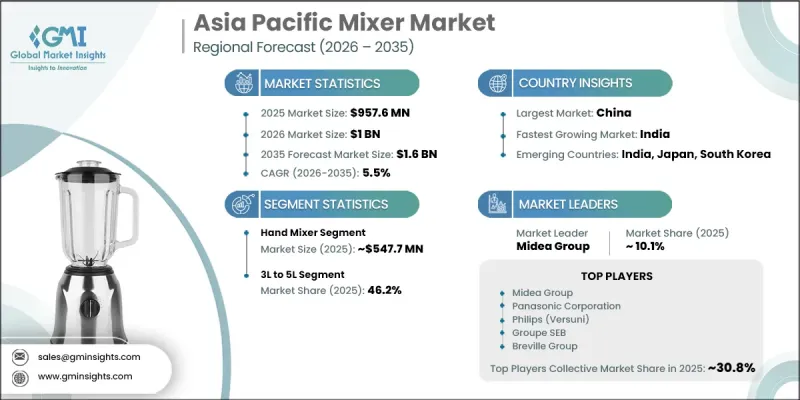
Asia Pacific Mixer Market was valued at USD 957.6 million in 2025 and is estimated to grow at a CAGR of 5.5% to reach USD 1.6 billion by 2035.
The market is witnessing growth driven by rapid urbanization and evolving consumer lifestyles that emphasize convenience and efficiency in everyday cooking. As the middle-class population continues to expand across the region, rising disposable incomes are enabling greater spending on modern kitchen appliances that simplify food preparation. Mixers are increasingly becoming essential household tools due to their ability to reduce manual effort and improve cooking efficiency. The growing preference for compact living spaces is also encouraging demand for multifunctional appliances that can perform multiple tasks while occupying minimal space. Expanding retail networks and the rapid growth of e-commerce platforms are improving product accessibility, especially in developing economies. Additionally, changing dietary patterns and increasing consumption of processed and ready-to-cook food products are further supporting demand for mixers. These factors, combined with continuous product innovation and enhanced design features, are contributing to sustained growth in the Asia Pacific mixer market.
| Market Scope | |
|---|---|
| Start Year | 2025 |
| Forecast Year | 2026-2035 |
| Start Value | $957.6 Million |
| Forecast Value | $1.6 Billion |
| CAGR | 5.5% |
The hand mixer segment generated USD 547.7 million in 2025 and is expected to grow at a CAGR of 4.4% between 2026 and 2035. This segment maintains a leading position due to its practicality and strong alignment with daily household cooking requirements. Hand mixers are widely adopted for a range of food preparation tasks, offering convenience and efficiency in modern kitchens. Their lightweight structure, ease of use, and compact design make them particularly suitable for urban households where space optimization is essential. Additionally, their relatively lower cost compared to larger appliances enhances affordability, allowing broader consumer adoption. Increasing interest in home cooking and evolving lifestyle preferences are further supporting demand for this segment.
The 3L to 5L capacity segment held a 46.2% share in 2025 and is projected to grow at a CAGR of 5.2% through 2035. This segment is gaining traction due to its balanced capacity, making it suitable for both residential and small-scale commercial applications. It offers sufficient volume for routine food preparation while maintaining a compact footprint, which is ideal for modern kitchens with limited space. The ability to support multiple functions enhances its versatility, while its cost-effectiveness compared to larger units makes it an attractive option for a wide range of users. Growing consumer demand for appliances that combine performance, convenience, and space efficiency is further driving growth in this category.
China Mixer Market captured USD 476.2 million in 2025, and is anticipated to grow at a CAGR of 4.9% from 2026 to 2035. The country's market expansion is supported by ongoing urban development, increasing household incomes, and rising adoption of advanced kitchen appliances. Consumers are increasingly incorporating electric mixers into their daily cooking routines, reflecting a shift toward more efficient food preparation methods. Demand for compact and multifunctional appliances remains strong due to space constraints in urban housing, while interest in higher-capacity models is also growing among consumers seeking enhanced functionality. Domestic manufacturers maintain a competitive edge by offering feature-rich products at competitive prices, while international brands cater to premium market segments. The strong presence of digital sales platforms continues to play a key role in driving product visibility and accessibility.
Key companies operating in the Asia Pacific Mixer Market include Panasonic Corporation, Midea Group, Electrolux AB, Groupe SEB, Bajaj Electricals, Breville Group, Philips (Versuni), TTK Prestige Limited, Preethi Kitchen Appliances, Usha International Limited, Inalsa, De'Longhi Group, Smeg S.p.A., Wonderchef Home Appliances, Tiger Corporation, Zojirushi Corporation, Joyoung Company Limited, Guangdong Bear Electric Appliance, Miyako Electronics, PT Cosmos, and SharkNinja Inc. Companies in the Asia Pacific Mixer Market are focusing on a combination of innovation, expansion, and customer-centric strategies to strengthen their market position. Product development remains a key priority, with manufacturers introducing advanced features such as multiple speed settings, energy-efficient motors, and multifunctional capabilities to enhance user experience. Firms are also emphasizing compact and ergonomic designs to cater to urban consumers with limited kitchen space. Strategic partnerships with distributors and online platforms are helping companies expand their reach and improve product availability across diverse markets. Additionally, competitive pricing strategies and localized manufacturing are enabling brands to target a broader consumer base. Investment in digital marketing, influencer collaborations, and e-commerce integration is further boosting brand visibility.
Table of Contents
Chapter 1 Methodology & Scope
- 1.1 Market scope and definition
- 1.2 Research design
- 1.2.1 Research approach
- 1.2.2 Data collection methods
- 1.3 Data mining sources
- 1.3.1 Global
- 1.3.2 Regional/Country
- 1.4 Base estimates and calculations
- 1.4.1 Base year calculation
- 1.4.2 Key trends for market estimation
- 1.5 Primary research and validation
- 1.5.1 Primary sources
- 1.6 Forecast model
- 1.7 Research assumptions and limitations
Chapter 2 Executive Summary
- 2.1 Industry 360° synopsis
- 2.2 Key market trends
- 2.2.1 Country
- 2.2.2 Product Type
- 2.2.3 Capacity
- 2.2.4 Power
- 2.2.5 Price
- 2.2.6 End User
- 2.2.7 Distribution channel
Chapter 3 Industry Insights
- 3.1 Industry ecosystem analysis
- 3.1.1 Supplier landscape
- 3.1.2 Profit margin
- 3.1.3 Value addition at each stage
- 3.1.4 Factor affecting the value chain
- 3.2 Industry impact forces
- 3.2.1 Growth drivers
- 3.2.1.1 Growing demand from food processing and bakery industries
- 3.2.1.2 Rising adoption of household kitchen appliances
- 3.2.1.3 Expansion of ready-to-eat and packaged food consumption
- 3.2.2 Pitfalls & Challenges
- 3.2.2.1 High competition from low-cost and unbranded products
- 3.2.2.2 Frequent maintenance and wear of mechanical components
- 3.2.3 Opportunities
- 3.2.3.1 Growing demand for smart and automated mixing systems
- 3.2.3.2 Expansion of commercial foodservice and bakery chains
- 3.2.1 Growth drivers
- 3.3 Growth potential analysis
- 3.4 Future market trends
- 3.5 Technology and innovation landscape
- 3.5.1 Current technological trends
- 3.5.2 Emerging technologies
- 3.6 Regulatory landscape
- 3.6.1 Standards and compliance requirements
- 3.6.2 Regional regulatory frameworks
- 3.6.3 Certification standards
- 3.7 Porter's analysis
- 3.8 PESTEL analysis
- 3.9 Pricing analysis (driven by primary research)
- 3.9.1 Historical price trend analysis (driven by primary research)
- 3.9.2 Pricing strategy by player type (premium / value / cost-plus) (driven by primary research)
- 3.10 Trade data analysis (driven by paid database)
- 3.10.1 Import/export volume and value trends (driven by paid database)
- 3.10.2 Key trade corridors and tariff impact (driven by paid database)
- 3.11 Impact of AI and generative AI on the market
- 3.11.1 AI-driven disruption of existing business models
- 3.11.2 GenAI use cases and adoption roadmap by segment
- 3.11.3 Risks, limitations and regulatory considerations
- 3.12 Distribution infrastructure and channel penetration landscape (driven by primary research)
- 3.12.1 Channel coverage by region and format (modern vs. traditional trade) (driven by primary research)
- 3.12.2 Last-mile infrastructure gaps and emerging channel shifts (driven by primary research)
Chapter 4 Competitive Landscape, 2025
- 4.1 Introduction
- 4.2 Company market share analysis
- 4.2.1 By Country
- 4.2.1.1 China
- 4.2.1.2 India
- 4.2.1.3 Japan
- 4.2.1.4 Australia
- 4.2.1.5 Rest of Asia Pacific
- 4.2.1 By Country
- 4.3 Company matrix analysis
- 4.4 Competitive analysis of major market players
- 4.5 Competitive positioning matrix
- 4.6 Key developments
- 4.6.1 Mergers & acquisitions
- 4.6.2 Partnerships & collaborations
- 4.6.3 New product launches
- 4.6.4 Expansion plans
Chapter 5 Market Estimates & Forecast, By Product Type, 2022 - 2035, (USD Billion) (Thousand Units)
- 5.1 Key trends
- 5.2 Hand mixer
- 5.3 Stand mixer
- 5.3.1 Bowl-lift
- 5.3.2 Tilt-head
Chapter 6 Market Estimates & Forecast, By Capacity, 2022 - 2035, (USD Billion) (Thousand Units)
- 6.1 Key trends
- 6.2 Below 3L
- 6.3 3L to 5L
- 6.4 5L to 7L
- 6.5 Above 7L
Chapter 7 Market Estimates & Forecast, By Power, 2022 - 2035, (USD Billion) (Thousand Units)
- 7.1 Key trends
- 7.2 Low
- 7.3 Medium
- 7.4 High
Chapter 8 Market Estimates & Forecast, By End User, 2022 - 2035, (USD Billion) (Thousand Units)
- 8.1 Key trends
- 8.2 Residential
- 8.3 Commercial
- 8.3.1 HoReCa
- 8.3.2 Catering services
- 8.3.3 Juice bars
- 8.3.4 Others
Chapter 9 Market Estimates & Forecast, By Distribution Channel, 2022 - 2035, (USD Billion) (Thousand Units)
- 9.1 Key trends
- 9.2 Online
- 9.2.1 E-commerce
- 9.2.2 Company websites
- 9.3 Offline
- 9.3.1 Mega retail store
- 9.3.2 Specialty stores
- 9.3.3 Others
Chapter 10 Market Estimates & Forecast, By Country, 2022 - 2035, (USD Billion) (Thousand Units)
- 10.1 Key trends
- 10.2 China
- 10.3 India
- 10.4 Japan
- 10.5 South Korea
- 10.6 Australia
Chapter 11 Company Profiles
- 11.1 Top Global Players
- 11.1.1 Midea Group
- 11.1.2 Groupe SEB
- 11.1.3 Electrolux AB
- 11.1.4 Panasonic Corporation
- 11.1.5 Bajaj Electricals
- 11.1.6 Breville Group
- 11.1.7 Philips (Versuni)
- 11.2 Regional Champions
- 11.2.1 TTK Prestige Limited
- 11.2.2 Preethi Kitchen Appliances
- 11.2.3 Usha International Limited
- 11.2.4 Inalsa
- 11.2.5 De'Longhi Group
- 11.2.6 Smeg S.p.A.
- 11.2.7 Wonderchef Home Appliances
- 11.3 Emerging & Specialized Players
- 11.3.1 Tiger Corporation
- 11.3.2 Zojirushi Corporation
- 11.3.3 Joyoung Company Limited
- 11.3.4 Guangdong Bear Electric Appliance
- 11.3.5 Miyako Electronics
- 11.3.6 PT Cosmos
- 11.3.7 SharkNinja Inc.

