
PUBLISHER: Global Market Insights Inc. | PRODUCT CODE: 2038299

PUBLISHER: Global Market Insights Inc. | PRODUCT CODE: 2038299
North America Vertical Farming Automation System Market Opportunity, Growth Drivers, Industry Trend Analysis, and Forecast 2026 - 2035
North America Vertical Farming Automation System Market was valued at USD 370 million in 2025 and is estimated to grow at a CAGR of 5.2% to reach USD 1.6 billion by 2035.
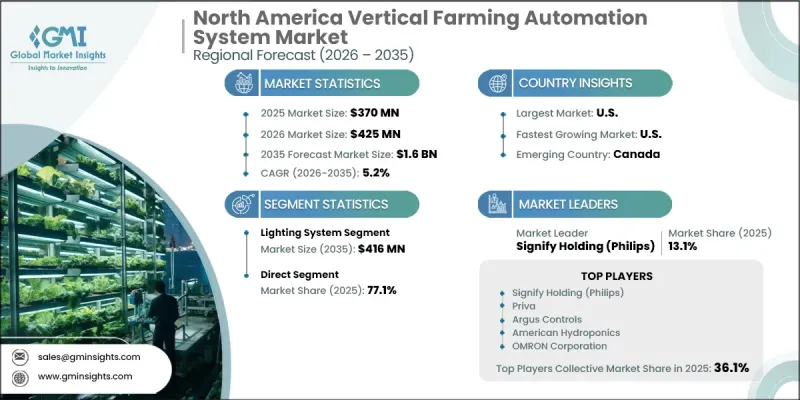
The market is gaining momentum as demand for locally produced, pesticide-free food continues to rise, particularly in densely populated urban regions where consumers prioritize freshness, quality, and reduced supply chain dependency. Increasing urbanization, combined with the decline in available agricultural land, is accelerating the adoption of vertical farming systems that maximize space efficiency while delivering high crop yields. Automated vertical farming solutions are becoming essential in enabling consistent, year-round production under controlled environmental conditions, minimizing the impact of unpredictable weather patterns associated with traditional agriculture. In addition, advancements in climate-resilient food production systems are supporting the transition toward more sustainable farming practices. Growing investments from both public and private sectors are fueling infrastructure expansion and encouraging the integration of advanced technologies, including artificial intelligence and digital monitoring tools. These developments are improving operational efficiency, enhancing crop management precision, and reducing labor dependency. As innovation continues to reshape the agricultural landscape, vertical farming automation systems are emerging as a critical solution for addressing food security challenges and meeting evolving consumer expectations across North America.
| Market Scope | |
|---|---|
| Start Year | 2025 |
| Forecast Year | 2026-2035 |
| Start Value | $370 Million |
| Forecast Value | $1.6 Billion |
| CAGR | 5.2% |
The lighting system segment generated USD 94.2 million in 2025 and is expected to reach USD 416 million by 2035, reflecting its critical role within vertical farming operations. Artificial lighting systems are fundamental to indoor crop cultivation, as they replace natural sunlight and enable photosynthesis throughout the year. These systems represent a significant portion of overall operational costs due to their high energy consumption, often accounting for a substantial share of total electricity usage within vertical farming facilities. Modern LED lighting technologies offer advanced customization in terms of spectrum, intensity, and duration, allowing growers to optimize plant growth and improve yield quality. However, the complexity of these systems requires substantial investment in both hardware and automation software to ensure efficient performance and energy management. Continuous advancements in lighting efficiency and smart control systems are further strengthening the segment's growth trajectory.
The direct distribution segment accounted for 77.1% share in 2025. Vertical farming operations are inherently aligned with direct-to-consumer and direct-to-business distribution models due to their proximity to urban centers. This approach enables producers to streamline supply chains by reducing reliance on intermediaries and delivering products more efficiently. Direct distribution enhances product freshness and preserves nutritional value, which aligns with growing consumer demand for high-quality, locally sourced food. Additionally, this model supports improved profit margins for growers while enabling faster response to market demand and consumption trends.
United States Vertical Farming Automation System Market held a 76.7% share in 2025. The country's leadership is driven by early adoption of controlled environment agriculture technologies and substantial investment in agricultural innovation. Large-scale vertical farming operations are increasingly integrating automation systems to enhance production consistency, optimize resource utilization, and address labor challenges. High operational costs in urban environments are further encouraging the adoption of automated solutions that improve efficiency and scalability. Supportive regulatory frameworks focused on sustainability, resource conservation, and food security are also accelerating the deployment of advanced farming technologies. Continuous innovation and strong financial backing are expected to sustain the country's leading position in the regional market.
Key players operating in the North America Vertical Farming Automation System Market include Signify Holding (Philips), OMRON Corporation, Heliospectra, Fluence, Argus Controls, Priva, Ridder, Urban Crop Solutions, AutoStore, Jungheinrich, Danfoss, Modula USA, Swisslog, Sollum Technologies, California LightWorks, American Hydroponics, GrowFlux, Green Automation, Link4 Corporation, Arianetech, and TTA (TTA-ISO). Companies in the North America vertical farming automation system market are focusing on strategic initiatives to strengthen their competitive position and expand market presence. A primary focus is on continuous innovation in automation technologies, including advanced sensors, artificial intelligence, and data-driven control systems that improve crop monitoring and yield optimization. Firms are investing heavily in research and development to enhance system efficiency, reduce energy consumption, and lower operational costs. Strategic collaborations with agricultural technology providers, urban farming enterprises, and research institutions are helping accelerate product development and commercialization. Companies are also expanding their geographic footprint and establishing localized production and service networks to better serve regional demand.
Table of Contents
Chapter 1 Methodology & Scope
- 1.1 Research approach
- 1.2 Quality Commitments
- 1.3 GMI AI policy & data integrity commitment
- 1.3.1 Source consistency protocol
- 1.4 Research Trail & Confidence Scoring
- 1.4.1 Research Trail Components
- 1.4.2 Scoring Components
- 1.5 Data Collection
- 1.5.1 Partial list of primary sources
- 1.6 Data mining sources
- 1.7 Paid sources
- 1.7.1 Sources, by region
- 1.8 Base estimates and calculations
- 1.8.1 Base year calculation for any one approach
- 1.9 Forecast model
- 1.9.1 Quantified market impact analysis
- 1.9.1.1 Mathematical impact of growth parameters on forecast
- 1.9.1 Quantified market impact analysis
- 1.10 Research transparency addendum
- 1.10.1 Source attribution framework
- 1.10.2 Quality assurance metrics
- 1.10.3 Our commitment to trust
Chapter 2 Executive Summary
- 2.1 Industry 360° synopsis
- 2.2 Key market trends
- 2.2.1 Country
- 2.2.2 System Type
- 2.2.3 Technology Type
- 2.2.4 Automation Level
- 2.2.5 Crop Type
- 2.2.6 End Use
- 2.2.7 Distribution Channel
Chapter 3 Industry insights
- 3.1 Industry ecosystem analysis
- 3.1.1 Supplier landscape
- 3.1.2 Profit margin
- 3.1.3 Value addition at each stage
- 3.1.4 Factor affecting the value chain
- 3.2 Industry impact forces
- 3.2.1 Growth drivers
- 3.2.2 Industry pitfalls & challenges
- 3.2.3 Opportunities
- 3.3 Growth potential analysis
- 3.4 Regulatory Framework
- 3.5 Major market trends and disruptions
- 3.6 Technological and innovation landscape
- 3.6.1 Current trends
- 3.6.2 Emerging trends
- 3.7 Pricing analysis (driven by primary research)
- 3.7.1 Historical price trend analysis (2025) (driven by primary research)
- 3.7.2 Pricing strategy by player type (Premium/Value/Cost-Plus) (driven by primary research)
- 3.8 Future market trends
- 3.9 Trade data analysis (driven by paid database) (HS Code: 8436.80.90)
- 3.9.1 Import/export volume & value trends (driven by primary research)
- 3.9.2 Key trade corridors & tariff impact (driven by primary research)
- 3.10 Impact of AI & Generative AI on the Market
- 3.10.1 AI-driven disruption of existing business models
- 3.10.2 Gen-AI use cases & adoption roadmap by segment
- 3.10.3 Risks, limitations & regulatory considerations
- 3.11 Porter's analysis
- 3.12 PESTEL analysis
- 3.13 Capacity & production landscape (driven by primary research)
- 3.13.1 Capacity by region & key producer (driven by primary research)
- 3.13.2 Capacity utilization rates & expansion pipelines (driven by primary research)
Chapter 4 Competitive landscape, 2025
- 4.1 Introduction
- 4.2 Company market share analysis
- 4.3 By country
- 4.3.1 U.S.
- 4.3.2 Canada
- 4.4 Company matrix analysis
- 4.5 Competitive analysis of major market players
- 4.6 Competitive positioning matrix
- 4.7 Key developments
- 4.7.1 Mergers & acquisitions
- 4.7.2 Partnerships & collaborations
- 4.7.3 New product launches
- 4.7.4 Expansion plans
Chapter 5 Market Estimates & Forecast, By System Type, 2022 - 2035 (USD Million, Thousand Units)
- 5.1 Key trends
- 5.2 Climate control systems
- 5.3 HVAC systems
- 5.3.1 Dehumidifiers
- 5.3.2 Humidification systems
- 5.3.3 Ventilation systems
- 5.3.4 Others (Co2 injection/enrichment systems etc.)
- 5.4 Lighting systems
- 5.4.1 LED grow light systems
- 5.4.2 Fluorescent light systems
- 5.4.3 Others (light distribution hardware etc.)
- 5.5 Irrigation & fertigation systems
- 5.5.1 Drip irrigation systems
- 5.5.2 Automated dosing equipment
- 5.5.3 Water filtration & treatment systems
- 5.5.4 Others (nutrient film technique systems etc.)
- 5.6 Sensor & monitoring hardware
- 5.6.1 Environmental sensors
- 5.6.2 Light measurement sensors
- 5.6.3 Gas sensors
- 5.6.4 Others (water quality sensors etc.)
- 5.7 Others (robotic automation systems etc.)
Chapter 6 Market Estimates & Forecast, By Technology Type, 2022 - 2035 (USD Million, Thousand Units)
- 6.1 Key trends
- 6.2 Hydroponics
- 6.3 Aeroponics
- 6.4 Aquaponics
Chapter 7 Market Estimates & Forecast, By Automation Level, 2022 - 2035 (USD Million, Thousand Units)
- 7.1 Key trends
- 7.2 Semi-automatic
- 7.3 Fully automatic
Chapter 8 Market Estimates & Forecast, By Crop Type, 2022 - 2035 (USD Million, Thousand Units)
- 8.1 Key trends
- 8.2 Leafy greens & herbs
- 8.3 Fruiting vegetables
- 8.4 Flowers & ornamentals
- 8.5 Others (medicinal plants etc.)
Chapter 9 Market Estimates & Forecast, By End Use, 2022 - 2035 (USD Million, Thousand Units)
- 9.1 Key trends
- 9.2 Commercial vertical farm operators
- 9.2.1 Large-scale commercial farms (over 50,000 sq ft)
- 9.2.2 Mid-sized commercial farms (10,000-50,000 sq ft)
- 9.2.3 Small-scale/urban commercial farms (under 10,000 sq ft)
- 9.3 Captive food production operations
- 9.3.1 Grocery chains with in-store/on-site farms
- 9.3.2 Restaurants and hospitality venues with on-site growing operations
- 9.4 Research & educational institutions
- 9.5 Individual/residential
Chapter 10 Market Estimates & Forecast, By Distribution Channel, 2022 - 2035 (USD Million, Thousand Units)
- 10.1 Key trends
- 10.2 Direct sales
- 10.3 Indirect sales
Chapter 11 Market Estimates & Forecast, By Country, 2022 - 2035 (USD Million, Thousand Units)
- 11.1 Key trends
- 11.2 U.S.
- 11.3 Canada
Chapter 12 Company Profiles
- 12.1 Global Companies
- 12.1.1 Danfoss
- 12.1.2 Jungheinrich
- 12.1.3 OMRON Corporation
- 12.1.4 Priva
- 12.1.5 Ridder
- 12.1.6 Signify Holding (Philips)
- 12.1.7 Swisslog
- 12.2 Regional Champions
- 12.2.1 American Hydroponics
- 12.2.2 Argus Controls
- 12.2.3 California LightWorks
- 12.2.4 Fluence
- 12.2.5 Link4 Corporation
- 12.2.6 Modula USA
- 12.2.7 Sollum Technologies
- 12.3 Emerging Companies
- 12.3.1 Arianetech
- 12.3.2 AutoStore
- 12.3.3 Green Automation
- 12.3.4 GrowFlux
- 12.3.5 Heliospectra
- 12.3.6 TTA (TTA-ISO)
- 12.3.7 Urban Crop Solutions

