PUBLISHER: Global Market Insights Inc. | PRODUCT CODE: 2038304

PUBLISHER: Global Market Insights Inc. | PRODUCT CODE: 2038304
Aircraft Predictive Maintenance Market Opportunity, Growth Drivers, Industry Trend Analysis, and Forecast 2026 - 2035
The Global Aircraft Predictive Maintenance Market was valued at USD 6.3 billion in 2025 and is estimated to grow at a CAGR of 10.4% to reach USD 16.8 billion by 2035.
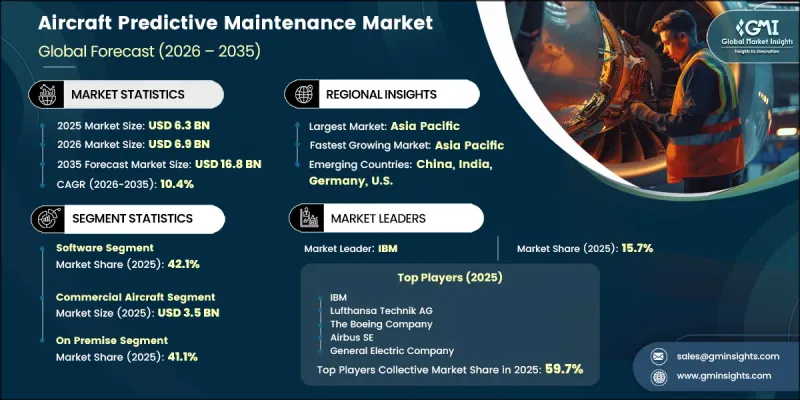
The growth is driven by increasing operational complexity, rising demand for efficiency, and the ongoing digital transformation of aircraft systems. Airlines and aviation stakeholders are placing greater emphasis on predictive maintenance to improve performance, reduce downtime, and optimize lifecycle management. Advancements in connected aircraft technologies, integrated monitoring systems, and enhanced onboard diagnostics are strengthening the adoption of proactive maintenance approaches. The increasing use of advanced analytics, combined with evolving safety standards and rising global air traffic, continues to support the expansion of predictive maintenance solutions across various aviation segments, reinforcing the long-term outlook of the aircraft predictive maintenance market.
| Market Scope | |
|---|---|
| Start Year | 2025 |
| Forecast Year | 2026-2035 |
| Start Value | $6.3 Billion |
| Forecast Value | $16.8 Billion |
| CAGR | 10.4% |
The aircraft predictive maintenance industry is gaining traction due to the continuous rise in air travel demand, which is intensifying the need for accurate and timely maintenance insights. Expanding aircraft fleets and tighter operational schedules are encouraging aviation operators to rely on advanced monitoring systems that can anticipate potential issues and improve efficiency. Additionally, regulatory frameworks are increasingly focusing on operational reliability and safety, promoting the adoption of data-driven maintenance systems that enhance monitoring capabilities and minimize technical risks across aviation operations.
The software segment accounted for 42.1% share in 2025. This segment's leadership is supported by the growing reliance on advanced digital platforms that enable real-time data processing, predictive analytics, and automated maintenance scheduling. The shift toward connected systems and digitally integrated workflows continues to reinforce the importance of software-driven solutions in predictive maintenance operations.
The commercial aircraft segment reached USD 3.5 billion in 2025, driven by the scale and operational intensity of global aviation fleets. The need to maintain high utilization rates and ensure consistent performance is encouraging operators to adopt predictive maintenance solutions that enhance scheduling efficiency and reduce operational disruptions. Strong adoption of advanced maintenance technologies within this segment continues to support its leading position.
North America Aircraft Predictive Maintenance Market accounted for 36.5% share in 2025, supported by rapid adoption of advanced aviation technologies and high levels of fleet connectivity. Market growth in the region is being fueled by increasing demand for operational efficiency, along with strong investment in digital aviation infrastructure. Aviation stakeholders are focusing on enhancing maintenance processes through predictive analytics, contributing to sustained market expansion across the region.
Key players in the Global Aircraft Predictive Maintenance Market include Microsoft Corporation, The Boeing Company, IBM, Airbus SE, Honeywell International Inc., Lufthansa Technik AG, General Electric Company, Thales Group, SAP SE, Safran Aircraft Engines, Rolls-Royce Holdings plc, Pratt & Whitney, Delta TechOps, Air France KLM Engineering & Maintenance, ST Engineering Aerospace, Swiss Aviation Software, CAMP Systems International Inc., Aviation Intertec Services Inc., Veryon, and Wingops. Companies operating in the aircraft predictive maintenance market are strengthening their competitive position through a combination of technological innovation, strategic alliances, and global expansion initiatives. They are focusing on developing advanced analytics platforms powered by artificial intelligence and machine learning to improve predictive accuracy and operational efficiency. Partnerships with aviation stakeholders are enabling companies to integrate their solutions across broader ecosystems and enhance service capabilities. Organizations are also expanding their presence in high-growth regions to capture emerging opportunities.
Table of Contents
Chapter 1 Methodology and Scope
- 1.1 Market scope and definition
- 1.2 Research design
- 1.2.1 Research approach
- 1.2.2 Data collection methods
- 1.3 Data mining sources
- 1.3.1 Global
- 1.3.2 Regional/Country
- 1.4 Base estimates and calculations
- 1.4.1 Base year calculation
- 1.4.2 Key trends for market estimation
- 1.5 Primary research and validation
- 1.5.1 Primary sources
- 1.6 Forecast model
- 1.7 Research assumptions and limitations
Chapter 2 Executive Summary
- 2.1 Industry 360° synopsis, 2022 - 2035
- 2.2 Key market trends
- 2.2.1 Component trends
- 2.2.2 Aircraft type trends
- 2.2.3 Deployment trends
- 2.2.4 Application trends
- 2.2.5 End-user trends
- 2.2.6 Regional trends
- 2.3 TAM Analysis, 2026-2035
- 2.4 CXO perspectives: Strategic imperatives
Chapter 3 Industry Insights
- 3.1 Industry ecosystem analysis
- 3.1.1 Supplier Landscape
- 3.1.2 Profit Margin
- 3.1.3 Cost structure
- 3.1.4 Value addition at each stage
- 3.1.5 Factor affecting the value chain
- 3.1.6 Disruptions
- 3.2 Industry impact forces
- 3.2.1 Growth drivers
- 3.2.1.1 Rising air traffic and fleet expansion
- 3.2.1.2 Expansion of connected aircraft and digital aviation infrastructure
- 3.2.1.3 Regulatory emphasis on safety, reliability, and maintenance transparency
- 3.2.1.4 Rising demand for real-time aircraft health monitoring
- 3.2.1.5 Growing adoption of AI, machine learning, and digital twins in aviation
- 3.2.2 Industry pitfalls and challenges
- 3.2.2.1 High integration cost of predictive maintenance systems
- 3.2.2.2 Limited availability of high-quality, standardized aircraft operational data
- 3.2.3 Market opportunities
- 3.2.3.1 Expansion of next-generation connected aircraft programs
- 3.2.3.2 Increasing adoption of digital-twin and simulation technology by airlines and OEMs
- 3.2.1 Growth drivers
- 3.3 Growth potential analysis
- 3.4 Regulatory landscape
- 3.4.1 North America
- 3.4.2 Europe
- 3.4.3 Asia Pacific
- 3.4.4 Latin America
- 3.4.5 Middle East & Africa
- 3.5 Porter's analysis
- 3.6 PESTEL analysis
- 3.7 Technology and Innovation landscape
- 3.7.1 Current technological trends
- 3.7.2 Emerging technologies
- 3.8 Price trends
- 3.8.1 By region
- 3.8.2 By product
- 3.9 Pricing Strategies
- 3.10 Emerging Business Models
- 3.11 Compliance Requirements
- 3.12 Patent and IP analysis
Chapter 4 Competitive Landscape, 2025
- 4.1 Introduction
- 4.2 Company market share analysis
- 4.2.1 By region
- 4.2.1.1 North America
- 4.2.1.2 Europe
- 4.2.1.3 Asia Pacific
- 4.2.1.4 Latin America
- 4.2.1.5 Middle East & Africa
- 4.2.2 Market concentration analysis
- 4.2.1 By region
- 4.3 Competitive benchmarking of key players
- 4.3.1 Financial performance comparison
- 4.3.1.1 Revenue
- 4.3.1.2 Profit margin
- 4.3.1.3 R&D
- 4.3.2 Product portfolio comparison
- 4.3.2.1 Product range breadth
- 4.3.2.2 Technology
- 4.3.2.3 Innovation
- 4.3.3 Geographic presence comparison
- 4.3.3.1 Global footprint analysis
- 4.3.3.2 Service network coverage
- 4.3.3.3 Market penetration by region
- 4.3.4 Competitive positioning matrix
- 4.3.4.1 Leaders
- 4.3.4.2 Challengers
- 4.3.4.3 Followers
- 4.3.4.4 Niche players
- 4.3.5 Strategic outlook matrix
- 4.3.1 Financial performance comparison
- 4.4 Key developments
- 4.4.1 Mergers and acquisitions
- 4.4.2 Partnerships and collaborations
- 4.4.3 Technological advancements
- 4.4.4 Expansion and investment strategies
- 4.4.5 Digital transformation initiatives
- 4.5 Emerging/ startup competitors landscape
Chapter 5 Market Estimates and Forecast, By Component, 2022 - 2035 (USD Million)
- 5.1 Key trends
- 5.2 Hardware
- 5.2.1 Edge Computing Devices
- 5.2.2 Sensors & IoT Devices
- 5.2.3 Flight Data Recorders & Health Monitoring Units
- 5.2.4 Connectivity modules
- 5.2.5 Others
- 5.3 Software
- 5.3.1 Predictive analytics software
- 5.3.2 Condition-based monitoring platforms
- 5.3.3 Digital Twin Solutions
- 5.3.4 Data Management & Integration Software
- 5.3.5 Others
- 5.4 Services
- 5.4.1 System Integration & Implementation
- 5.4.2 Consulting & Advisory Services
- 5.4.3 Training & Enablement
- 5.4.4 Support & Maintenance
- 5.4.5 Others
Chapter 6 Market Estimates and Forecast, By Aircraft Type, 2022 - 2035 (USD Million)
- 6.1 Key trends
- 6.2 Commercial Aircraft
- 6.2.1 Narrow-body aircraft
- 6.2.2 Wide-body aircraft
- 6.2.3 Regional jets
- 6.3 Military Aircraft
- 6.3.1 Fighter Jets & Combat Aircraft
- 6.3.2 Transport & Tanker Aircraft
- 6.3.3 Surveillance & Reconnaissance Aircraft
- 6.3.4 Others
- 6.4 Business Jets
- 6.5 Rotary-Wing Aircraft
Chapter 7 Market Estimates and Forecast, By Deployment, 2022 - 2035 (USD Million)
- 7.1 Key trends
- 7.2 On premise
- 7.3 Cloud
- 7.4 Hybrid
Chapter 8 Market Estimates and Forecast, By Application, 2022 - 2035 (USD Million)
- 8.1 Key trends
- 8.2 Engine Health Monitoring
- 8.2.1 Turbofan & Turbojet Engines
- 8.2.2 Turboprop Engines
- 8.2.3 Auxiliary Power Units (APU)
- 8.2.4 Others
- 8.3 Airframe Health Monitoring
- 8.3.1 Structural Integrity Monitoring
- 8.3.2 Environmental Control Systems
- 8.3.3 Hydraulic Systems
- 8.3.4 Others
- 8.4 Avionics & Systems Monitoring
- 8.4.1 Flight Control Systems
- 8.4.2 Navigation & Communication Systems
- 8.4.3 Cockpit Instrumentation
- 8.4.4 Others
- 8.5 Landing Gear Monitoring
- 8.5.1 Brakes & Wheels
- 8.5.2 Shock Absorbers & Actuation Systems
- 8.5.3 Others
- 8.6 Connectivity & Data Transmission Systems
- 8.7 Other
Chapter 9 Market Estimates and Forecast, By End-user, 2022 - 2035 (USD Million)
- 9.1 Key trends
- 9.2 Original Equipment Manufacturers (OEMs)
- 9.3 Airlines & Operators
- 9.4 MRO Service Providers
- 9.5 Lessors & Fleet Managers
Chapter 10 Market Estimates and Forecast, By Region, 2022 - 2035 (USD Million)
- 10.1 Key trends
- 10.2 North America
- 10.2.1 U.S.
- 10.2.2 Canada
- 10.3 Europe
- 10.3.1 Germany
- 10.3.2 UK
- 10.3.3 France
- 10.3.4 Spain
- 10.3.5 Italy
- 10.3.6 Russia
- 10.4 Asia Pacific
- 10.4.1 China
- 10.4.2 India
- 10.4.3 Japan
- 10.4.4 Australia
- 10.4.5 South Korea
- 10.5 Latin America
- 10.5.1 Brazil
- 10.5.2 Mexico
- 10.5.3 Argentina
- 10.6 Middle East and Africa
- 10.6.1 South Africa
- 10.6.2 Saudi Arabia
- 10.6.3 UAE
Chapter 11 Company Profiles
- 11.1 Global Key Players
- 11.1.1 IBM
- 11.1.2 Lufthansa Technik AG
- 11.1.3 The Boeing Company
- 11.1.4 Airbus SE
- 11.1.5 General Electric Company
- 11.2 Regional key players
- 11.2.1 North America
- 11.2.1.1 Honeywell International Inc.
- 11.2.1.2 Pratt & Whitney
- 11.2.1.3 Delta TechOps
- 11.2.1.4 Microsoft Corporation
- 11.2.1.5 CAMP Systems International Inc.
- 11.2.1.6 Aviation Intertec Services Inc.
- 11.2.1.7 Veryon
- 11.2.2 Asia Pacific
- 11.2.2.1 ST Engineering Aerospace
- 11.2.3 Europe
- 11.2.3.1 Thales Group
- 11.2.3.2 Safran Aircraft Engines
- 11.2.3.3 Air France KLM Engineering & Maintenance
- 11.2.3.4 Rolls-Royce Holdings plc
- 11.2.3.5 SAP SE
- 11.2.3.6 Swiss Aviation Software
- 11.2.3.7 Wingops
- 11.2.1 North America

