PUBLISHER: Global Market Insights Inc. | PRODUCT CODE: 2071212

PUBLISHER: Global Market Insights Inc. | PRODUCT CODE: 2071212
Asia Pacific Metalworking Machine Market Opportunity, Growth Drivers, Industry Trend Analysis, and Forecast 2026 - 2035
Asia Pacific Metalworking Machine Market was valued at USD 33.9 billion in 2025 and is estimated to grow at a CAGR of 5% to reach USD 56.6 billion by 2035.
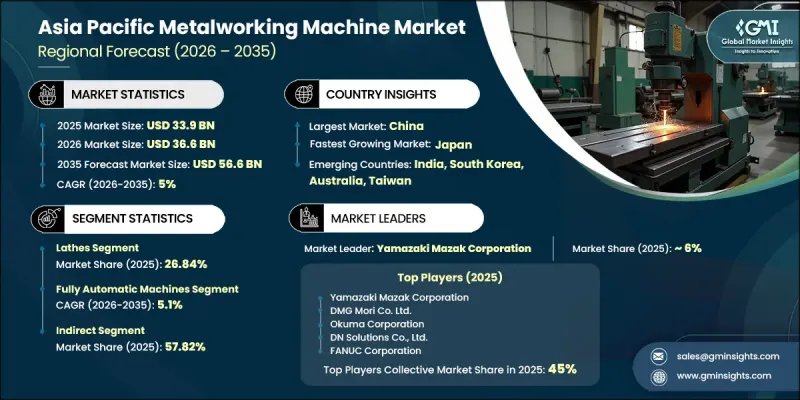
Growth is being supported by rising requirements for precision manufacturing, expanding electric vehicle production, and increasing investments in advanced industrial facilities. Manufacturers throughout the region are actively upgrading production capabilities through automation and digital manufacturing technologies to improve productivity, efficiency, and product quality. The transition toward smart manufacturing environments is encouraging the replacement of traditional machinery with semi-automated and fully automated CNC systems. Industrial modernization programs, increasing adoption of Industry 4.0 technologies, and supportive government manufacturing initiatives are further strengthening equipment procurement across regional markets. In addition, ongoing investments in new production facilities and advanced engineering operations continue to create favorable opportunities for metalworking machine manufacturers throughout Asia Pacific.
| Market Scope | |
|---|---|
| Start Year | 2025 |
| Forecast Year | 2026-2035 |
| Start Value | $33.9 Billion |
| Forecast Value | $56.6 Billion |
| CAGR | 5% |
The lathe segment held a 26.84% share in 2025, generating USD 9.1 billion. Lathes remain critical equipment for machining rotational components used across a broad range of manufacturing applications. Rising production requirements for precision-engineered components and increased demand for advanced turning solutions are contributing to sustained investments in both conventional and CNC-based lathe systems. The growing emphasis on production accuracy, operational efficiency, and high-volume manufacturing is expected to support continued segment growth throughout the forecast period.
The fully automatic machines segment accounted for 46.31% share in 2025. The strong market position of fully automated systems reflects years of continuous investment in manufacturing automation across the region. Companies are increasingly adopting advanced machining centers, automated production cells, and integrated fabrication systems to improve productivity, reduce labor dependency, and achieve higher manufacturing precision. The ongoing shift toward digitally connected production environments is expected to further accelerate demand for fully automatic metalworking equipment.
China Metalworking Machine Market held a 35.3% share in 2025. Growth is being driven by the country's ongoing transformation toward high-precision, technology-intensive manufacturing. Increasing investments in advanced production capabilities, modernization of industrial infrastructure, and widespread adoption of CNC technologies continue to strengthen equipment demand. The focus on improving manufacturing quality, operational efficiency, and global competitiveness is expected to support long-term expansion of the Chinese metalworking machine market.
Major companies operating in the Asia Pacific metalworking machine market include Yamazaki Mazak Corporation, Okuma Corporation, Tongtai Machine & Tool Co., Ltd., FANUC Corporation, Shibaura Machine Co., Ltd., Sodick Co., Ltd., Victor Taichung Machinery Works Co., Ltd., Makino Milling Machine Co., Ltd., DMG Mori Co. Ltd., JTEKT Corporation, Brother Industries, Ltd., Komatsu NTC Ltd., Nidec Machine Tool Corporation, DN Solutions Co., Ltd., Shenyang Machine Tool Co., Ltd., Hwacheon Machinery Co., Ltd., Genertec Dalian Machine Tool Co., Ltd. (DMTG), BFW Bharat Fritz Werner Ltd., AIDA Engineering, Ltd., Amada Holdings Co., Ltd., and YCM, Yeong Chin Machinery Industries Co., Ltd. Companies operating in the Asia Pacific metalworking machine market are focusing on product innovation, automation advancement, and digital manufacturing capabilities to strengthen their competitive position. Manufacturers are investing heavily in advanced CNC technologies, smart factory solutions, and Industry 4.0-compatible equipment to meet evolving customer requirements. Strategic partnerships with industrial automation providers, software developers, and manufacturing technology firms are helping companies expand their technological expertise and market reach. Businesses are also enhancing after-sales support, predictive maintenance services, and remote monitoring capabilities to improve customer retention. Capacity expansion initiatives, regional distribution network development, and investments in research and development remain key priorities.
Table of Contents
Chapter 1 Methodology and Scope
- 1.1 Research approach
- 1.2 Quality Commitments
- 1.2.1 GMI AI policy & data integrity commitment
- 1.2.1.1 Source consistency protocol
- 1.2.1 GMI AI policy & data integrity commitment
- 1.3 Research Trail & Confidence Scoring
- 1.3.1 Research Trail Components
- 1.3.2 Scoring Components
- 1.4 Data Collection
- 1.4.1 Partial list of primary sources
- 1.5 Data mining sources
- 1.5.1 Paid sources
- 1.5.1.1 Sources, by region
- 1.5.1 Paid sources
- 1.6 Base estimates and calculations
- 1.6.1 Base year calculation for any one approach
- 1.7 Forecast model
- 1.7.1 Quantified market impact analysis
- 1.7.1.1 Mathematical impact of growth parameters on forecast
- 1.7.1 Quantified market impact analysis
- 1.8 Research transparency addendum
- 1.8.1 Source attribution framework
- 1.8.2 Quality assurance metrics
- 1.8.3 Our commitment to trust
Chapter 2 Executive Summary
- 2.1 Industry 360° synopsis
- 2.2 Business trends
- 2.2.1 Product
- 2.2.2 Automation Level
- 2.2.3 Application
- 2.2.4 Material
- 2.2.5 Distribution Channel
Chapter 3 Industry Insights
- 3.1 Industry ecosystem analysis
- 3.1.1 Factor affecting the value chain
- 3.1.2 Profit margin analysis
- 3.1.3 Disruptions
- 3.1.4 Future outlook
- 3.1.5 Manufacturers
- 3.1.6 Distributors
- 3.2 Supplier landscape
- 3.3 Key news & initiatives
- 3.4 Technology & Innovation Landscape
- 3.5 Regulatory landscape
- 3.6 Impact on forces
- 3.6.1 Growth drivers
- 3.6.2 Industry pitfalls & challenges
- 3.6.3 Opportunities
- 3.7 Pricing analysis, 2025 (driven by primary research)
- 3.7.1 Historical price trend analysis (2022-2025)
- 3.7.2 Pricing strategy by player type (premium/value/cost-plus)
- 3.7.3 Regional price variation analysis
- 3.8 Growth potential analysis
- 3.9 Porter's analysis
- 3.10 PESTEL analysis
- 3.11 Trade data analysis (driven by paid database)
- 3.11.1 Import/export volume & value trends (Driven by Primary Research)
- 3.11.2 Key trade corridors & tariff impact (Driven by Primary Research)
- 3.12 Impact of AI & generative AI on the market
- 3.12.1 AI-driven disruption of existing business models
- 3.12.2 GenAI use cases & adoption roadmap by segment
- 3.12.3 Risks, limitations & regulatory considerations
- 3.13 Capacity & Production Landscape (Driven by Primary Research)
- 3.13.1 Installed Capacity by Region & Key Producer (Driven by Primary Research)
- 3.13.2 Capacity Utilization Rates & Expansion Pipelines (Driven by Primary Research)
Chapter 4 Competitive Landscape, 2025
- 4.1 Introduction
- 4.2 Company market share analysis
- 4.3 Company matrix analysis
- 4.4 Competitive analysis of major market players
- 4.5 Competitive positioning matrix
- 4.6 Key developments
- 4.6.1 Mergers & acquisitions
- 4.6.2 Partnerships & collaborations
- 4.6.3 New product launches
- 4.6.4 Expansion plans
Chapter 5 Market Estimates & Forecast, By Product, 2022-2035 (USD Billion) (Million Units)
- 5.1 Key trends
- 5.2 Lathes
- 5.3 Milling machines
- 5.4 Drilling machines
- 5.5 Boring machines
- 5.6 Others
Chapter 6 Market Estimates & Forecast, By Automation Level, 2022-2035 (USD Billion) (Million Units)
- 6.1 Key trends
- 6.2 Manual machines
- 6.3 Semi-automatic machines
- 6.4 Fully automatic machines
Chapter 7 Market Estimates & Forecast, By Application, 2022-2035 (USD Billion) (Million Units)
- 7.1 Key trends
- 7.2 Automotive
- 7.3 Aerospace and defense
- 7.4 Construction
- 7.5 Energy and power
- 7.6 Electronics
- 7.7 Industrial equipment
- 7.8 Medical devices
- 7.9 Consumer goods
- 7.10 Others
Chapter 8 Market Estimates & Forecast, By Material, 2022-2035 (USD Billion) (Million Units)
- 8.1 Key trends
- 8.2 Steel
- 8.3 Aluminum
- 8.4 Cast iron
- 8.5 Titanium
- 8.6 Other
Chapter 9 Market Estimates & Forecast, By Distribution Channel, 2022-2035 (USD Billion) (Million Units)
- 9.1 Key trends
- 9.2 Direct
- 9.3 Indirect
Chapter 10 Market Estimates and Forecast, By Country, 2022 - 2035 (USD Billion) (Million Units)
- 10.1 Key trends
- 10.2 China
- 10.3 Japan
- 10.4 India
- 10.5 South Korea
- 10.6 Australia
- 10.7 Taiwan
- 10.8 Singapore
- 10.9 Thailand
Chapter 11 Company Profiles
- 11.1 Tier 1 Global/Top PLAYERS
- 11.1.1 DMG Mori Co. Ltd.
- 11.1.2 Yamazaki Mazak Corporation
- 11.1.3 FANUC Corporation
- 11.1.4 Okuma Corporation
- 11.1.5 DN Solutions Co., Ltd.
- 11.1.6 Amada Holdings Co., Ltd.
- 11.1.7 Makino Milling Machine Co., Ltd.
- 11.2 Tier 2 REGIONAL/NICHE PLAYERS
- 11.2.1 Nidec Machine Tool Corporation
- 11.2.2 Shibaura Machine Co., Ltd.
- 11.2.3 JTEKT Corporation
- 11.2.4 Brother Industries Ltd.
- 11.2.5 Sodick Co., Ltd.
- 11.2.6 Komatsu NTC Ltd.
- 11.2.7 Hwacheon Machinery Co., Ltd.
- 11.2.8 Shenyang Machine Tool Co., Ltd.
- 11.3 Tier 3: Emerging players
- 11.3.1 AIDA Engineering Ltd.
- 11.3.2 Victor Taichung Machinery Works Co., Ltd.
- 11.3.3 YCM, Yeong Chin Machinery Industries Co., Ltd.
- 11.3.4 Tongtai Machine & Tool Co., Ltd.
- 11.3.5 BFW, Bharat Fritz Werner Ltd.
- 11.3.6 Genertec Dalian Machine Tool Co., Ltd. (DMTG)

