PUBLISHER: Global Market Insights Inc. | PRODUCT CODE: 2038313

PUBLISHER: Global Market Insights Inc. | PRODUCT CODE: 2038313
Smart Tire Software Market Opportunity, Growth Drivers, Industry Trend Analysis, and Forecast 2026 - 2035
The Global Smart Tire Software Market was valued at USD 19.2 billion in 2025 and is estimated to grow at a CAGR of 10.4% to reach USD 51.2 billion by 2035.
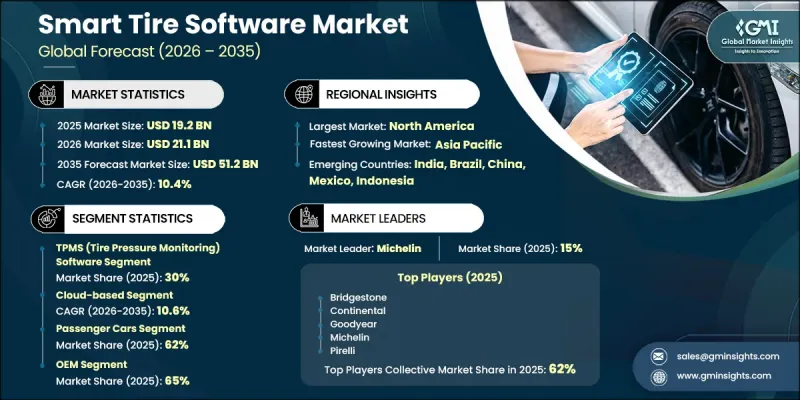
Rapid expansion in connected vehicle adoption is a factor accelerating market growth, as modern vehicles increasingly integrate sensors and telematics systems that continuously generate tire performance data. This shift is enabling real-time monitoring and software-driven insights that enhance vehicle efficiency and safety. Automotive manufacturers are embedding connectivity features as standard, which is widening the scope for smart tire software across both passenger and commercial vehicle segments. These platforms support predictive maintenance and operational optimization, allowing users to make data-informed decisions. As digital transformation continues across the automotive ecosystem, the integration of intelligent tire solutions is becoming essential. The growing reliance on data analytics, combined with the need for improved vehicle performance and safety, is reinforcing long-term demand for smart tire software solutions worldwide.
| Market Scope | |
|---|---|
| Start Year | 2025 |
| Forecast Year | 2026-2035 |
| Start Value | $19.2 Billion |
| Forecast Value | $51.2 Billion |
| CAGR | 10.4% |
Fleet operators and logistics providers are increasingly prioritizing operational efficiency by minimizing downtime, lowering fuel consumption, and reducing maintenance costs. Smart tire software enables these goals by offering real-time analytics, performance optimization, and predictive maintenance capabilities. The use of digital platforms for tire monitoring has become a critical component of fleet management strategies, helping operators improve delivery reliability and reduce unexpected disruptions. As transportation networks become more complex, data-driven decision-making plays a larger role in ensuring efficiency and cost control.
The TPMS segment accounted for 30% share in 2025 and is projected to grow at a CAGR of 10% from 2026 to 2035. This software continuously tracks tire pressure levels and provides alerts related to potential issues such as underinflation. It supports vehicle safety, ensures compliance with regulatory standards, and enhances fuel efficiency. In addition, TPMS serves as a foundational layer for more advanced analytics and connected vehicle functionalities, strengthening its importance within the broader smart tire ecosystem.
The cloud-based segment held a 64.8% share in 2025 and is expected to grow at a CAGR of 10.6% through 2035. These platforms rely on remote infrastructure to deliver scalable and flexible software capabilities, enabling access to real-time data across multiple locations. Cloud deployment reduces upfront investment requirements and simplifies system updates, making it an attractive option for organizations managing large fleets. Integration with telematics systems further enhances operational visibility and efficiency, contributing to widespread adoption.
U.S. Smart Tire Software Market generated USD 5.1 billion in 2025 and is anticipated to grow at a CAGR of 10.9% between 2026 and 2035. Increasing adoption of advanced tire monitoring systems is being driven by the need to improve fuel efficiency, reduce vehicle downtime, and meet stringent safety requirements. The expansion of logistics and e-commerce activities is also fueling demand for predictive maintenance technologies across long-haul transportation networks. Regulatory frameworks emphasizing safety standards and tire monitoring requirements are further encouraging large-scale deployment of smart tire software solutions.
Key companies operating in the Global Smart Tire Software Market include Bridgestone, Continental, Denso, Goodyear Tire & Rubber Company, Michelin, NIRA Dynamics, Nokian Tyres, Pirelli, Robert Bosch, Sensata Technologies, Valeo, and ZF Friedrichshafen. Companies in the smart tire software market are enhancing their competitive position through continuous innovation, strategic collaborations, and digital ecosystem expansion. Industry players are investing in advanced analytics, artificial intelligence, and cloud-based platforms to deliver more accurate and actionable insights. Partnerships with automotive manufacturers and fleet operators are helping companies integrate their solutions more effectively into connected vehicle systems. Many firms are also focusing on expanding their global footprint and strengthening distribution networks to reach a wider customer base.
Table of Contents
Chapter 1 Methodology
- 1.1 Research approach
- 1.2 Quality Commitments
- 1.2.1 GMI AI policy & data integrity commitment
- 1.2.1.1 Source consistency protocol
- 1.2.1 GMI AI policy & data integrity commitment
- 1.3 Research Trail & Confidence Scoring
- 1.3.1 Research Trail Components
- 1.3.2 Scoring Components
- 1.4 Data Collection
- 1.4.1 Partial list of primary sources
- 1.5 Data mining sources
- 1.5.1 Paid sources
- 1.5.1.1 Sources, by region
- 1.5.1 Paid sources
- 1.6 Base estimates and calculations
- 1.6.1 Base year calculation
- 1.7 Forecast model
- 1.7.1 Quantified market impact analysis
- 1.7.1.1 Mathematical impact of growth parameters on forecast
- 1.7.1 Quantified market impact analysis
- 1.8 Research transparency addendum
- 1.8.1 Source attribution framework
- 1.8.2 Quality assurance metrics
- 1.8.3 Our commitment to trust
Chapter 2 Executive Summary
- 2.1 Industry 360° synopsis
- 2.2 Key market trends
- 2.2.1 Regional
- 2.2.2 Software
- 2.2.3 Deployment mode
- 2.2.4 Vehicle
- 2.2.5 End use
- 2.3 TAM analysis, 2026-2035
- 2.4 CXO perspectives: Strategic imperatives
Chapter 3 Industry Insights
- 3.1 Industry ecosystem analysis
- 3.1.1 Supplier landscape
- 3.1.2 Profit margin
- 3.1.3 Cost structure
- 3.1.4 Value addition at each stage
- 3.1.5 Factor affecting the value chain
- 3.1.6 Disruptions
- 3.2 Industry impact forces
- 3.2.1 Growth drivers
- 3.2.1.1 Rising connected vehicle adoption globally
- 3.2.1.2 Increasing demand for fleet efficiency
- 3.2.1.3 Stringent vehicle safety regulations worldwide
- 3.2.1.4 Growth in predictive maintenance adoption
- 3.2.2 Industry pitfalls and challenges
- 3.2.2.1 High integration and implementation complexity
- 3.2.2.2 Data privacy and cybersecurity concerns
- 3.2.3 Market opportunities
- 3.2.3.1 Expansion of AI-driven tire analytics
- 3.2.3.2 Growth in SaaS-based business models
- 3.2.3.3 Increasing adoption in emerging markets
- 3.2.3.4 Integration with autonomous vehicle ecosystems
- 3.2.1 Growth drivers
- 3.3 Growth potential analysis
- 3.4 Technology and innovation landscape
- 3.4.1 Current technological trends
- 3.4.2 Emerging technologies
- 3.5 Regulatory landscape
- 3.5.1 North America
- 3.5.1.1 National Highway Traffic Safety Administration (NHTSA) - USA
- 3.5.1.2 Transport Canada
- 3.5.2 Europe
- 3.5.2.1 European Commission (EC)
- 3.5.2.2 European Automobile Manufacturers' Association (ACEA)
- 3.5.3 Asia Pacific
- 3.5.3.1 Ministry of Road Transport and Highways (India)
- 3.5.3.2 Ministry of Land, Infrastructure, Transport and Tourism (Japan)
- 3.5.4 Latin America
- 3.5.4.1 National Traffic Secretariat (SENATRAN, Brazil)
- 3.5.4.2 Ministry of Transport (Argentina)
- 3.5.5 Middle East & Africa
- 3.5.5.1 Ministry of Transport (UAE)
- 3.5.5.2 Saudi Standards, Metrology and Quality Organization (SASO)
- 3.5.1 North America
- 3.6 Porter's analysis
- 3.7 PESTEL analysis
- 3.8 Patent analysis (Driven by primary research)
- 3.9 Impact of AI & Generative AI on the Market
- 3.9.1 AI-driven disruption of existing business models
- 3.9.2 Gen AI use cases & adoption roadmap by segment
- 3.9.3 Risks, limitations & regulatory considerations
- 3.10 Sustainability and environmental aspects
- 3.10.1 Sustainable practices
- 3.10.2 Waste reduction strategies
- 3.10.3 Energy efficiency in production
- 3.10.4 Eco-friendly initiatives
- 3.10.5 Carbon footprint considerations
- 3.11 Forecast assumptions & scenario analysis (Driven by primary research)
- 3.11.1 Base Case - key macro & industry variables driving CAGR
- 3.11.2 Optimistic Scenarios - Favorable Macro and Industry Tailwinds
- 3.11.3 Pessimistic Scenario - Macroeconomic slowdown or industry headwinds
Chapter 4 Competitive Landscape, 2025
- 4.1 Introduction
- 4.2 Company market share analysis
- 4.2.1 North America
- 4.2.2 Europe
- 4.2.3 Asia Pacific
- 4.2.4 LATAM
- 4.2.5 MEA
- 4.3 Competitive analysis of major market players
- 4.4 Competitive positioning matrix
- 4.5 Key developments
- 4.5.1 Mergers & acquisitions
- 4.5.2 Partnerships & collaborations
- 4.5.3 New product launches
- 4.5.4 Expansion plans and funding
Chapter 5 Market Estimates & Forecast, By Software, 2022 - 2035 ($Mn)
- 5.1 Key trends
- 5.2 TPMS (Tire Pressure Monitoring) software
- 5.3 Tire performance analytics & optimization software
- 5.4 Predictive maintenance software
- 5.5 Fleet tire management software
- 5.6 Load & weight distribution monitoring software
- 5.7 Tread depth monitoring software
- 5.8 Temperature monitoring software
- 5.9 Real-time tire health dashboard software
Chapter 6 Market Estimates & Forecast, By Deployment mode, 2022 - 2035 ($Mn)
- 6.1 Key trends
- 6.2 Cloud-based
- 6.3 On premises
- 6.4 Hybrid
Chapter 7 Market Estimates & Forecast, By Vehicle, 2022 - 2035 ($Mn)
- 7.1 Key trends
- 7.2 Passenger cars
- 7.2.1 Hatchback
- 7.2.2 SUV
- 7.2.3 Sedan
- 7.3 Commercial vehicles
- 7.3.1 LCV
- 7.3.2 MCV
- 7.3.3 HCV
Chapter 8 Market Estimates & Forecast, By End use, 2022 - 2035 ($Mn)
- 8.1 Key trends
- 8.2 OEM
- 8.2.1 Automotive manufacturers
- 8.2.2 Embedded / factory-installed tire software systems
- 8.3 Aftermarket
- 8.3.1 Fleet operators
- 8.3.2 Tire retailers & service centers
- 8.3.3 Individual vehicle owners
Chapter 9 Market Estimates & Forecast, By Region, 2022 - 2035 ($Mn)
- 9.1 Key trends
- 9.2 North America
- 9.2.1 U.S.
- 9.2.2 Canada
- 9.3 Europe
- 9.3.1 Germany
- 9.3.2 UK
- 9.3.3 France
- 9.3.4 Italy
- 9.3.5 Spain
- 9.3.6 Nordics
- 9.3.7 Russia
- 9.3.8 Poland
- 9.3.9 Romania
- 9.4 Asia Pacific
- 9.4.1 China
- 9.4.2 India
- 9.4.3 Japan
- 9.4.4 South Korea
- 9.4.5 ANZ
- 9.4.6 Vietnam
- 9.4.7 Indonesia
- 9.4.8 Philippines
- 9.5 Latin America
- 9.5.1 Brazil
- 9.5.2 Mexico
- 9.5.3 Argentina
- 9.6 MEA
- 9.6.1 South Africa
- 9.6.2 Saudi Arabia
- 9.6.3 UAE
Chapter 10 Company Profiles
- 10.1 Global players
- 10.1.1 Bridgestone
- 10.1.2 Continental
- 10.1.3 Denso
- 10.1.4 Goodyear Tire & Rubber Company
- 10.1.5 Michelin
- 10.1.6 Pirelli
- 10.1.7 Robert Bosch
- 10.1.8 Sensata Technologies
- 10.1.9 ZF Friedrichshafen
- 10.2 Regional players
- 10.2.1 Alps Alpine
- 10.2.2 Hankook Tire & Technology
- 10.2.3 Huf Hulsbeck & Furst
- 10.2.4 NIRA Dynamics
- 10.2.5 Nokian Tyres
- 10.2.6 Pacific Industrial
- 10.2.7 STMicroelectronics
- 10.2.8 Sumitomo Rubber Industries
- 10.2.9 Yokohama Rubber Company
- 10.3 Emerging players
- 10.3.1 Dextera
- 10.3.2 Revvo Technologies
- 10.3.3 Tactile Mobility
- 10.3.4 Tyrata

