PUBLISHER: Global Market Insights Inc. | PRODUCT CODE: 2038326

PUBLISHER: Global Market Insights Inc. | PRODUCT CODE: 2038326
Asia Pacific Cut Flowers Market Opportunity, Growth Drivers, Industry Trend Analysis, and Forecast 2026 - 2035
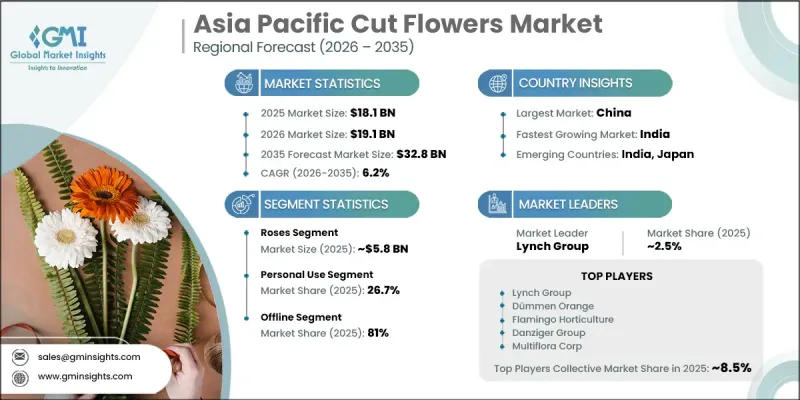
Asia Pacific Cut Flowers Market was valued at USD 18.1 billion in 2025 and is estimated to grow at a CAGR of 6.2% to reach USD 32.8 billion by 2035.
Market growth is fueled by the deep-rooted cultural importance of flowers across the region, where they play a central role in ceremonies, celebrations, and social traditions. Increasing consumer inclination toward aesthetically appealing floral arrangements is contributing to steady demand for fresh-cut flowers. Rising disposable income levels and urban expansion are also encouraging higher spending on decorative and ornamental products, including floral displays. The market is benefiting from improved accessibility through well-established distribution networks spanning both retail and wholesale channels. At the production level, advancements in floriculture practices, greenhouse cultivation, and controlled-environment farming are enabling growers to enhance yield quality and consistency. Technology integration is further optimizing output per unit area, ensuring a more reliable supply chain. The combined effect of cultural relevance, evolving consumer preferences, and agricultural innovation continues to support the sustained expansion of the Asia Pacific cut flowers industry.
| Market Scope | |
|---|---|
| Start Year | 2025 |
| Forecast Year | 2026-2035 |
| Start Value | $18.1 Billion |
| Forecast Value | $32.8 Billion |
| CAGR | 6.2% |
The roses segment generated USD 5.8 billion in 2025 and is forecast to grow at a CAGR of 5.6% between 2026 and 2035 owing to its widespread appeal, commercial significance, and consistent demand across diverse applications. Roses are highly valued for their visual attractiveness and symbolic associations, making them a preferred choice across various consumer segments. Their availability in numerous varieties, colors, and forms enables suppliers to cater to a broad spectrum of preferences. Additionally, well-established cultivation methods and efficient supply networks contribute to stable production levels and dependable market availability, reinforcing the segment's continued prominence.
The personal use segment held a 26.7% share in 2025 and is anticipated to grow at a CAGR of 5.1% through 2035. This segment leads the market due to frequent individual purchases driven by gifting practices, decorative needs, and emotional expression. Growing urbanization and higher disposable incomes are encouraging consumers to incorporate fresh flowers into their daily lifestyles. Changing social patterns and increasing emphasis on personal aesthetics are further driving demand. The consistent buying behavior and strong emotional connection associated with floral products continue to support the segment's leading market position.
China Cut Flowers Market accounted for USD 8.7 billion in 2025 and is expected to grow at a CAGR of 6.8% from 2026 to 2035, making it the dominant market within the Asia Pacific region. Growth in China is supported by rapid economic development, increasing urban populations, and strong consumer demand for decorative products. The market is also benefiting from the expansion of digital sales platforms and modern retail channels, which are enhancing product accessibility and enabling customized purchasing experiences. Continuous improvements in logistics and distribution infrastructure are further strengthening market growth and ensuring efficient delivery systems.
Key participants operating in the Asia Pacific Cut Flowers Market include Alexandra Farms, Danziger Group, AQ Roses, Dos Gringos, Dummen Orange, Elite Flower, Esmeralda Farms, Flamingo Horticulture, Karen Roses Ltd., Lynch Group, Marginpar Group, Multiflora Corp, Oserian Development, Red Lands Roses, Rosaprima, Shalimar, and Sher Ethiopia. Companies in the Asia Pacific Cut Flowers Market are adopting a combination of innovation, supply chain optimization, and market expansion strategies to strengthen their competitive position. Businesses are investing in advanced cultivation techniques, including greenhouse farming and climate-controlled production, to enhance yield quality and consistency. Strategic partnerships with distributors and retailers are helping improve market reach and ensure efficient product availability. Many firms are also focusing on product diversification by introducing new flower varieties and customized floral solutions to meet evolving consumer preferences. Digital platforms and e-commerce channels are being leveraged to streamline sales and improve customer engagement.
Table of Contents
Chapter 1 Methodology & Scope
- 1.1 Market scope and definition
- 1.2 Research design
- 1.2.1 Research approach
- 1.2.2 Data collection methods
- 1.3 Data mining sources
- 1.3.1 Global
- 1.3.2 Country
- 1.4 Base estimates and calculations
- 1.4.1 Base year calculation
- 1.4.2 Key trends for market estimation
- 1.5 Primary research and validation
- 1.5.1 Primary sources
- 1.6 Forecast model
- 1.7 Research assumptions and limitations
Chapter 2 Executive Summary
- 2.1 Industry 360° synopsis
- 2.2 Key market trends
- 2.2.1 Country
- 2.2.2 Flower Type
- 2.2.3 Cultivation Method
- 2.2.4 Application
- 2.2.5 Distribution channel
Chapter 3 Industry Insights
- 3.1 Industry ecosystem analysis
- 3.1.1 Supplier landscape
- 3.1.2 Profit margin
- 3.1.3 Value addition at each stage
- 3.1.4 Factor affecting the value chain
- 3.2 Industry impact forces
- 3.2.1 Growth drivers
- 3.2.1.1 Rising demand for floral decorations in weddings, events, and celebrations
- 3.2.1.2 Expansion of the hospitality, retail, and corporate gifting sectors
- 3.2.1.3 Rising disposable income and changing lifestyle trends
- 3.2.2 Pitfalls & Challenges
- 3.2.2.1 Perishable nature of cut flowers leading to high wastage
- 3.2.2.2 Seasonal availability and dependence on climatic conditions
- 3.2.3 Opportunities
- 3.2.3.1 Rising demand for exotic and rare flower varieties
- 3.2.3.2 Expansion of corporate gifting and subscription-based floral services
- 3.2.1 Growth drivers
- 3.3 Growth potential analysis
- 3.4 Future market trends
- 3.5 Technology and innovation landscape
- 3.5.1 Current technological trends
- 3.5.2 Emerging technologies
- 3.6 Regulatory landscape
- 3.6.1 Standards and compliance requirements
- 3.6.2 Regional regulatory frameworks
- 3.6.3 Certification standards
- 3.7 Porter's analysis
- 3.8 PESTEL analysis
- 3.9 Pricing analysis (driven by primary research)
- 3.9.1 Historical price trend analysis (driven by primary research)
- 3.9.2 Pricing strategy by player type (premium / value / cost-plus) (driven by primary research)
- 3.10 Trade data analysis (driven by paid database)
- 3.10.1 Import/export volume and value trends (driven by paid database)
- 3.10.2 Key trade corridors and tariff impact (driven by paid database)
- 3.11 Distribution infrastructure and channel penetration landscape (driven by primary research)
- 3.11.1 Channel coverage by region and format (modern vs. traditional trade) (driven by primary research)
- 3.11.2 Last-mile infrastructure gaps and emerging channel shifts (driven by primary research)
Chapter 4 Competitive Landscape, 2025
- 4.1 Introduction
- 4.2 Company market share analysis
- 4.2.1 By Country
- 4.2.1.1 China
- 4.2.1.2 Japan
- 4.2.1.3 India
- 4.2.1.4 South Korea
- 4.2.1.5 Australia
- 4.2.1 By Country
- 4.3 Company matrix analysis
- 4.4 Competitive analysis of major market players
- 4.5 Competitive positioning matrix
- 4.6 Key developments
- 4.6.1 Mergers & acquisitions
- 4.6.2 Partnerships & collaborations
- 4.6.3 New product launches
- 4.6.4 Expansion plans
Chapter 5 Market Estimates & Forecast, By Flower Type, 2022 - 2035, (USD Billion) (Thousand Units)
- 5.1 Key trends
- 5.2 Roses
- 5.3 Carnations
- 5.4 Chrysanthemums
- 5.5 Tulips
- 5.6 Lilies
- 5.7 Orchids
- 5.8 Others
Chapter 6 Market Estimates & Forecast, By Cultivation Method, 2022 - 2035, (USD Billion) (Thousand Units)
- 6.1 Key trends
- 6.2 Conventional
- 6.3 Organic
Chapter 7 Market Estimates & Forecast, By Application, 2022 - 2035, (USD Billion) (Thousand Units)
- 7.1 Key trends
- 7.2 Personal Use
- 7.3 Parties & Special Days
- 7.4 Wedding & Mega Events
- 7.5 Conference & Activities
- 7.6 Others
Chapter 8 Market Estimates & Forecast, By Distribution Channel, 2022 - 2035, (USD Billion) (Thousand Units)
- 8.1 Key trends
- 8.2 Online
- 8.3 Offline
- 8.3.1 Florists
- 8.3.2 Supermarkets
- 8.3.3 Others
Chapter 9 Market Estimates & Forecast, By Region, 2022 - 2035, (USD Billion) (Thousand Units)
- 9.1 Key trends
- 9.2 Asia Pacific
- 9.2.1 China
- 9.2.2 India
- 9.2.3 Japan
- 9.2.4 South Korea
- 9.2.5 Australia
Chapter 10 Company Profiles
- 10.1 Alexandra Farms
- 10.2 AQ Roses
- 10.3 Danziger Group
- 10.4 Dos Gringos
- 10.5 Dummen Orange
- 10.6 Elite Flower
- 10.7 Esmeralda Farms
- 10.8 Flamingo Horticulture
- 10.9 Karen Roses Ltd.
- 10.10 Lynch Group
- 10.11 Marginpar Group
- 10.12 Multiflora Corp
- 10.13 Oserian Development
- 10.14 Red Lands Roses
- 10.15 Rosaprima
- 10.16 Shalimar
- 10.17 Sher Ethiopia

