PUBLISHER: Global Market Insights Inc. | PRODUCT CODE: 2038789

PUBLISHER: Global Market Insights Inc. | PRODUCT CODE: 2038789
Cut Flowers Market Opportunity, Growth Drivers, Industry Trend Analysis, and Forecast 2026 - 2035
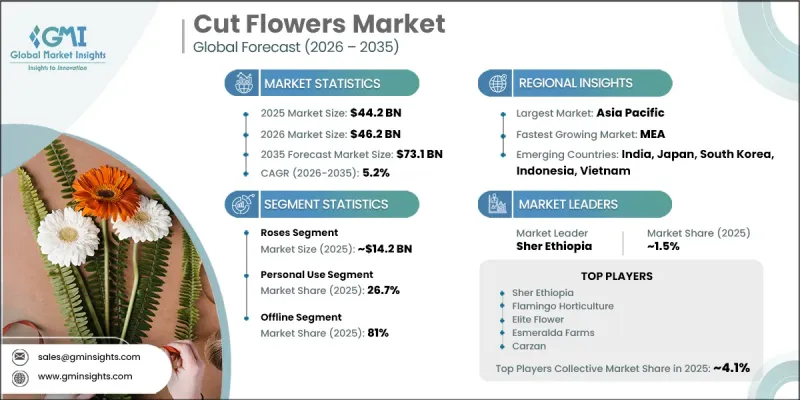
The Global Cut Flowers Market was valued at USD 44.2 billion in 2025 and is estimated to grow at a CAGR of 5.2% to reach USD 73.1 billion by 2035.
The market is gaining momentum as fresh flowers continue to play a central role in social, cultural, and commercial events across global regions. Rising demand for floral decoration in weddings, corporate gatherings, and private celebrations is significantly strengthening market growth. Cut flowers are widely used for decorative arrangements such as centerpieces, bouquets, and venue styling, where visual appeal and freshness are key purchase drivers. Consumers increasingly prefer seasonal and exotic flower varieties, which has encouraged customized floral designs and premium offerings across the supply chain. Retailers and online floral platforms are expanding their assortments to meet rising expectations for convenience, variety, and same-day delivery services. Increasing disposable income and the growing preference for experience-based celebrations are also contributing to higher purchase frequency. In addition, the hospitality, retail, and corporate gifting sectors are reinforcing demand, as hotels, restaurants, and event venues consistently integrate floral aesthetics into their environments to enhance customer experience and ambiance.
| Market Scope | |
|---|---|
| Start Year | 2025 |
| Forecast Year | 2026-2035 |
| Start Value | $44.2 Billion |
| Forecast Value | $ 73.1 Billion |
| CAGR | 5.2% |
The roses category generated USD 14.2 billion in 2025 and is projected to grow at a CAGR of 4.7% from 2026 to 2035. Roses continue to lead the cut flowers market due to their universal appeal, high availability, and strong cultural and emotional significance across regions. They remain a preferred choice for gifting, ceremonial arrangements, weddings, and corporate decor, reinforcing their commercial importance. The availability of roses in diverse colors, sizes, and hybrid forms allows suppliers to meet varied consumer preferences across different markets. Established cultivation systems and efficient international supply chains ensure consistent production, smooth distribution, and year-round availability. Their strong symbolic value, premium perception, and rapid turnover across multiple occasions further strengthen their dominant position in the global cut flowers landscape.
The offline distribution channel held an 81% share in 2025 and is projected to grow at a CAGR of 4.6% from 2026 to 2035. Offline sales remain dominant because consumers prioritize freshness, fragrance, and visual inspection before purchase. Traditional florists, local flower shops, and specialized retail outlets provide customers with the ability to evaluate quality directly and select personalized arrangements. These channels also support instant purchase fulfillment, making them essential for urgent and event-driven demand. Physical stores enable customized bouquet creation and immediate delivery for last-minute requirements, which strengthens customer satisfaction. Well-established retail networks and local vendor systems ensure wide accessibility across both urban and semi-urban regions, reinforcing the continued dominance of offline flower purchasing channels.
China Cut Flowers Market captured USD 6.2 billion in 2025 and is forecasted to grow at a CAGR of 6.3% through 2035. The market in China is expanding due to rising urban lifestyles, increasing disposable income levels, and the growing integration of flowers into everyday gifting and decoration practices. Floral usage has extended beyond traditional festivals into daily lifestyle and commercial applications, including weddings, corporate events, and home decoration. Major urban centers act as key consumption hubs, supported by advanced logistics and cold chain systems that ensure product freshness and timely distribution. Strong domestic production, especially from key growing regions, supports a large-scale supply of roses, lilies, chrysanthemums, and carnations, strengthening China's position in the regional market.
Major players operating in the Cut Flowers Industry include Alexandra Farms, AQ Roses, Marginpar Group (Carzan Flowers), Danziger Group, Dos Gringos, Elite Flower, Esmeralda Farms, Flamingo Horticulture, Karen Roses Ltd., Multiflora Corp, Oserian Development Company, Red Lands Roses, Rosaprima, Shalimar Fresh, and Sher Ethiopia. Key companies in the Cut Flowers Market are focusing on strengthening their supply chain efficiency through cold chain expansion and advanced logistics to maintain freshness during long-distance transportation. They are investing in greenhouse cultivation, breeding technologies, and high-yield flower varieties to ensure consistent production throughout the year. Digital sales channels and e-commerce partnerships are being expanded to improve customer reach and enable faster order fulfillment. Many players are also emphasizing product differentiation through premium floral designs, exotic varieties, and customized arrangements for weddings and corporate events. Sustainability practices, including water-efficient farming and eco-friendly packaging, are increasingly adopted to meet environmental expectations. Strategic collaborations with retailers, hospitality chains, and event management firms are also helping companies strengthen market penetration and build long-term demand stability.
Table of Contents
Chapter 1 Methodology & Scope
- 1.1 Market scope and definition
- 1.2 Research design
- 1.2.1 Research approach
- 1.2.2 Data collection methods
- 1.3 Data mining sources
- 1.3.1 Global
- 1.3.2 Regional/Country
- 1.4 Base estimates and calculations
- 1.4.1 Base year calculation
- 1.4.2 Key trends for market estimation
- 1.5 Primary research and validation
- 1.5.1 Primary sources
- 1.6 Forecast model
- 1.7 Research assumptions and limitations
Chapter 2 Executive Summary
- 2.1 Industry 360° synopsis
- 2.2 Key market trends
- 2.2.1 Regional
- 2.2.2 Flower Type
- 2.2.3 Cultivation Method
- 2.2.4 Application
- 2.2.5 Distribution channel
Chapter 3 Industry Insights
- 3.1 Industry ecosystem analysis
- 3.1.1 Supplier landscape
- 3.1.2 Profit margin
- 3.1.3 Value addition at each stage
- 3.1.4 Factor affecting the value chain
- 3.2 Industry impact forces
- 3.2.1 Growth drivers
- 3.2.1.1 Rising demand for floral decorations in weddings, events, and celebrations
- 3.2.1.2 Expansion of the hospitality, retail, and corporate gifting sectors
- 3.2.1.3 Rising disposable income and changing lifestyle trends
- 3.2.2 Pitfalls & Challenges
- 3.2.2.1 Perishable nature of cut flowers leading to high wastage
- 3.2.2.2 Seasonal availability and dependence on climatic conditions
- 3.2.3 Opportunities
- 3.2.3.1 Rising demand for exotic and rare flower varieties
- 3.2.3.2 Expansion of corporate gifting and subscription-based floral services
- 3.2.1 Growth drivers
- 3.3 Growth potential analysis
- 3.4 Future market trends
- 3.5 Technology and innovation landscape
- 3.5.1 Current technological trends
- 3.5.2 Emerging technologies
- 3.6 Regulatory landscape
- 3.6.1 Standards and compliance requirements
- 3.6.2 Regional regulatory frameworks
- 3.6.3 Certification standards
- 3.7 Porter's analysis
- 3.8 PESTEL analysis
- 3.9 Pricing Analysis (Driven by Primary Research)
- 3.9.1 Historical Price Trend Analysis (Driven by Primary Research)
- 3.9.2 Pricing Strategy by Player Type (Premium / Value / Cost-Plus) (Driven by Primary Research)
- 3.10 Trade Data Analysis (Driven by Primary Research)
- 3.10.1 Import/Export Volume & Value Trends (Driven by Primary Research)
- 3.10.2 Key Trade Corridors & Tariff Impact (Driven by Primary Research)
- 3.11 Distribution Infrastructure & Channel Penetration Landscape (Driven by Primary Research)
- 3.11.1 Channel Coverage by Region & Format (Modern vs. Traditional Trade) (Driven by Primary Research)
- 3.11.2 Last-Mile Infrastructure Gaps & Emerging Channel Shifts (Driven by Primary Research)
Chapter 4 Competitive Landscape, 2025
- 4.1 Introduction
- 4.2 Company market share analysis
- 4.2.1 By Region
- 4.2.1.1 North America
- 4.2.1.2 Europe
- 4.2.1.3 Asia Pacific
- 4.2.1.4 Latin America
- 4.2.1.5 Middle East & Africa
- 4.2.1 By Region
- 4.3 Company matrix analysis
- 4.4 Competitive analysis of major market players
- 4.5 Competitive positioning matrix
- 4.6 Key developments
- 4.6.1 Mergers & acquisitions
- 4.6.2 Partnerships & collaborations
- 4.6.3 New product launches
- 4.6.4 Expansion plans
Chapter 5 Market Estimates & Forecast, By Flower Type, 2022 - 2035, (USD Billion) (Thousand Units)
- 5.1 Key trends
- 5.2 Roses
- 5.3 Carnations
- 5.4 Chrysanthemums
- 5.5 Tulips
- 5.6 Lilies
- 5.7 Orchids
- 5.8 Others
Chapter 6 Market Estimates & Forecast, By Cultivation Method, 2022 - 2035, (USD Billion) (Thousand Units)
- 6.1 Key trends
- 6.2 Conventional
- 6.3 Organic
Chapter 7 Market Estimates & Forecast, By Application, 2022 - 2035, (USD Billion) (Thousand Units)
- 7.1 Key trends
- 7.2 Personal Use
- 7.3 Parties & Special Days
- 7.4 Wedding & Mega Events
- 7.5 Conference & Activities
- 7.6 Others
Chapter 8 Market Estimates & Forecast, By Distribution Channel, 2022 - 2035, (USD Billion) (Thousand Units)
- 8.1 Key trends
- 8.2 Online
- 8.3 Offline
- 8.3.1 Florists
- 8.3.2 Supermarkets
- 8.3.3 Others
Chapter 9 Market Estimates & Forecast, By Region, 2022 - 2035, (USD Billion) (Thousand Units)
- 9.1 Key trends
- 9.2 North America
- 9.2.1 U.S.
- 9.2.2 Canada
- 9.3 Europe
- 9.3.1 Germany
- 9.3.2 UK
- 9.3.3 France
- 9.3.4 Italy
- 9.3.5 Spain
- 9.4 Asia Pacific
- 9.4.1 China
- 9.4.2 India
- 9.4.3 Japan
- 9.4.4 South Korea
- 9.4.5 Australia
- 9.5 Latin America
- 9.5.1 Brazil
- 9.5.2 Mexico
- 9.5.3 Argentina
- 9.6 MEA
- 9.6.1 Saudi Arabia
- 9.6.2 UAE
- 9.6.3 South Africa
Chapter 10 Company Profiles
- 10.1 Marginpar Group (Carzan Flowers)
- 10.2 Danziger Group
- 10.3 Esmeralda Farms
- 10.4 Flamingo Horticulture
- 10.5 Karen Roses Ltd.
- 10.6 Multiflora Corp
- 10.7 Dos Gringos
- 10.8 Oserian Development Company
- 10.9 Sher Ethiopia
- 10.10 Red Lands Roses
- 10.11 Alexandra Farms
- 10.12 Rosaprima
- 10.13 Elite Flower
- 10.14 Shalimar Fresh / East African Growers
- 10.15 AQ Roses

