
PUBLISHER: Global Market Insights Inc. | PRODUCT CODE: 2038362

PUBLISHER: Global Market Insights Inc. | PRODUCT CODE: 2038362
Single Axis Solar Tracker Market Opportunity, Growth Drivers, Industry Trend Analysis, and Forecast 2026 - 2035
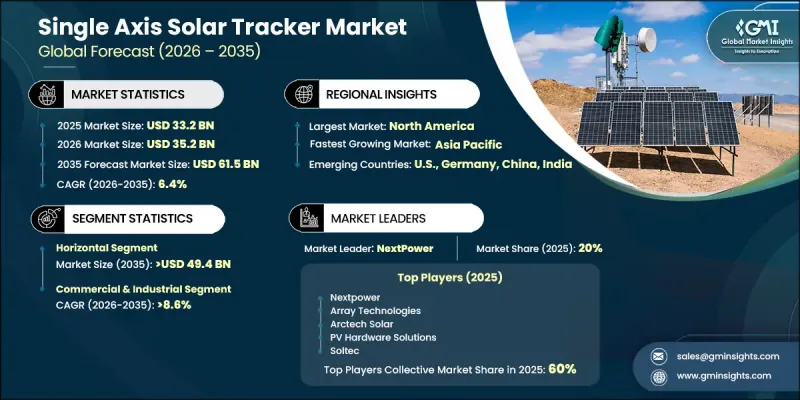
The Global Single Axis Solar Tracker Market was valued at USD 33.2 billion in 2025 and is estimated to grow at a CAGR of 6.4% to reach USD 61.5 billion by 2035.
The industry is gaining momentum as the global energy sector continues transitioning toward more efficient and cost-effective solar power solutions. Developers increasingly prioritize technologies that improve energy yield, positioning single axis trackers as a widely adopted solution across utility-scale and distributed installations. Continuous advancements in structural engineering, control systems, and material science are enhancing system performance while improving durability in harsh environmental conditions. These improvements strengthen operational reliability and increase investor confidence in long-term project performance, thereby accelerating adoption. The push to reduce the levelized cost of electricity further supports deployment, as single axis trackers significantly enhance daily solar energy capture compared to fixed-tilt systems. Supportive policy frameworks continue to influence market expansion by encouraging large-scale solar developments where tracking systems provide clear efficiency gains. Growing demand for adaptable solar infrastructure across diverse terrains and climates is also fueling uptake, while flexible tracker configurations allow manufacturers to differentiate offerings and expand global penetration.
| Market Scope | |
|---|---|
| Start Year | 2025 |
| Forecast Year | 2026-2035 |
| Start Value | $33.2 Billion |
| Forecast Value | $61.5 Billion |
| CAGR | 6.4% |
Horizontal single-axis trackers are expected to reach USD 49.4 billion by 2035, supported by strong demand across utility-scale solar projects where higher energy output compared to fixed-tilt systems makes them a preferred choice, particularly in regions with high direct normal irradiation. The segment continues to shape the competitive landscape as project developers prioritize performance optimization and long-term yield improvements. Ongoing retrofitting activities and continuous upgrades in tracker architecture are improving structural strength and extending system lifespan. Enhanced durability combined with digital monitoring capabilities is also improving operational reliability while reducing maintenance and operating expenditures. These advancements are strengthening the overall industry outlook and encouraging broader deployment across diverse solar installations.
The commercial and industrial applications is projected to grow at a CAGR of 8.6% through 2035, driven by rising energy costs and the growing corporate shift toward onsite renewable power generation. Businesses are increasingly adopting solar systems to lower operational expenses while meeting long-term sustainability objectives, which is boosting demand for tracker-enabled installations that maximize energy output from limited rooftop and ground-mounted spaces. Advancements in tracker design, simplified installation methods, and improved system reliability are accelerating adoption across commercial projects. As regulatory pressure intensifies and clean energy commitments strengthen, the C&I segment is expected to remain a key adopter of single axis tracking technology, supporting sustained industry growth.
United States Single Axis Solar Tracker Market is projected to reach USD 6 billion by 2035, supported by rapid expansion of utility-scale solar installations and increasing demand for technologies that maximize energy generation. Solar developers are focusing on enhancing plant performance across new project developments, contributing to a broader shift toward large-scale, high-efficiency solar farms. Supportive federal incentives and expanding domestic manufacturing capacity are further accelerating adoption. Continuous improvements in tracker durability, automation, and installation techniques are making systems more cost-efficient and reinforcing their importance in the country's long-term solar growth trajectory. Favorable policy measures aimed at improving operational efficiency and reducing manufacturing costs are expected to further strengthen market expansion over the coming years.
Prominent companies operating in the Single Axis Solar Tracker Market include Array Technologies, Arctech, GameChange Solar, Soltec, Valmont Solar, OMCO Corporation, Trinasolar, Clenergy, MECASOLAR, Pv hardware, ANTAI Solar, Arcelor Mittal, DEGERENERGIE GMBH & CO. KG, EcoFlow, Greentech Renewables, Huge Energy, IDEEMATIC, KSI Holding, Nextpower Inc., Sun Action Trackers, and Targray. Companies operating in the Single Axis Solar Tracker Industry are focusing on multiple strategic initiatives to strengthen their market position. A key approach involves continuous product innovation, structural designs, tracking algorithms, and materials that improve durability and efficiency. Manufacturers are prioritizing cost optimization through streamlined production processes and supply chain integration to remain competitive. Strategic partnerships with EPC contractors, project developers, and solar module suppliers are expanding market reach and accelerating project deployment. Geographic expansion into emerging solar markets, along with localized manufacturing, is enhancing responsiveness to regional demand.
Table of Contents
Chapter 1 Methodology & Scope
- 1.1 Research design
- 1.2 Quality commitment
- 1.2.1 GMI AI policy & data integrity commitment
- 1.2.1.1 Source consistency protocol
- 1.2.1 GMI AI policy & data integrity commitment
- 1.3 Research trail & Confidence Scoring
- 1.3.1 Research trail components
- 1.3.2 Scoring components
- 1.4 Data Collection
- 1.4.1 Partial list of primary sources
- 1.5 Data mining sources
- 1.5.1 Paid sources
- 1.5.1.1 Sources, by region
- 1.5.1 Paid sources
- 1.6 Base estimates and calculations
- 1.6.1 Base year calculation for any one approach
- 1.7 Forecast model
- 1.8 Research transparency addendum
- 1.8.1 Source attribution framework
- 1.8.2 Quality assurance metrics
- 1.8.3 Our commitment to trust
- 1.9 Market definitions
Chapter 2 Executive Summary
- 2.1 Industry synopsis, 2022 - 2035
- 2.2 Business trends
- 2.3 Product trends
- 2.4 Application trends
- 2.5 Regional trends
Chapter 3 Industry Insights
- 3.1 Industry ecosystem analysis
- 3.2 Industry impact forces
- 3.2.1 Growth drivers
- 3.2.2 Industry pitfalls & challenges
- 3.3 Regulatory landscape
- 3.4 Growth potential analysis
- 3.5 Porter's analysis
- 3.5.1 Bargaining power of suppliers
- 3.5.2 Bargaining power of buyers
- 3.5.3 Threat of new entrants
- 3.5.4 Threat of substitutes
- 3.6 PESTEL analysis
- 3.6.1 Political factors
- 3.6.2 Economic factors
- 3.6.3 Social factors
- 3.6.4 Technological factors
- 3.6.5 Legal factors
- 3.6.6 Environmental factors
- 3.7 Cost structure analysis
- 3.8 Price trend analysis, 2022-2035 (USD/MW)
- 3.8.1 By Product
- 3.8.2 By Region
- 3.9 Emerging opportunities & trends
- 3.9.1 Digitalization & IoT integration
- 3.10 Investment analysis & future outlook
Chapter 4 Competitive landscape, 2025
- 4.1 Introduction
- 4.2 Company market share analysis, by region, 2025
- 4.2.1 North America
- 4.2.2 Europe
- 4.2.3 Asia Pacific
- 4.2.4 Middle East
- 4.2.5 Africa
- 4.2.6 Latin America
- 4.3 Competitive positioning matrix
- 4.4 Key developments
- 4.4.1 Mergers & acquisitions
- 4.4.2 Partnerships & collaborations
- 4.4.3 New product launches
- 4.4.4 Expansion plans & funding
Chapter 5 Market Size and Forecast, By Product, 2022 - 2035 (USD Million & MW)
- 5.1 Key trends
- 5.2 Horizontal
- 5.3 Vertical
Chapter 6 Market Size and Forecast, By Application, 2022 - 2035 (USD Million & MW)
- 6.1 Key trends
- 6.2 Residential
- 6.3 Commercial & Industrial
- 6.4 Utility
Chapter 7 Market Size and Forecast, By Region, 2022 - 2035 (USD Million & MW)
- 7.1 Key trends
- 7.2 North America
- 7.2.1 U.S.
- 7.2.2 Canada
- 7.2.3 Mexico
- 7.3 Europe
- 7.3.1 UK
- 7.3.2 France
- 7.3.3 Netherlands
- 7.3.4 Germany
- 7.3.5 Sweden
- 7.3.6 Spain
- 7.3.7 Austria
- 7.4 Asia Pacific
- 7.4.1 China
- 7.4.2 Australia
- 7.4.3 India
- 7.4.4 Japan
- 7.4.5 South Korea
- 7.5 Middle East
- 7.5.1 Saudi Arabia
- 7.5.2 UAE
- 7.5.3 Jordan
- 7.5.4 Israel
- 7.6 Africa
- 7.6.1 South Africa
- 7.6.2 Egypt
- 7.6.3 Algeria
- 7.6.4 Nigeria
- 7.6.5 Morocco
- 7.7 Latin America
- 7.7.1 Brazil
- 7.7.2 Chile
Chapter 8 Company Profiles
- 8.1 ANTAI Solar
- 8.2 Arcelor Mittal
- 8.3 Array Technologies
- 8.4 Arctech
- 8.5 Clenergy
- 8.6 DEGERENERGIE GMBH & CO. KG
- 8.7 EcoFlow
- 8.8 GameChange Solar
- 8.9 Greentech Renewables
- 8.10 Huge Energy
- 8.11 IDEEMATIC
- 8.12 KSI Holding
- 8.13 MECASOLAR
- 8.14 Nextpower Inc.
- 8.15 OMCO Corporation
- 8.16 Pv hardware
- 8.17 Soltec
- 8.18 Sun Action Trackers
- 8.19 Targray
- 8.20 Trinasolar
- 8.21 Valmont Solar

