PUBLISHER: Global Market Insights Inc. | PRODUCT CODE: 2038363

PUBLISHER: Global Market Insights Inc. | PRODUCT CODE: 2038363
Exhibition Market Opportunity, Growth Drivers, Industry Trend Analysis, and Forecast 2026 - 2035
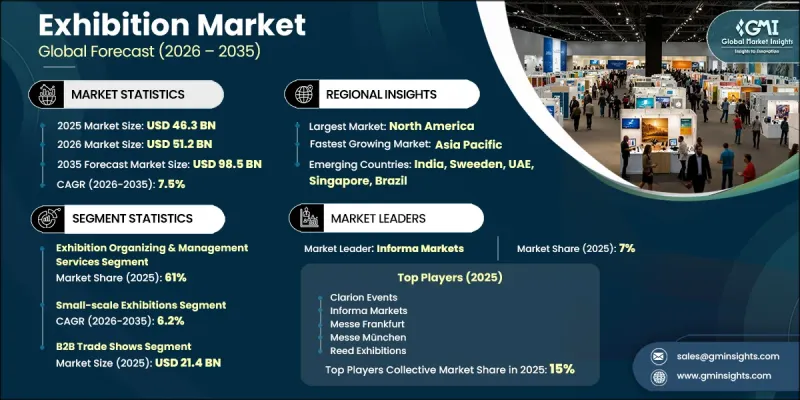
The Global Exhibition Market was valued at USD 46.3 billion in 2025 and is estimated to grow at a CAGR of 7.5% to reach USD 98.5 billion by 2035.
The market is expanding steadily due to increasing global business activity, rising participation in trade shows, and growing demand for structured networking platforms that connect buyers and sellers across industries. Exhibitions continue to play a central role in enabling product visibility, commercial partnerships, and knowledge exchange across domestic and international markets. The growing emphasis on experience-driven engagement is encouraging organizers to design more interactive and data-enabled event formats. At the same time, hybrid event models are becoming widely accepted, allowing both physical and virtual participation, which expands audience reach and improves engagement outcomes. Recovery in international travel is further supporting exhibitor and visitor inflows, strengthening cross-border business opportunities. Sustainability expectations are also reshaping event design, influencing materials used in booth construction, logistics planning, and operational reporting. Venue modernization across key global cities is enhancing infrastructure capabilities to support digital integration, higher connectivity demands, and improved visitor navigation. Increasing use of analytics-based tools is helping organizers demonstrate measurable ROI, reinforcing exhibitions as a high-impact channel for business development.
| Market Scope | |
|---|---|
| Start Year | 2025 |
| Forecast Year | 2026-2035 |
| Start Value | $46.3 Billion |
| Forecast Value | $98.5 Billion |
| CAGR | 7.5% |
The exhibition organizing and management services segment accounted for 61% share in 2025 and is expected to grow at a CAGR of 6.4% from 2026 to 2035. Growth in this segment is supported by comprehensive service offerings that include event planning, exhibitor coordination, content development, and audience engagement solutions. The integration of digital platforms for registration, visitor tracking, and performance analysis is improving operational efficiency and enabling better measurement of event outcomes, which is strengthening client retention and revenue generation.
The small-scale exhibitions segment held 45% share in 2025 and is projected to grow at a CAGR of 6.2% between 2026 and 2035. These events typically operate with a limited number of exhibitors and attract a moderate visitor base within compact venue spaces over short durations. Their format supports focused networking, targeted buyer engagement, and cost-efficient participation, making them a preferred option for niche industries and regional markets seeking direct business interactions.
U.S. Exhibition Market captured USD 16.8 billion in 2025. Market strength is supported by a well-established exhibition ecosystem, strong participation from corporate buyers and sellers, and a mature network of service providers, including logistics, technology, and event support companies. Consistent marketing investments by enterprises, combined with extensive venue infrastructure across multiple cities, continue to sustain high levels of exhibition activity even during fluctuating economic conditions.
Key companies operating in the Global Exhibition Market include Informa Markets, Messe Frankfurt, GL events Exhibitions, Clarion Events, Messe Munchen, Reed Exhibitions, Messe Dusseldorf, Comexposium, China Foreign Trade Centre, and Emerald Expositions. Companies in the exhibition market are focusing on digital transformation, hybrid event integration, and enhanced attendee engagement to strengthen their market position. Many organizers are investing in data analytics, AI-driven matchmaking tools, and digital registration platforms to improve exhibitor and visitor experiences. Expansion of hybrid and virtual event capabilities is helping companies increase global reach and participation flexibility. Strategic partnerships with venues, technology providers, and logistics firms are enhancing operational efficiency and service delivery. Firms are also emphasizing sustainability by adopting eco-friendly event materials and reducing logistical footprints. In addition, personalization of attendee experiences through data-driven insights and targeted networking solutions is becoming a key competitive strategy to improve retention and maximize event ROI.
Table of Contents
Chapter 1 Methodology & Scope
- 1.1 Research approach
- 1.2 Quality Commitments
- 1.2.1 GMI AI policy & data integrity commitment
- 1.2.1.1 Source consistency protocol
- 1.2.1 GMI AI policy & data integrity commitment
- 1.3 Research Trail & Confidence Scoring
- 1.3.1 Research Trail Components
- 1.3.2 Scoring Components
- 1.4 Data Collection
- 1.4.1 Partial list of primary sources
- 1.5 Data mining sources
- 1.5.1 Paid sources
- 1.5.1.1 Sources, by region
- 1.5.1 Paid sources
- 1.6 Base estimates and calculations
- 1.6.1 Base year calculation for any one approach
- 1.7 Forecast
- 1.7.1 Quantified market impact analysis
- 1.7.1.1 Mathematical impact of growth parameters on forecast
- 1.7.1 Quantified market impact analysis
- 1.8 Research transparency addendum
- 1.8.1 Source attribution framework
- 1.8.2 Quality assurance metrics
- 1.8.3 Our commitment to trust
Chapter 2 Executive Summary
- 2.1 Industry 360° synopsis
- 2.2 Key market trends
- 2.2.1 Service
- 2.2.2 Exhibition
- 2.2.3 Exhibition Scale
- 2.2.4 End-Use
- 2.2.5 Regional
- 2.3 TAM Analysis, 2026-2035
- 2.4 CXO perspectives: Strategic imperatives
Chapter 3 Industry Insights
- 3.1 Industry ecosystem analysis
- 3.1.1 Supplier landscape
- 3.1.1.1 Solution providers & platform vendors
- 3.1.1.2 Implementation partners & system integrators
- 3.1.1.3 Technology enablers & infrastructure providers
- 3.1.1.4 Managed service providers
- 3.1.1.5 End-use organizations
- 3.1.2 Cost structure
- 3.1.3 Profit margin
- 3.1.4 Value addition at each stage
- 3.1.5 Vertical integration trends
- 3.1.6 Disruptors
- 3.1.1 Supplier landscape
- 3.2 Impact on forces
- 3.2.1 Growth drivers
- 3.2.1.1 Rising demand for face-to-face business networking and deal-making
- 3.2.1.2 Growth in industry-specific trade shows and niche exhibitions
- 3.2.1.3 Expansion of emerging market participation
- 3.2.1.4 Strong recovery and backlog of postponed events post-pandemic
- 3.2.2 Industry pitfalls & challenges
- 3.2.2.1 High operational and participation costs
- 3.2.2.2 Competition from digital marketing and virtual events
- 3.2.3 Market opportunities
- 3.2.3.1 Shift toward hybrid exhibition formats
- 3.2.3.2 Increasing use of data analytics and AI for attendee engagement
- 3.2.3.3 Growth of experience-driven and immersive exhibition formats
- 3.2.3.4 Sustainability-focused exhibition practices
- 3.2.1 Growth drivers
- 3.3 Growth potential analysis
- 3.4 Regulatory landscape
- 3.4.1 North America
- 3.4.1.1 U.S. Americans with Disabilities Act (ADA)
- 3.4.1.2 Cybersecurity and Infrastructure Security Agency (CISA)
- 3.4.2 Europe
- 3.4.2.1 General Data Protection Regulation (GDPR)
- 3.4.2.2 NIS2 Directive
- 3.4.3 Asia-Pacific
- 3.4.3.1 China Cybersecurity Law
- 3.4.3.2 Digital India & Smart City/Event Infrastructure Policies
- 3.4.4 Latin America
- 3.4.4.1 Brazil National Infrastructure Modernization Program
- 3.4.4.2 Mexico Energy & Industrial Compliance Standards (NOM Framework)
- 3.4.5 Middle East & Africa
- 3.4.5.1 UAE Net Zero 2050 Strategy
- 3.4.5.2 Saudi Vision 2030 Industrial Digitalization Program
- 3.4.1 North America
- 3.5 Porter's analysis
- 3.6 PESTEL analysis
- 3.7 Technology trends & innovation ecosystem
- 3.7.1 Current technologies
- 3.7.2 Emerging technologies
- 3.8 Patent analysis (Driven by Primary Research)
- 3.9 Pricing Analysis (Driven by Primary Research)
- 3.9.1 Historical Price Trend Analysis
- 3.9.2 Pricing Strategy by Player Type
- 3.10 Base case scenarios
- 3.11 Use cases
- 3.12 Sustainability and environmental aspects
- 3.12.1 Sustainable practices
- 3.12.2 Waste reduction strategies
- 3.12.3 Energy efficiency in production
- 3.12.4 Eco-friendly initiatives
- 3.12.5 Carbon footprint considerations
- 3.13 Impact of AI & generative AI on the market
- 3.13.1 AI-driven disruption of existing business models
- 3.13.2 GenAI use cases & adoption roadmap by segment
- 3.13.3 Risks, limitations & regulatory considerations
- 3.14 Forecast assumptions & scenario analysis (Driven by Primary Research)
- 3.14.1 Base Case - key macro & industry variables driving CAGR
- 3.14.2 Optimistic Scenarios - Favorable Macro and Industry Tailwinds
- 3.14.3 Pessimistic Scenario - Macroeconomic slowdown or industry headwinds
Chapter 4 Competitive Landscape, 2025
- 4.1 Introduction
- 4.2 Company market share analysis
- 4.2.1 North America
- 4.2.2 Europe
- 4.2.3 Asia Pacific
- 4.2.4 Latin America
- 4.2.5 MEA
- 4.3 Competitive analysis of major market players
- 4.4 Competitive positioning matrix
- 4.5 Company Tier Benchmarking
- 4.5.1 Tier Classification Criteria & Qualifying Thresholds
- 4.5.2 Tier Positioning Matrix by Revenue, Geography & Innovation
- 4.6 Key developments
- 4.6.1 Mergers & acquisitions
- 4.6.2 Partnerships & collaborations
- 4.6.3 New product launches
- 4.6.4 Expansion plans and funding
Chapter 5 Market Estimates & Forecast, By Service, 2022 - 2035 ($Bn)
- 5.1 Key trends
- 5.2 Exhibition Organizing & Management Services
- 5.3 Booth Design & Fabrication Services
- 5.4 Exhibition Support Services
- 5.5 Others
Chapter 6 Market Estimates & Forecast, By Exhibition, 2022 - 2035 ($Bn)
- 6.1 Key trends
- 6.2 B2B Trade Shows
- 6.3 B2C Consumer Shows
- 6.4 Hybrid Exhibitions
Chapter 7 Market Estimates & Forecast, By Exhibition Scale, 2022 - 2035 ($Bn)
- 7.1 Key trends
- 7.2 Small-Scale Exhibitions
- 7.3 Medium-Scale Exhibitions
- 7.4 Large-Scale/Mega Exhibitions
Chapter 8 Market Estimates & Forecast, By End-Use, 2022 - 2035 ($Bn)
- 8.1 Key trends
- 8.2 Technology & Electronics
- 8.3 Automotive & Transportation
- 8.4 Healthcare & Medical Devices
- 8.5 Industrial & Manufacturing
- 8.6 Consumer Goods & Retail
- 8.7 Art, Culture & Education
- 8.8 Others
Chapter 9 Market Estimates & Forecast, By Region, 2022 - 2035 ($Bn)
- 9.1 Key trends
- 9.2 North America
- 9.2.1 US
- 9.2.2 Canada
- 9.3 Europe
- 9.3.1 UK
- 9.3.2 Germany
- 9.3.3 France
- 9.3.4 Italy
- 9.3.5 Spain
- 9.3.6 Belgium
- 9.3.7 Netherlands
- 9.3.8 Sweden
- 9.3.9 Russia
- 9.4 Asia Pacific
- 9.4.1 China
- 9.4.2 India
- 9.4.3 Japan
- 9.4.4 Australia
- 9.4.5 Singapore
- 9.4.6 South Korea
- 9.4.7 Vietnam
- 9.4.8 Indonesia
- 9.5 Latin America
- 9.5.1 Brazil
- 9.5.2 Mexico
- 9.5.3 Argentina
- 9.6 MEA
- 9.6.1 South Africa
- 9.6.2 Saudi Arabia
- 9.6.3 UAE
Chapter 10 Company Profiles
- 10.1 Global players
- 10.1.1 Informa Markets (Informa)
- 10.1.2 Reed Exhibitions
- 10.1.3 Messe Frankfurt
- 10.1.4 Messe Dusseldorf
- 10.1.5 Messe Munchen
- 10.1.6 Clarion Events
- 10.1.7 Emerald Expositions
- 10.2 Regional players
- 10.2.1 China Foreign Trade Centre
- 10.2.2 Comexposium
- 10.2.3 GL events Exhibitions
- 10.2.4 COEX
- 10.2.5 KINTEX
- 10.2.6 KOTRA
- 10.2.7 Viparis
- 10.2.8 VNU Exhibitions Asia
- 10.3 Emerging players
- 10.3.1 Bizzabo
- 10.3.2 Diversified Communications
- 10.3.3 Hopin
- 10.3.4 MCH
- 10.3.5 RX Japan

