PUBLISHER: Mordor Intelligence | PRODUCT CODE: 2124712

PUBLISHER: Mordor Intelligence | PRODUCT CODE: 2124712
India Event And Exhibition - Market Share Analysis, Industry Trends & Statistics, Growth Forecasts (2026 - 2031)
According to Mordor Intelligence, the India event and exhibition market size was valued at USD 5.69 billion in 2025 and estimated to grow from USD 6.15 billion in 2026 to reach USD 9.04 billion by 2031, at a CAGR of 8.05% during the forecast period (2026-2031).
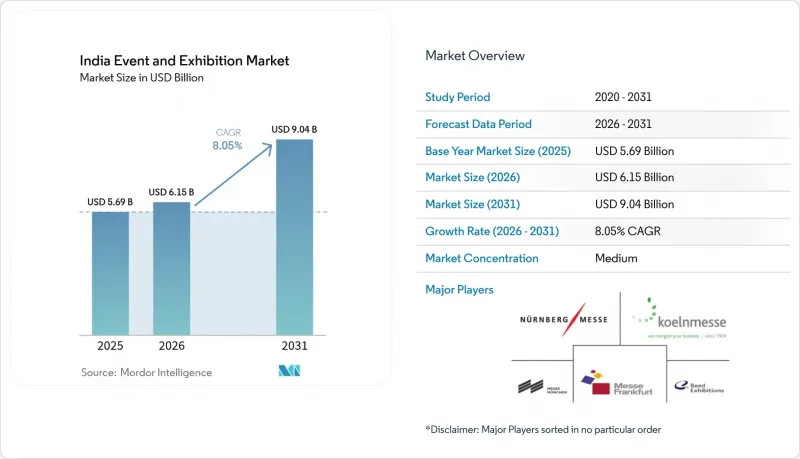
This report is Segmented by Event Type (B2B, B2C, and Hybrid), Mode (Physical/In-person, Virtual/Digital, and Hybrid), Revenue Stream (Exhibitor Fee, Sponsorship Fee, and More), End-User Industry (Consumer Goods and Retail, Automotive and Transportation, Industrial Manufacturing and Engineering, and More), and Region. The Market Forecasts are Provided in Terms of Value (USD).
India Event And Exhibition Market Trends and Insights
Accelerating Government-Led MICE Infrastructure Build-Out
Central and state authorities are investing in landmark convention facilities such as Bharat Mandapam, whose 13,500-seat capacity and 5G-ready backbone set a new regional benchmark. Coupled with the creation of city-level MICE Promotion Bureaus, this pipeline eases historical space constraints, attracts larger global shows, and catalyzes hotel and airline traffic. Delhi-Mumbai expressway improvements shorten freight lead times for mobile exhibits, and dedicated freight corridors reduce handling costs for heavy engineering shows. Over the medium term, those assets are expected to lift venue utilization rates and underpin price discipline for floor-space rentals. As publicly funded venues embed fiber connectivity and modular halls, organizers gain flexibility to stage concurrent events and monetize ancillary services. These developments collectively add roughly 2.1 percentage points to the forecast CAGR.
Rapid Brand Spending Shift from ATL to Experiential Marketing
Indian advertisers allocated USD 19 billion to paid media in 2024, with digital formats already absorbing 57% of budgets. Marketers now prioritize measurable in-person engagements to complement online funnels, favoring exhibitions that integrate data capture and mobile commerce. Case studies such as AB InBev India's owned festivals illustrate how brands can extend dwell time and command higher ticket prices than traditional sponsorships. Organizers respond by bundling lead-gen analytics and on-site content creation studios, allowing exhibitors to justify bigger stand designs. The spending realignment is most visible in Mumbai and Bengaluru, where technology and consumer-packaged-goods firms seek omnichannel touchpoints. These dynamics add an estimated 1.8% lift to CAGR over the next two years.
Rising Virtual-Only Alternatives Cannibalizing Physical Footfall
Cloud-native event suites offer on-demand streaming and matchmaking at a fraction of physical participation costs. Knowledge-centric sectors software, publishing, and professional education now alternate flagship shows with virtual summits, trimming travel budgets. Organizers must therefore articulate unique in-person value, such as live equipment demos and serendipitous networking, to defend visitor counts. Hybrid models soften the blow but risk diluting urgency for onsite attendance. In net terms, virtual cannibalization shaves 1.4 percentage points from short-term CAGR.
Other drivers and restraints analyzed in the detailed report include:
- Post-Pandemic Revenge Travel Fueling B2C Fairs and Festivals
- Corporate Decarbonization Targets Raising Demand for Net-Zero Venues
- Persistently Elevated Logistics and Booth-Build Costs
For complete list of drivers and restraints, kindly check the Table Of Contents.
Segment Analysis
B2B exhibitions delivered 57.60% of the India event and exhibition market size in 2025, as India's manufacturing build-out necessitated large trade shows where buyers can benchmark machinery specifications and negotiate bulk contracts. Flagship engineering fairs in Coimbatore and Delhi transform venue halls into live factories, emphasizing why digital replicas cannot replace tactile product validation. The India event and exhibition market share commanded by B2B formats is anchored in high stand-rent yields and multi-day delegate packages, bolstering organizer cash conversion.
B2C shows, however, are expanding at a 9.12% CAGR on the back of rising household incomes and pent-up demand for in-person entertainment. Comic conventions, food carnivals, and gaming expos adopt influencer-driven programming to attract Gen-Z visitors who amplify reach via social video clips. Hybrid sub-formats emerge when auto shows open consumer days after press and dealer previews, extracting incremental ticket revenue while preserving trade-day exclusivity. This dual-track evolution positions organizers to diversify revenue and mitigate cyclical risks.
Physical formats retained 71.85% of 2025 revenue because large capital-goods displays and tactile sampling still require showroom-style setups. Venues like Pragati Maidan host more than 500 shows yearly, demonstrating sustained demand even as virtual add-ons proliferate. Physical dominance is evident in the India event and exhibition market size for venue services, where ancillary income from parking, food, and advertising boards supplements hall rentals.
Hybrid models, advancing at 9.28% CAGR, use simultaneous streaming and on-demand replays to expand audience pools beyond geography and visa constraints. Organizers bundle "digital exhibitor booths" that remain live for 30 days post-show, selling sponsorship banners inside virtual lobbies. This convergence keeps the India event and exhibition market competitive by offering tiered participation packages to cost-sensitive SMEs while preserving premium in-person tiers for enterprise buyers.
Complete Report Scope:
- By Event Type
- B2B
- B2C
- Hybrid
- By Mode
- Physical/In-person
- Virtual/Digital
- Hybrid (Phygital)
- By Revenue Stream
- Exhibitor Fee
- Sponsorship Fee
- Entrance Fee
- Ancillary Services
- By End-user Industry
- Consumer Goods and Retail
- Automotive and Transportation
- Industrial Manufacturing and Engineering
- Entertainment and Media
- Real Estate and Property
- Hospitality and Tourism
- Healthcare and Pharmaceutical
- Other End-user Industries
- By Region
- North India
- West India
- South India
- East and Northeast India
List of Companies Covered in this Report:
- Reed Exhibitions India Private Limited
- Messe Muenchen India Private Limited
- Messe Frankfurt Trade Fairs India Private Limited
- NurnbergMesse India Private Limited
- Koelnmesse YA Tradefair Private Limited
- Deutsche Messe India Private Limited
- Messe Dusseldorf India Private Limited
- Fiera Milano India Private Limited
- GL Events India Private Limited
- Clarion Events India Private Limited
- Hyve India Private Limited
- Easyfairs India Private Limited
- dmg events India Private Limited
- Tarsus Exhibitions India Private Limited
- Italian Exhibition Group India Private Limited
- RAI India Exhibition Services Private Limited
- MCH India Exhibitions Private Limited
- ABEC Exhibitions & Conferences Private Limited
- MEX Exhibitions Private Limited
- Hyderabad International Trade Expositions Limited (HiTEX)
- India Trade Promotion Organisation (ITPO)
Additional Benefits:
- The market estimate (ME) sheet in Excel format
- 3 months of analyst support
TABLE OF CONTENTS
1 INTRODUCTION
- 1.1 Study Assumptions and Market Definition
- 1.2 Scope of the Study
2 RESEARCH METHODOLOGY
3 EXECUTIVE SUMMARY
4 MARKET LANDSCAPE
- 4.1 Market Overview
- 4.2 Market Drivers
- 4.2.1 Accelerating government-led MICE infrastructure build-out
- 4.2.2 Rapid brand spending shift from ATL to experiential marketing
- 4.2.3 Post-pandemic revenge-travel fuelling B2C fairs and festivals
- 4.2.4 Corporate decarbonisation targets raising demand for net-zero venues
- 4.2.5 Tier-2 city convention-centre boom widening organiser footprint
- 4.2.6 Web-3 based digital-twin exhibitions unlocking incremental revenue
- 4.3 Market Restraints
- 4.3.1 Rising virtual-only alternatives cannibalising physical footfall
- 4.3.2 Persistently elevated logistics and booth-build costs
- 4.3.3 Complex multi-state GST compliance for travelling exhibitions
- 4.3.4 Hybrid-tech skills shortage inflating organiser OPEX
- 4.4 Value Chain Analysis
- 4.5 Regulatory Landscape
- 4.6 Technological Outlook
- 4.7 Porter's Five Forces Analysis
- 4.7.1 Bargaining Power of Suppliers
- 4.7.2 Bargaining Power of Buyers
- 4.7.3 Threat of New Entrants
- 4.7.4 Threat of Substitutes
- 4.7.5 Intensity of Competitive Rivalry
- 4.8 Impact of Macroeconomic Factors on the Market
- 4.9 Top Exhibition Centres in India
- 4.10 Global Event and Exhibition Centres Analysis
5 MARKET SIZE AND GROWTH FORECASTS (VALUES)
- 5.1 By Event Type
- 5.1.1 B2B
- 5.1.2 B2C
- 5.1.3 Hybrid
- 5.2 By Mode
- 5.2.1 Physical/In-person
- 5.2.2 Virtual/Digital
- 5.2.3 Hybrid (Phygital)
- 5.3 By Revenue Stream
- 5.3.1 Exhibitor Fee
- 5.3.2 Sponsorship Fee
- 5.3.3 Entrance Fee
- 5.3.4 Ancillary Services
- 5.4 By End-user Industry
- 5.4.1 Consumer Goods and Retail
- 5.4.2 Automotive and Transportation
- 5.4.3 Industrial Manufacturing and Engineering
- 5.4.4 Entertainment and Media
- 5.4.5 Real Estate and Property
- 5.4.6 Hospitality and Tourism
- 5.4.7 Healthcare and Pharmaceutical
- 5.4.8 Other End-user Industries
- 5.5 By Region
- 5.5.1 North India
- 5.5.2 West India
- 5.5.3 South India
- 5.5.4 East and Northeast India
6 COMPETITIVE LANDSCAPE
- 6.1 Market Concentration
- 6.2 Strategic Moves
- 6.3 Market Share Analysis
- 6.4 Company Profiles (includes Global level Overview, Market level overview, Core Segments, Financials as available, Strategic Information, Market Rank/Share for key companies, Products and Services, and Recent Developments)
- 6.4.1 Reed Exhibitions India Private Limited
- 6.4.2 Messe Muenchen India Private Limited
- 6.4.3 Messe Frankfurt Trade Fairs India Private Limited
- 6.4.4 NurnbergMesse India Private Limited
- 6.4.5 Koelnmesse YA Tradefair Private Limited
- 6.4.6 Deutsche Messe India Private Limited
- 6.4.7 Messe Dusseldorf India Private Limited
- 6.4.8 Fiera Milano India Private Limited
- 6.4.9 GL Events India Private Limited
- 6.4.10 Clarion Events India Private Limited
- 6.4.11 Hyve India Private Limited
- 6.4.12 Easyfairs India Private Limited
- 6.4.13 dmg events India Private Limited
- 6.4.14 Tarsus Exhibitions India Private Limited
- 6.4.15 Italian Exhibition Group India Private Limited
- 6.4.16 RAI India Exhibition Services Private Limited
- 6.4.17 MCH India Exhibitions Private Limited
- 6.4.18 ABEC Exhibitions & Conferences Private Limited
- 6.4.19 MEX Exhibitions Private Limited
- 6.4.20 Hyderabad International Trade Expositions Limited (HiTEX)
- 6.4.21 India Trade Promotion Organisation (ITPO)
7 MARKET OPPORTUNITIES AND FUTURE OUTLOOK
- 7.1 White-Space and Unmet-Need Assessment

