PUBLISHER: Global Market Insights Inc. | PRODUCT CODE: 2038366

PUBLISHER: Global Market Insights Inc. | PRODUCT CODE: 2038366
Transportation Liquid Hydrogen Market Opportunity, Growth Drivers, Industry Trend Analysis, and Forecast 2026 - 2035
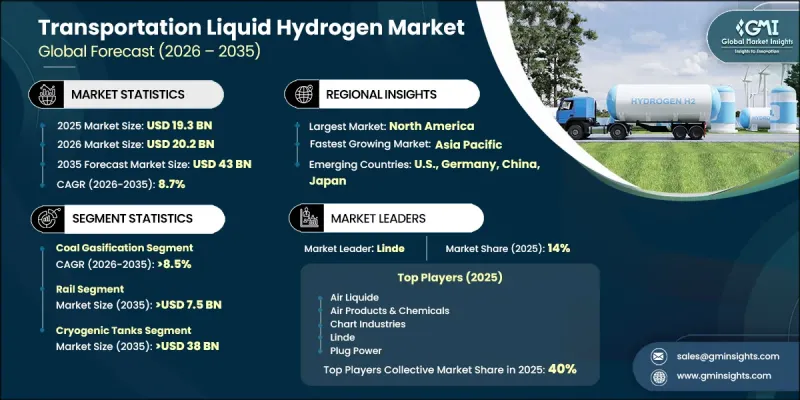
The Global Transportation Liquid Hydrogen Market was valued at USD 19.3 billion in 2025 and is estimated to grow at a CAGR of 8.7% to reach USD 43 billion by 2035.
The market is gaining strong traction as liquid hydrogen is increasingly recognized for its high energy density, which makes it highly suitable for long-distance and heavy-duty transportation applications. Its efficiency in storage and transport is particularly important for aviation and freight-intensive mobility systems where performance and range are critical. The rising deployment of hydrogen fuel cell-based mobility solutions, including buses and trucks, is further accelerating industry adoption. Continuous investments in advanced hydrogen technologies by key market participants are strengthening commercialization efforts and expanding infrastructure capabilities. At the same time, strict environmental regulations and global sustainability commitments are pushing the transportation sector toward low-emission and zero-emission energy alternatives. Growing demand for fuels that offer fast refueling, extended range, and high operational efficiency is also reinforcing market expansion. In addition, increasing net zero targets, tighter emission standards, and improvements in cryogenic storage systems and fuel cell technologies are collectively supporting the long-term growth outlook of the transportation liquid hydrogen market.
| Market Scope | |
|---|---|
| Start Year | 2025 |
| Forecast Year | 2026-2035 |
| Start Value | $19.3 Billion |
| Forecast Value | $43 Billion |
| CAGR | 8.7% |
The coal gasification market is projected to grow at a CAGR of 8.5% by 2035, supported by favorable policy frameworks aimed at advancing clean energy transitions. Expanding hydrogen economy initiatives backed by government targets are encouraging wider adoption of coal gasification technologies. Integration of coal gasification systems with carbon capture and storage solutions is further improving environmental performance and enhancing industry acceptance. In addition, continuous technological improvements in gasification processes, along with the availability of cost-effective raw materials, are increasing operational efficiency and reducing environmental impact, making hydrogen production more economically attractive and supporting broader market penetration.
The cryogenic tanks market is expected to reach USD 38 billion by 2035. Growing focus on advancing cryogenic technologies to enhance operational safety, efficiency, and performance is significantly contributing to market expansion. Ongoing improvements in insulation materials and engineering techniques are further strengthening storage capabilities and supporting broader adoption across hydrogen and industrial gas applications.
U.S. Transportation Liquid Hydrogen Market is projected to grow at a CAGR of 8.6% through 2035. Increasing efforts to reduce greenhouse gas emissions and address climate change are driving strong policy and industrial support for clean mobility solutions. Both government bodies and private sector stakeholders are actively investing in decarbonization strategies for the transportation industry, which is accelerating hydrogen adoption across mobility applications.
Major players operating in the Global Transportation Liquid Hydrogen Industry include Air Liquide, Linde plc, Air Products and Chemicals, Shell plc, Chart Industries, Kawasaki Heavy Industries, Cryolor, ENGIE, Cryostar, Nikkiso Co., Ltd., Demaco, Mitsubishi Heavy Industries, Hexagon Purus, Messer, INOX India Limited, Plug Power Inc., Iwatani Corporation, Worthington Industries, Salzburger Aluminium Group, and Wuxi Yuantong Gas. Key companies in the Transportation Liquid Hydrogen Market are actively focusing on expanding large-scale hydrogen infrastructure, including liquefaction plants, storage systems, and transport networks to support growing demand. They are investing heavily in advanced cryogenic technologies to improve safety, efficiency, and cost-effectiveness of hydrogen handling. Strategic collaborations with governments, energy companies, and automotive manufacturers are strengthening ecosystem development and accelerating commercialization. Firms are also prioritizing R&D to enhance fuel cell integration, improve energy density, and reduce operational losses during storage and transport. Expansion into emerging markets through joint ventures and long-term supply contracts is helping companies secure stable revenue streams.
Table of Contents
Chapter 1 Methodology & Scope
- 1.1 Research design
- 1.2 Quality commitment
- 1.2.1 GMI AI policy & data integrity commitment
- 1.2.1.1 Source consistency protocol
- 1.2.1 GMI AI policy & data integrity commitment
- 1.3 Research Trail & Confidence Scoring
- 1.3.1 Research Trail Components
- 1.3.2 Scoring Components
- 1.4 Data Collection
- 1.4.1 Partial list of primary sources
- 1.5 Data mining sources
- 1.5.1 Paid sources
- 1.5.1.1 Sources, by region
- 1.5.1 Paid sources
- 1.6 Base estimates and calculations
- 1.6.1 Base year calculation for any one approach
- 1.7 Forecast model
- 1.8 Research transparency addendum
- 1.8.1 Source attribution framework
- 1.8.2 Quality assurance metrics
- 1.8.3 Our commitment to trust
- 1.9 Market definitions
Chapter 2 Executive Summary
- 2.1 Industry synopsis, 2022 - 2035
- 2.2 Business trends
- 2.3 Production Method trends
- 2.4 Distribution Method trends
- 2.5 Type trends
- 2.6 Regional trends
Chapter 3 Industry Insights
- 3.1 Industry ecosystem analysis
- 3.2 Regulatory landscape
- 3.3 Industry impact forces
- 3.3.1 Growth drivers
- 3.3.1.1 Shifting focus toward decarbonization
- 3.3.1.2 Surging interest in alternative fuels
- 3.3.2 Industry pitfalls & challenges
- 3.3.2.1 Lack of network of hydrogen fuelling stations
- 3.3.1 Growth drivers
- 3.4 Growth potential analysis
- 3.5 Porter's Analysis
- 3.5.1 Bargaining power of suppliers
- 3.5.2 Bargaining power of buyers
- 3.5.3 Threat of new entrants
- 3.5.4 Threat of substitutes
- 3.6 PESTEL Analysis
- 3.6.1 Political factors
- 3.6.2 Economic factors
- 3.6.3 Social factors
- 3.6.4 Technological factors
- 3.6.5 Legal factors
- 3.6.6 Environmental factors
- 3.7 Cost structure analysis
- 3.8 Price trend analysis, 2022-2035
- 3.8.1 By Type
- 3.8.2 By Region
- 3.9 Emerging opportunities & trends
- 3.9.1 Digitalization & IoT integration
- 3.10 Investment analysis & future outlook
Chapter 4 Competitive Landscape, 2026
- 4.1 Introduction
- 4.2 Company market share analysis, by country, 2025
- 4.2.1 North America
- 4.2.2 Europe
- 4.2.3 Asia Pacific
- 4.3 Competitive positioning matrix
- 4.4 Key developments
- 4.4.1 Mergers & acquisitions
- 4.4.2 Partnerships & collaborations
- 4.4.3 New product launches
- 4.4.4 Expansion plans & funding
Chapter 5 Market Size and Forecast, By Production Method, 2022 - 2035 (USD Billion & MT)
- 5.1 Key trends
- 5.2 Coal Gasification
- 5.3 SMR
- 5.4 Electrolysis
Chapter 6 Market Size and Forecast, By Distribution Method, 2022 - 2035 (USD Billion & MT)
- 6.1 Key trends
- 6.2 Pipelines
- 6.3 Cryogenic Tanks
Chapter 7 Market Size and Forecast, By Type, 2022 - 2035 (USD Billion & MT)
- 7.1 Key trends
- 7.2 LDV
- 7.3 HDV
- 7.4 Hydrogen Ship
- 7.5 Rail
- 7.6 Port machinery
- 7.7 Construction machinery
Chapter 8 Market Size and Forecast, By Region, 2022 - 2035 (USD Billion & MT)
- 8.1 Key trends
- 8.2 North America
- 8.2.1 U.S.
- 8.2.2 Canada
- 8.3 Europe
- 8.3.1 Germany
- 8.3.2 UK
- 8.3.3 France
- 8.3.4 Italy
- 8.4 Asia Pacific
- 8.4.1 China
- 8.4.2 Japan
- 8.4.3 South Korea
- 8.4.4 India
- 8.4.5 Australia
Chapter 9 Company Profiles
- 9.1 Air Liquide
- 9.2 Air Products and Chemicals
- 9.3 Chart Industries
- 9.4 Cryolor
- 9.5 Cryostar
- 9.6 Demaco
- 9.7 ENGIE
- 9.8 Hexagon Purus
- 9.9 INOX India Limited
- 9.10 Iwatani Corporation
- 9.11 Kawasaki Heavy Industries
- 9.12 Linde plc
- 9.13 Messer
- 9.14 Mitsubishi Heavy Industries
- 9.15 Nikkiso Co., Ltd.
- 9.16 Plug Power Inc.
- 9.17 Salzburger Aluminium Group
- 9.18 Shell plc
- 9.19 Worthington Industries
- 9.20 Wuxi Yuantong Gas

