PUBLISHER: Global Market Insights Inc. | PRODUCT CODE: 2038380

PUBLISHER: Global Market Insights Inc. | PRODUCT CODE: 2038380
Semiconductor IP Market Opportunity, Growth Drivers, Industry Trend Analysis, and Forecast 2026 - 2035
The Global Semiconductor IP Market was valued at USD 9.8 billion in 2025 and is estimated to grow at a CAGR of 14.7% to reach USD 38 billion by 2035.
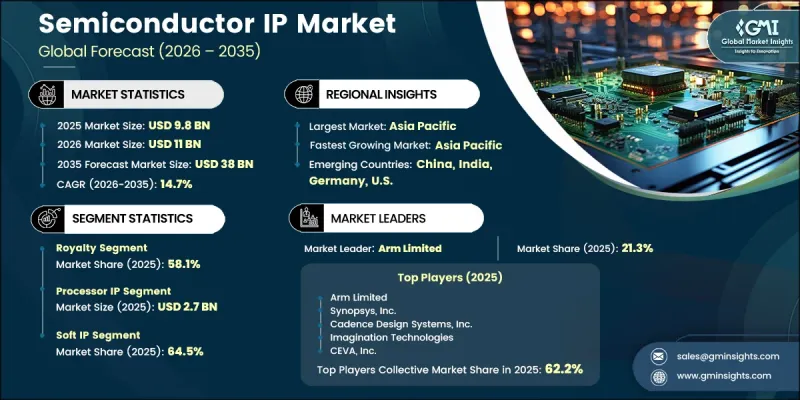
Market expansion is strongly influenced by the rapid adoption of electric vehicles, which is accelerating demand for advanced power electronics such as IGBTs and silicon carbide-based devices. At the same time, increasing industrial automation, large-scale deployment of fast-charging infrastructure, and the rapid growth of hyperscale data centers are driving the adoption of wide-bandgap semiconductor technologies. The market is also benefiting from the growing complexity of System on Chip (SoC) designs, especially at advanced process nodes of 3 nm and below, where multiple functions such as computing, interconnects, and power management are integrated into a single architecture. Modern chip development is increasingly reliant on nanosheet transistor structures, advanced interconnect technologies, and design-technology co-optimization, making in-house design of all functional blocks less practical. As a result, reusable semiconductor intellectual property has become essential for reducing development cycles, controlling costs, and improving performance efficiency. These shifts are further reinforced by rising demand for faster time-to-market, expanding computing requirements in automotive electronics, and the need for scalable, high-performance silicon solutions across multiple end-use industries globally, supporting long-term market growth momentum.
| Market Scope | |
|---|---|
| Start Year | 2025 |
| Forecast Year | 2026-2035 |
| Start Value | $9.8 Billion |
| Forecast Value | $38 Billion |
| CAGR | 14.7% |
The royalty-based licensing segment held a 58.1% share in 2025, supported by high-volume semiconductor production and long lifecycle products across automotive, consumer electronics, and industrial applications. This model generates continuous revenue streams by linking payments to product shipments, making it highly suitable for large-scale semiconductor manufacturing ecosystems and ensuring stable long-term monetization across multiple product generations.
The processor IP segment reached USD 2.7 billion in 2025. Its leadership is driven by widespread integration of CPUs and processing cores across mobile devices, automotive systems, data centers, and embedded platforms. Processor IP remains a foundational element of SoC architectures, enabling scalable computing performance, improved energy efficiency, and seamless software compatibility, while its extensive reuse across high-volume chip designs reinforces its strong market presence.
North America Semiconductor IP Market captured a 33.1% share in 2025, supported by a strong ecosystem of chip designers, fabless semiconductor companies, and leading hyperscale technology firms. Regional growth is fueled by rising adoption of artificial intelligence workloads, cloud infrastructure expansion, advanced automotive electronics, and aerospace applications. The mature design environment in the region further promotes extensive reuse of third-party IP, accelerating innovation and strengthening demand across multiple high-growth technology sectors.
Synopsys, Inc., Arm Limited, Cadence Design Systems, Inc., Advanced Micro Devices, Inc., Rambus, SiFive, Inc., Imagination Technologies, CEVA, Inc., Siemens, Lattice Semiconductor, Silvaco, Inc., VeriSilicon, Achronix Semiconductor Corporation, ALPHA WAVE SEMI, Analog Bits, ART ERIS, INC, Frontgrade Gaisler, Dolphin Design, Eureka Technology, Inc., Faraday Technology Corporation, eMemory Technology Inc., and Renesas Electronics Corporation are among the key companies operating in the Global Semiconductor IP Industry. Companies in the Semiconductor IP Market are focusing on expanding their licensing portfolios and strengthening royalty-based revenue models to ensure long-term income stability. They are heavily investing in advanced IP development for next-generation process nodes, particularly for AI, automotive, and high-performance computing applications. Strategic collaborations with foundries, fabless semiconductor firms, and system integrators are being prioritized to improve design compatibility and accelerate adoption. Firms are also enhancing R&D efforts in processor, interface, and security IP to meet rising demand for complex SoC architectures.
Table of Contents
Chapter 1 Methodology and Scope
- 1.1 Market scope and definition
- 1.2 Research design
- 1.2.1 Research approach
- 1.2.2 Data collection methods
- 1.3 Data mining sources
- 1.3.1 Global
- 1.3.2 Regional/Country
- 1.4 Base estimates and calculations
- 1.4.1 Base year calculation
- 1.4.2 Key trends for market estimation
- 1.5 Primary research and validation
- 1.5.1 Primary sources
- 1.6 Forecast model
- 1.7 Research assumptions and limitations
Chapter 2 Executive Summary
- 2.1 Industry 360° synopsis, 2022 - 2035
- 2.2 Key market trends
- 2.2.1 IP source trends
- 2.2.2 IP type trends
- 2.2.3 IP core type trends
- 2.2.4 End user trends
- 2.2.5 Regional trends
- 2.3 TAM Analysis, 2026-2035
- 2.4 CXO perspectives: Strategic imperatives
Chapter 3 Industry Insights
- 3.1 Industry ecosystem analysis
- 3.1.1 Supplier Landscape
- 3.1.2 Profit Margin
- 3.1.3 Cost structure
- 3.1.4 Value addition at each stage
- 3.1.5 Factor affecting the value chain
- 3.1.6 Disruptions
- 3.2 Industry impact forces
- 3.2.1 Growth drivers
- 3.2.1.1 Rapid increase in SoC complexity across end-use applications
- 3.2.1.2 Expansion of automotive electronics driven by safety regulations
- 3.2.1.3 Surge in AI, data center, and high-performance computing (HPC) workloads
- 3.2.1.4 Growth of fabless semiconductor business models
- 3.2.1.5 Time-to-market pressure and rising development costs
- 3.2.2 Industry pitfalls and challenges
- 3.2.2.1 High integration and verification complexity of IP blocks
- 3.2.2.2 Limited customization flexibility and vendor lock-in risks
- 3.2.3 Market opportunities
- 3.2.3.1 Rising demand for custom SoC development across AI and HPC applications
- 3.2.3.2 Growing adoption of IP-based chip design among fabless and emerging players
- 3.2.1 Growth drivers
- 3.3 Growth potential analysis
- 3.4 Regulatory landscape
- 3.4.1 North America
- 3.4.2 Europe
- 3.4.3 Asia Pacific
- 3.4.4 Latin America
- 3.4.5 Middle East & Africa
- 3.5 Porter's analysis
- 3.6 PESTEL analysis
- 3.7 Technology and Innovation landscape
- 3.7.1 Current technological trends
- 3.7.2 Emerging technologies
- 3.8 Price trends
- 3.8.1 By region
- 3.8.2 By product
- 3.9 Pricing Strategies
- 3.10 Emerging Business Models
- 3.11 Compliance Requirements
- 3.12 Patent and IP analysis
Chapter 4 Competitive Landscape, 2025
- 4.1 Introduction
- 4.2 Company market share analysis
- 4.2.1 By region
- 4.2.1.1 North America
- 4.2.1.2 Europe
- 4.2.1.3 Asia Pacific
- 4.2.1.4 Latin America
- 4.2.1.5 Middle East & Africa
- 4.2.2 Market concentration analysis
- 4.2.1 By region
- 4.3 Competitive benchmarking of key players
- 4.3.1 Financial performance comparison
- 4.3.1.1 Revenue
- 4.3.1.2 Profit margin
- 4.3.1.3 R&D
- 4.3.2 Product portfolio comparison
- 4.3.2.1 Product range breadth
- 4.3.2.2 Technology
- 4.3.2.3 Innovation
- 4.3.3 Geographic presence comparison
- 4.3.3.1 Global footprint analysis
- 4.3.3.2 Service network coverage
- 4.3.3.3 Market penetration by region
- 4.3.4 Competitive positioning matrix
- 4.3.4.1 Leaders
- 4.3.4.2 Challengers
- 4.3.4.3 Followers
- 4.3.4.4 Niche players
- 4.3.5 Strategic outlook matrix
- 4.3.1 Financial performance comparison
- 4.4 Key developments
- 4.4.1 Mergers and acquisitions
- 4.4.2 Partnerships and collaborations
- 4.4.3 Technological advancements
- 4.4.4 Expansion and investment strategies
- 4.4.5 Digital transformation initiatives
- 4.5 Emerging/ startup competitors landscape
Chapter 5 Market Estimates and Forecast, By IP Source, 2022 - 2035 (USD Million)
- 5.1 Key trends
- 5.2 Licensing
- 5.3 Royalty
Chapter 6 Market Estimates and Forecast, By IP Type, 2022 - 2035 (USD Million)
- 6.1 Key trends
- 6.2 Processor IP
- 6.3 Interface IP
- 6.4 Memory IP
- 6.5 Security IP
- 6.6 Analog & mixed-signal IP
- 6.7 Verification IP
- 6.8 Foundation IP
Chapter 7 Market Estimates and Forecast, By IP Core Type, 2022 - 2035 (USD Million)
- 7.1 Key trends
- 7.2 Soft IP
- 7.2.1 RTL-based IP
- 7.2.2 Technology-independent
- 7.2.3 Synthesizable IP
- 7.3 Hard IP
- 7.3.1 Layout-ready IP
- 7.3.2 Process-specific IP
- 7.3.3 Pre-verified silicon IP
Chapter 8 Market Estimates and Forecast, By End-User, 2022 - 2035 (USD Million)
- 8.1 Key trends
- 8.2 Consumer electronics
- 8.3 Automotive
- 8.4 Telecom & data centers
- 8.5 Industrial & IoT
- 8.6 Healthcare
- 8.7 Others
Chapter 9 Market Estimates and Forecast, By Region, 2022 - 2035 (USD Million)
- 9.1 Key trends
- 9.2 North America
- 9.2.1 U.S.
- 9.2.2 Canada
- 9.3 Europe
- 9.3.1 Germany
- 9.3.2 UK
- 9.3.3 France
- 9.3.4 Spain
- 9.3.5 Italy
- 9.3.6 Russia
- 9.4 Asia Pacific
- 9.4.1 China
- 9.4.2 India
- 9.4.3 Japan
- 9.4.4 Australia
- 9.4.5 South Korea
- 9.5 Latin America
- 9.5.1 Brazil
- 9.5.2 Mexico
- 9.5.3 Argentina
- 9.6 Middle East and Africa
- 9.6.1 South Africa
- 9.6.2 Saudi Arabia
- 9.6.3 UAE
Chapter 10 Company Profiles
- 10.1 Global Key Players
- 10.1.1 Arm Limited
- 10.1.2 Synopsys, Inc.
- 10.1.3 Cadence Design Systems, Inc.
- 10.1.4 Imagination Technologies
- 10.1.5 CEVA, Inc.
- 10.2 Regional key players
- 10.2.1 North America
- 10.2.1.1 Lattice Semiconductor
- 10.2.1.2 Rambus
- 10.2.1.3 Advanced Micro Devices, Inc.
- 10.2.1.4 Silvaco, Inc.
- 10.2.1.5 Analog Bits
- 10.2.1.6 SiFive, Inc.
- 10.2.2 Asia Pacific
- 10.2.2.1 VeriSilicon
- 10.2.2.2 eMemory Technology Inc.
- 10.2.2.3 Faraday Technology Corporation
- 10.2.2.4 Renesas Electronics Corporation
- 10.2.2.5 Eureka Technology, Inc.
- 10.2.3 Europe
- 10.2.3.1 Siemens
- 10.2.3.2 ARTERIS, INC
- 10.2.3.3 Dolphin Design
- 10.2.3.4 Frontgrade Gaisler
- 10.2.1 North America
- 10.3 Niche Players/Disruptors
- 10.3.1 Achronix Semiconductor Corporation
- 10.3.2 ALPHA WAVE SEMI

