PUBLISHER: Mordor Intelligence | PRODUCT CODE: 2066396

PUBLISHER: Mordor Intelligence | PRODUCT CODE: 2066396
Semiconductor Silicon Intellectual Property - Market Share Analysis, Industry Trends & Statistics, Growth Forecasts (2026 - 2031)
According to Mordor Intelligence, the semiconductor silicon IP market size is expected to grow from USD 7.9 billion in 2025 to USD 8.39 billion in 2026 and is forecast to reach USD 11.33 billion by 2031 at 6.2% CAGR over 2026-2031.
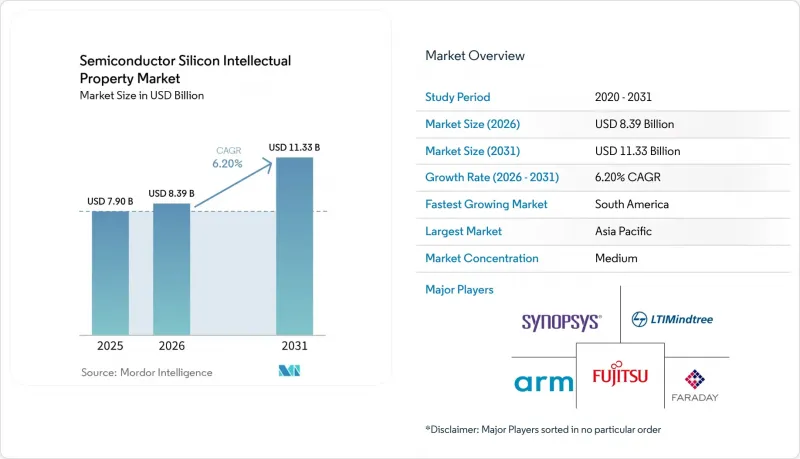
This report is Segmented by Revenue Type (License, and Services), IP Type (Processor IP, Wired Interface IP, and Other IP Types), End-User Vertical (Consumer Electronics, Computers and Peripherals, Automotive, Industrial, and Other Verticals), Process Node (28 Nm and Above, 16/14 Nm, 10/7 Nm, 5 Nm and Below), and Geography. The Market Forecasts are Provided in Terms of Value (USD).
Global Semiconductor Silicon Intellectual Property Market Trends and Insights
Proliferation of IoT-Enabled Connected Devices
Record shipments of smart meters, wearables, and asset-tracking tags are driving a surge in low-power processor, wireless transceiver, and sensor-hub IP demand. Edge architectures now favor domain-specific blocks that execute real-time inference close to the data source, reducing latency and backhaul bandwidth. Vendors offering turnkey subsystems that bundle MPU, RF, and secure-element IP are capturing design wins because they enable OEMs to integrate connectivity without expanding their internal teams. Heightened emphasis on hardware-rooted security is driving up attachment rates for cryptographic accelerators and physically unclonable function seeds, particularly where critical infrastructure is exposed to cyber risk. Proof-of-concepts piloted in smart factories and utilities during 2024 are moving to volume production, sustaining a multiyear growth runway for specialized IP portfolios.
Complexity of SoC Designs and Shrinking Time-to-Market
Top-tier smartphone and automotive chips now integrate upward of 50 IP blocks, spanning multiple voltage islands and asynchronous clock domains. Coordinating verification across this landscape adds schedule risk that most OEMs mitigate by sourcing pre-verified IP with published safety artifacts. Foundry-qualified variants trimmed for leakage, variation, and electromigration further shorten tape-out cycles, prompting suppliers to expand consultancy services that cover RTL, physical implementation, and package co-design. Chiplet architectures amplify the value of interface IP, adhering to the UCIe 2.0 spec because heterogeneous dies must interoperate across vendor boundaries. Fast-tracking silicon on these modular platforms has turned IP reuse into an operational necessity rather than a cost preference.
High Upfront Licensing Costs and Scale Disadvantages
Multi-million-dollar entry fees for high-end processors or SerDes IP deter startups and niche players, forcing them toward less capable open-source blocks or older nodes. Revenue-sharing and subscription licensing models are emerging but remain a minority, as entrenched suppliers protect premium pricing tied to proven validation collateral. Porting a popular IP core from 28 nm to 5 nm frequently doubles engineering cost, further widening the gap between tier-one chipmakers and smaller design houses. Consequently, market entry barriers slow overall innovation velocity and may cap addressable demand among mid-volume OEMs until alternative licensing frameworks scale.
Other drivers and restraints analyzed in the detailed report include:
- AI and ML Accelerators Integrated into Edge Devices
- Commercial Demand for Verified RISC-V CPU IP
- Royalty Disputes and Patent-Litigation Exposure
For complete list of drivers and restraints, kindly check the Table Of Contents.
Segment Analysis
Service-related payments represent the fastest-growing portion of the Semiconductor silicon IP market, climbing at an 8.12% CAGR through 2031 as chipmakers outsource customization, hardening, and bring-up tasks that exceed their internal bandwidth. However, licenses controlled 58.22% of revenue in 2025, and customers deploying 5 nm and below reported a steep rise in post-license engineering hours, making bundled service contracts attractive. IP vendors now position platform subscriptions that include continuous performance tuning, over-the-air security patch support, and silicon lifecycle analytics. These programs enhance account stickiness and mitigate cyclical swings associated with tape-out volume.
The shift also cushions price pressure facing commodity cores, particularly in mid-range processor and Ethernet IP categories. Vendors with large field-application teams leverage integration consulting as a margin-enhancing strategy, offsetting declining per-unit royalties as volumes shift to cost-sensitive IoT devices. Hybrid revenue models spur recurring cash flows and align supplier incentives with customer production milestones, reinforcing the prospect that services could capture a larger slice of the Semiconductor silicon IP market size by the end of the decade.
Expanding 5G infrastructure, WiFi 7 adoption, and Bluetooth LE Audio upgrades are propelling wireless interface IP toward a 7.05% CAGR. Chipmakers integrating multi-standard radios seek ready-made RF, baseband, and coexistence logic that meets global certification requirements, allowing for consumer device launches on aggressive timelines. Processor IP nevertheless remained the single biggest revenue contributor at 45.88% in 2025, anchored by the ubiquity of CPU cores in every SoC.
Competitive intensity within processor IP has increased due to the entry of RISC-V entrants, prompting incumbents to widen their differentiators through integrated AI acceleration and power management enhancements. In parallel, wired interface IP continues to serve data center and automotive connectivity demands at stable mid-single-digit growth. Security, memory-controller, and analog IP round out the opportunity landscape, collectively benefiting from SoC silicon area inflation and the rise of application-specific designs that require specialized subsystems.
Geography Analysis
The Asia-Pacific region led global revenue with a 52.14% stake in 2025, driven by its deep manufacturing ecosystems in China, South Korea, Taiwan, and Japan, as well as supportive semiconductor stimulus packages. Foundry co-development programs foster close collaboration on design rules and IP hardening, thereby enhancing regional adoption rates for both domestic and international portfolios. China's self-reliance mandate propels investment into RISC-V and security IP, while South Korea's K-Semiconductor Belt strengthens demand for memory-centric interface blocks. Japan concentrates on automotive semiconductors and advanced packaging, adding traction for functional-safety IP and chiplet interconnects.
North America remains pivotal as home to major IP licensors, hyperscale data center chip designers, and defense contractors. The CHIPS Act's incentives for onshore fabrication encourage coordinated IP, EDA, and foundry engagements that prioritize supply chain resiliency. Strong venture funding for AI startups translates into rapid prototyping of custom accelerators, sustaining domestic demand across all IP categories. Canada's growing quantum-computing ecosystem also emerges as a niche customer segment for cryogenic interface IP.
Europe, though smaller in aggregate revenue, exerts outsized influence through leadership in automotive electronics, industrial automation, and power semiconductors. EU Chips Act subsidies are earmarked for state-of-the-art pilot lines, spurring requests for 7 nm and below IP with built-in fail-operational safety logic. Meanwhile, South America's Semiconductor silicon IP market is projected to post the highest 8.24% CAGR as Brazil's localization incentives and Argentina's talent base attract design centers, expanding regional consumption of verified IP cores. Middle East and Africa remain a nascent market but shows potential through sovereign datacenter investments and edge-AI surveillance rollouts in the Gulf Cooperation Council, laying groundwork for future IP spending.
- Arm Ltd.
- Synopsys Inc.
- Cadence Design Systems Inc.
- Faraday Technology Corp.
- Fujitsu Ltd.
- CEVA Inc.
- Andes Technology Corp.
- LTIMindtree Ltd.
- MediaTek Inc.
- Digital Media Professionals Inc.
- Imagination Technologies Ltd.
- VeriSilicon Holdings Co. Ltd.
- Achronix Semiconductor Corp.
- Rambus Inc.
- eMemory Technology Inc.
- MIPS Tech LLC
- SiFive Inc.
- Alphawave IP Group plc
- Arteris Inc.
- Flex Logix Technologies Inc.
Additional Benefits:
- The market estimate (ME) sheet in Excel format
- 3 months of analyst support
TABLE OF CONTENTS
1 INTRODUCTION
- 1.1 Study Assumptions and Market Definition
- 1.2 Scope of the Study
2 RESEARCH METHODOLOGY
3 EXECUTIVE SUMMARY
4 MARKET LANDSCAPE
- 4.1 Market Overview
- 4.2 Market Drivers
- 4.2.1 Proliferation of IoT-enabled connected devices
- 4.2.2 Complexity of SoC designs and shrinking time-to-market
- 4.2.3 AI/ML accelerators integrated into edge devices
- 4.2.4 Commercial demand for verified RISC-V CPU IP
- 4.2.5 Chiplet and UCIe-based heterogeneous integration
- 4.2.6 Automotive functional-safety (ISO 26262) compliance
- 4.3 Market Restraints
- 4.3.1 High upfront licensing costs and scale disadvantages
- 4.3.2 Royalty disputes and patent-litigation exposure
- 4.3.3 Government chip-sovereignty programs favouring in-house IP
- 4.3.4 Security vulnerabilities eroding third-party IP trust
- 4.4 Value-Chain Analysis
- 4.5 Regulatory Landscape
- 4.6 Technological Outlook
- 4.7 Porter's Five Forces Analysis
- 4.7.1 Bargaining Power of Suppliers
- 4.7.2 Bargaining Power of Buyers
- 4.7.3 Threat of New Entrants
- 4.7.4 Threat of Substitute Products
- 4.7.5 Intensity of Competitive Rivalry
5 MARKET SIZE AND GROWTH FORECASTS (VALUE)
- 5.1 By Revenue Type
- 5.1.1 License
- 5.1.2 Royalty
- 5.1.3 Services
- 5.2 By IP Type
- 5.2.1 Processor IP
- 5.2.2 Wired Interface IP
- 5.2.3 Wireless Interface IP
- 5.2.4 Other IP Types
- 5.3 By End-User Vertical
- 5.3.1 Consumer Electronics
- 5.3.2 Computers and Peripherals
- 5.3.3 Automotive
- 5.3.4 Industrial
- 5.3.5 Other Verticals
- 5.4 By Process Node
- 5.4.1 28 nm and Above
- 5.4.2 16/14 nm
- 5.4.3 10/7 nm
- 5.4.4 5 nm and Below
- 5.5 By Geography
- 5.5.1 North America
- 5.5.1.1 United States
- 5.5.1.2 Canada
- 5.5.1.3 Mexico
- 5.5.2 Europe
- 5.5.2.1 United Kingdom
- 5.5.2.2 Germany
- 5.5.2.3 France
- 5.5.2.4 Italy
- 5.5.2.5 Rest of Europe
- 5.5.3 Asia-Pacific
- 5.5.3.1 China
- 5.5.3.2 Japan
- 5.5.3.3 India
- 5.5.3.4 South Korea
- 5.5.3.5 Rest of Asia
- 5.5.4 Middle East
- 5.5.4.1 Israel
- 5.5.4.2 Saudi Arabia
- 5.5.4.3 United Arab Emirates
- 5.5.4.4 Turkey
- 5.5.4.5 Rest of Middle East
- 5.5.5 Africa
- 5.5.5.1 South Africa
- 5.5.5.2 Egypt
- 5.5.5.3 Rest of Africa
- 5.5.6 South America
- 5.5.6.1 Brazil
- 5.5.6.2 Argentina
- 5.5.6.3 Rest of South America
- 5.5.1 North America
6 COMPETITIVE LANDSCAPE
- 6.1 Market Concentration
- 6.2 Strategic Moves
- 6.3 Market Share Analysis
- 6.4 Company Profiles (includes Global level Overview, Market level overview, Core Segments, Financials as available, Strategic Information, Market Rank/Share for key companies, Products and Services, and Recent Developments)
- 6.4.1 Arm Ltd.
- 6.4.2 Synopsys Inc.
- 6.4.3 Cadence Design Systems Inc.
- 6.4.4 Faraday Technology Corp.
- 6.4.5 Fujitsu Ltd.
- 6.4.6 CEVA Inc.
- 6.4.7 Andes Technology Corp.
- 6.4.8 LTIMindtree Ltd.
- 6.4.9 MediaTek Inc.
- 6.4.10 Digital Media Professionals Inc.
- 6.4.11 Imagination Technologies Ltd.
- 6.4.12 VeriSilicon Holdings Co. Ltd.
- 6.4.13 Achronix Semiconductor Corp.
- 6.4.14 Rambus Inc.
- 6.4.15 eMemory Technology Inc.
- 6.4.16 MIPS Tech LLC
- 6.4.17 SiFive Inc.
- 6.4.18 Alphawave IP Group plc
- 6.4.19 Arteris Inc.
- 6.4.20 Flex Logix Technologies Inc.
7 MARKET OPPORTUNITIES AND FUTURE OUTLOOK
- 7.1 White-space and Unmet-Need Assessment

