PUBLISHER: Global Market Insights Inc. | PRODUCT CODE: 2038389

PUBLISHER: Global Market Insights Inc. | PRODUCT CODE: 2038389
Premium Bottled Water Market Opportunity, Growth Drivers, Industry Trend Analysis, and Forecast 2026 - 2035
The Global Premium Bottled Water Market was valued at USD 41.2 billion in 2025 and is estimated to grow at a CAGR of 6.7% to reach USD 78.8 billion by 2035.
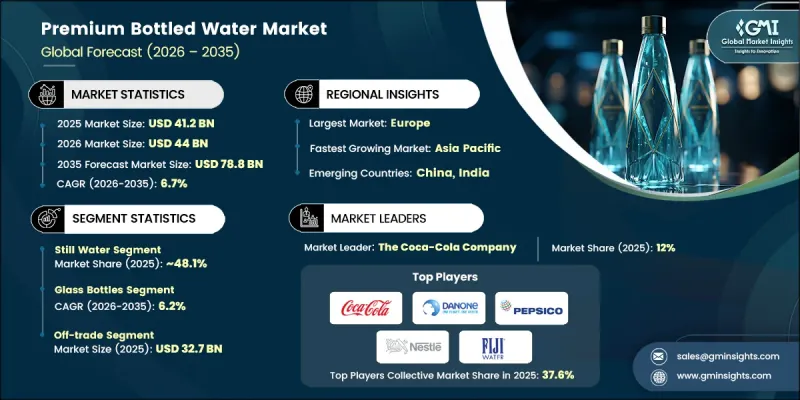
The industry is undergoing a dynamic transformation as consumer preferences increasingly align with health, wellness, and environmentally responsible choices. Demand for enhanced hydration solutions continues to rise, with consumers gravitating toward products formulated with added nutritional value. This trend is encouraging brands to elevate product positioning and introduce differentiated offerings that justify premium pricing. Sustainability has become a defining factor shaping purchasing behavior, prompting companies to adopt environmentally conscious packaging solutions and refine production practices. At the same time, visual appeal and packaging design are playing a growing role in strengthening brand identity and influencing purchase decisions. Distribution patterns indicate strong reliance on retail-driven channels, while hospitality-based channels contribute significantly to brand visibility and perception. Individual buyers account for the largest share of consumption, although institutional demand continues to support volume growth. Emerging regions are demonstrating steady expansion potential despite structural challenges. Overall, the market outlook remains optimistic, supported by innovation, premium positioning, and a strong focus on sustainability-led strategies.
| Market Scope | |
|---|---|
| Start Year | 2025 |
| Forecast Year | 2026-2035 |
| Start Value | $41.2 Billion |
| Forecast Value | $78.8 Billion |
| CAGR | 6.7% |
The still water segment accounted for 48.1% share in 2025 and is expected to grow at a CAGR of 6% through 2035. This category maintains a dominant position due to its widespread consumer acceptance and consistent demand patterns. In parallel, carbonated bottled water continues to gain traction as a preferred alternative within the broader beverage landscape, contributing to segment diversification.
The off-trade distribution segment generated USD 32.7 billion in 2025 and is anticipated to reach USD 60.6 billion by 2035, expanding at a CAGR of 6.4%. Retail-based channels continue to dominate due to their extensive accessibility and broad consumer reach. Additionally, digital sales platforms are gaining importance by enabling direct-to-consumer engagement, improving brand visibility, and supporting higher margins through streamlined distribution models.
North America Premium Bottled Water Market generated USD 13.8 billion in 2025. The region reflects a mature landscape characterized by high consumer awareness and well-established distribution networks. Ongoing innovation in packaging and sustainability initiatives continues to shape purchasing trends, while evolving consumer preferences are supporting increased demand for value-added water products.
Key players operating in the Global Premium Bottled Water Market include Danone S.A., PepsiCo Inc., The Coca-Cola Company, Nestle S.A., FIJI Water Company LLC, Nongfu Spring Co., Ltd., Tata Consumer Products Limited, Voss of Norway AS, Gerolsteiner Brunnen GmbH & Co. KG, and Groupe Castel. Companies in the premium bottled water market are strengthening their competitive position through product innovation, sustainability initiatives, and brand differentiation strategies. Many organizations are investing in advanced packaging solutions that reduce environmental impact while enhancing visual appeal. Strategic partnerships and distribution expansion are enabling broader market access and improved customer reach. Firms are also focusing on premiumization by introducing high-value formulations and unique product positioning to attract evolving consumer preferences. Digital transformation is playing a key role, with companies leveraging e-commerce and direct-to-consumer channels to enhance engagement and profitability.
Table of Contents
Chapter 1 Methodology & Scope
- 1.1 Research approach
- 1.2 Quality Commitments
- 1.2.1 GMI AI policy & data integrity commitment
- 1.2.1.1 Source consistency protocol
- 1.2.1 GMI AI policy & data integrity commitment
- 1.3 Research Trail & Confidence Scoring
- 1.3.1 Research Trail Components
- 1.3.2 Scoring Components
- 1.4 Data Collection
- 1.4.1 Partial list of primary sources
- 1.5 Data mining sources
- 1.5.1 Paid sources
- 1.5.1.1 Sources, by region
- 1.5.1 Paid sources
- 1.6 Base estimates and calculations
- 1.6.1 Base year calculation for any one approach
- 1.7 Forecast model
- 1.7.1 Quantified market impact analysis
- 1.7.1.1 Mathematical impact of growth parameters on forecast
- 1.7.1 Quantified market impact analysis
- 1.8 Research transparency addendum
- 1.8.1 Source attribution framework
- 1.8.2 Quality assurance metrics
- 1.8.3 Our commitment to trust
Chapter 2 Executive Summary
- 2.1 Industry 360° synopsis
- 2.2 Key market trends
- 2.2.1 Regional
- 2.2.2 Product Type
- 2.2.3 Packaging Type
- 2.2.4 Distribution Channel
- 2.2.5 End Users Segment
- 2.3 TAM Analysis, 2025-2034
- 2.4 CXO perspectives: Strategic imperatives
Chapter 3 Industry Insights
- 3.1 Industry ecosystem analysis
- 3.1.1 Supplier landscape
- 3.1.2 Profit margin
- 3.1.3 Value addition at each stage
- 3.1.4 Factor affecting the value chain
- 3.1.5 Disruptions
- 3.2 Industry impact forces
- 3.2.1 Growth drivers
- 3.2.2 Industry pitfalls and challenges
- 3.2.3 Market opportunities
- 3.3 Growth potential analysis
- 3.4 Regulatory landscape
- 3.4.1 North America
- 3.4.2 Europe
- 3.4.3 Asia Pacific
- 3.4.4 Latin America
- 3.4.5 Middle East & Africa
- 3.5 Porter's analysis
- 3.6 PESTEL analysis
- 3.7 Price trends
- 3.7.1 By region
- 3.7.2 By product type
- 3.8 Future market trends
- 3.9 Technology and Innovation landscape
- 3.9.1 Current technological trends
- 3.9.2 Emerging technologies
- 3.10 Patent Landscape
- 3.11 Trade statistics (HS code)
- 3.11.1 Major importing countries
- 3.11.2 Major exporting countries
- 3.12 Sustainability and environmental aspects
- 3.12.1 Sustainable practices
- 3.12.2 Waste reduction strategies
- 3.12.3 Energy efficiency in production
- 3.12.4 Eco-friendly initiatives
Chapter 4 Competitive Landscape, 2025
- 4.1 Introduction
- 4.2 Company market share analysis
- 4.2.1 By region
- 4.2.1.1 North America
- 4.2.1.2 Europe
- 4.2.1.3 Asia Pacific
- 4.2.1.4 LATAM
- 4.2.1.5 MEA
- 4.2.1 By region
- 4.3 Company matrix analysis
- 4.4 Competitive analysis of major market players
- 4.5 Competitive positioning matrix
- 4.6 Key developments
- 4.6.1 Mergers & acquisitions
- 4.6.2 Partnerships & collaborations
- 4.6.3 New Product Launches
- 4.6.4 Expansion Plans
Chapter 5 Market Estimates and Forecast, By Product Type, 2022-2035 (USD Million) (Kilo Tons)
- 5.1 Key trends
- 5.2 Still Water
- 5.3 Sparkling Water
- 5.4 Mineral Water
- 5.5 Functional Water
- 5.6 Flavored Water
Chapter 6 Market Estimates and Forecast, By Packaging Type, 2022-2035 (USD Million) (Kilo Tons)
- 6.1 Key trends
- 6.2 Plastic Bottles
- 6.3 Glass Bottles
- 6.4 Cans (Aluminum)
- 6.5 Alternative Packaging
Chapter 7 Market Estimates and Forecast, By Distribution Channel, 2022-2035 (USD Million) (Kilo Tons)
- 7.1 Key trends
- 7.2 On-Trade
- 7.3 Off-Trade
- 7.3.1 Supermarkets & Hypermarkets
- 7.3.2 Specialty Stores
- 7.3.3 Online
Chapter 8 Market Estimates and Forecast, By End User, 2022-2035 (USD Million) (Kilo Tons)
- 8.1 Key trends
- 8.2 Individual Consumers
- 8.3 Commercial Buyers
Chapter 9 Market Estimates and Forecast, By Region, 2022-2035 (USD Million) (Kilo Tons)
- 9.1 Key trends
- 9.2 North America
- 9.2.1 U.S.
- 9.2.2 Canada
- 9.3 Europe
- 9.3.1 Germany
- 9.3.2 UK
- 9.3.3 France
- 9.3.4 Spain
- 9.3.5 Italy
- 9.3.6 Rest of Europe
- 9.4 Asia Pacific
- 9.4.1 China
- 9.4.2 India
- 9.4.3 Japan
- 9.4.4 Australia
- 9.4.5 South Korea
- 9.4.6 Rest of Asia Pacific
- 9.5 Latin America
- 9.5.1 Brazil
- 9.5.2 Mexico
- 9.5.3 Argentina
- 9.5.4 Rest of Latin America
- 9.6 Middle East and Africa
- 9.6.1 Saudi Arabia
- 9.6.2 South Africa
- 9.6.3 UAE
- 9.6.4 Rest of Middle East and Africa
Chapter 10 Company Profiles
- 10.1 The Coca-Cola Company
- 10.2 Danone S.A.
- 10.3 PepsiCo Inc.
- 10.4 Nestle S.A.
- 10.5 FIJI Water Company LLC
- 10.6 Nongfu Spring Co., Ltd.
- 10.7 Voss of Norway AS
- 10.8 Gerolsteiner Brunnen GmbH & Co. KG
- 10.9 Groupe Castel (Cristalline)
- 10.10 Tata Consumer Products Limited

