PUBLISHER: Global Market Insights Inc. | PRODUCT CODE: 2038401

PUBLISHER: Global Market Insights Inc. | PRODUCT CODE: 2038401
Robotic Software Market Opportunity, Growth Drivers, Industry Trend Analysis, and Forecast 2026 - 2035
The Global Robotic Software Market was valued at USD 24.3 billion in 2025 and is estimated to grow at a CAGR of 22.6% to reach USD 185.2 billion by 2035.
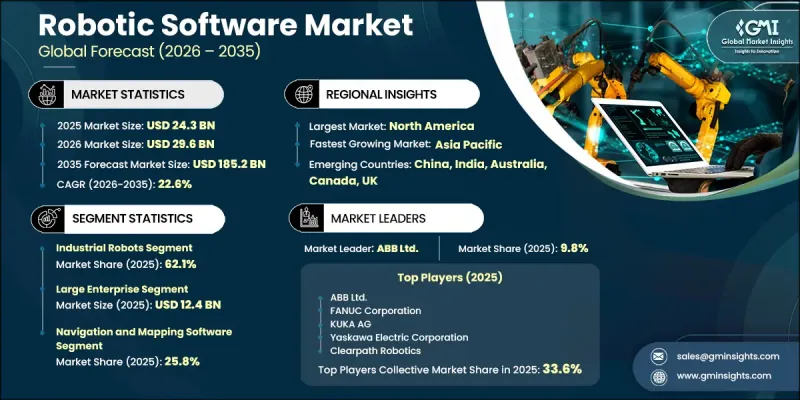
The industry is gaining strong momentum as organizations increasingly rely on intelligent automation powered by advanced software capabilities. The growing integration of artificial intelligence into robotic systems is enabling autonomous decision-making, improving efficiency, and enhancing operational precision. Rapid expansion of automation across logistics networks and industrial environments is further supporting market growth, while the rising adoption of Robotics-as-a-Service models is allowing businesses to scale operations without significant upfront investment. The emergence of digital twin technologies and simulation platforms is transforming how robotic systems are designed, tested, and deployed. Additionally, the incorporation of edge computing is enabling real-time processing and faster response times in robotic operations. Businesses are also prioritizing software-driven automation frameworks that deliver flexibility and improved control. The increasing demand for user-friendly development environments, including simplified programming interfaces, is making robotic software more accessible. These combined factors continue to strengthen the growth trajectory of the robotic software market across global industries.
| Market Scope | |
|---|---|
| Start Year | 2025 |
| Forecast Year | 2026-2035 |
| Start Value | $24.3 Billion |
| Forecast Value | $185.2 Billion |
| CAGR | 22.6% |
The robotic software industry is further supported by the rising need for intelligent automation solutions that can adapt to changing operational requirements. Organizations are increasingly adopting machine learning-enabled systems to enhance efficiency and gain real-time insights into processes. The shift toward software-defined automation has accelerated adoption, as companies seek scalable and flexible solutions that can be deployed quickly. Advancements in cloud-based robotics platforms are improving connectivity and enabling centralized control of robotic systems. At the same time, increasing focus on productivity optimization and seamless integration of robotics into diverse operational environments is contributing to sustained market expansion. The introduction of intuitive programming platforms is also reducing reliance on highly specialized technical expertise, making deployment easier for a wider range of businesses.
The service robots segment is expected to register a CAGR of 25.1% during 2026-2035, driven by rising demand for automation solutions designed for dynamic and interactive environments. These robots require advanced software capable of navigation, coordination, and interaction, making software innovation critical to their performance. Their ability to operate efficiently in varied conditions and support customer-facing functions is increasing their adoption among enterprises. The flexibility and scalability offered by service robot software solutions are enabling organizations to enhance productivity while maintaining operational agility, which continues to strengthen the segment's growth outlook.
The large enterprise segment captured USD 12.4 billion in 2025, supported by extensive deployment of robotic software across complex operational infrastructures. Large organizations rely on advanced automation systems to manage high production volumes, optimize workflows, and maintain operational continuity. These enterprises require robust software platforms capable of coordinating multiple robotic units while ensuring accuracy and efficiency. The need for reliable performance, predictive maintenance capabilities, and seamless integration across systems continues to drive demand within this segment, reinforcing its dominant position in the robotic software market.
North America Robotic Software Market accounted for a share of 35.3% in 2025, driven by strong investment in automation technologies and rapid adoption of advanced digital solutions. The region benefits from a well-established technological ecosystem that supports innovation in robotics and artificial intelligence. Companies are increasingly implementing robotic software to enhance efficiency across manufacturing and logistics operations. The growing focus on modernization and productivity improvement is encouraging the adoption of advanced automation platforms. Continuous technological advancements and increasing integration of intelligent systems are further strengthening the regional market landscape.
Prominent players operating in the Global Robotic Software Industry include ABB Ltd, Amazon Robotics (Amazon.com, Inc.), Autodesk, Inc., Blue Prism Group plc, Boston Dynamics, Clearpath Robotics, Cognex Corporation, Denso Corporation, FANUC Corporation, Hanson Robotics, iRobot Corporation, KUKA AG, Mitsubishi Electric Corporation, NVIDIA Corporation, Omron Corporation, Open Robotics (OSRF), Rockwell Automation, Inc., Siemens AG, SoftBank Robotics, Teradyne Inc., UiPath Inc., Universal Robots A/S, Vecna Robotics, and Yaskawa Electric Corporation. Companies operating in the Global Robotic Software Market are adopting a range of strategies to strengthen their competitive position and expand their global footprint. They are investing heavily in research and development to enhance AI capabilities, improve software functionality, and enable seamless integration with advanced hardware systems. Strategic collaborations and partnerships are being formed to accelerate innovation and access new markets. Businesses are also focusing on expanding their product portfolios with scalable and customizable solutions to meet diverse industry requirements. Emphasis on cloud-based platforms, edge computing, and real-time analytics is helping companies deliver high-performance solutions. Additionally, firms are prioritizing user-friendly interfaces and low-code development tools to broaden adoption. Continuous innovation, geographic expansion, and customer-centric solutions remain key to sustaining growth and market leadership.
Table of Contents
Chapter 1 Methodology and Scope
- 1.1 Market scope and definition
- 1.2 Research design
- 1.2.1 Research approach
- 1.2.2 Data collection methods
- 1.3 Data mining sources
- 1.3.1 Global
- 1.3.2 Regional/Country
- 1.4 Base estimates and calculations
- 1.4.1 Base year calculation
- 1.4.2 Key trends for market estimation
- 1.5 Primary research and validation
- 1.5.1 Primary sources
- 1.6 Forecast model
- 1.7 Research assumptions and limitations
Chapter 2 Executive Summary
- 2.1 Industry 360° synopsis, 2022 - 2035
- 2.2 Key market trends
- 2.2.1 Software type trends
- 2.2.2 Robot type trends
- 2.2.3 Deployment mode trends
- 2.2.4 Enterprise size trends
- 2.2.5 End-use industry trends
- 2.2.6 Regional trends
- 2.3 TAM Analysis, 2026-2035
- 2.4 CXO perspectives: Strategic imperatives
Chapter 3 Industry Insights
- 3.1 Industry ecosystem analysis
- 3.1.1 Supplier Landscape
- 3.1.2 Profit Margin
- 3.1.3 Cost structure
- 3.1.4 Value addition at each stage
- 3.1.5 Factor affecting the value chain
- 3.1.6 Disruptions
- 3.2 Industry impact forces
- 3.2.1 Growth drivers
- 3.2.1.1 AI-enabled autonomous decision-making in robotics
- 3.2.1.2 Rising warehouse automation in e-commerce logistics
- 3.2.1.3 Increased adoption of robotics-as-a-service models
- 3.2.1.4 Expansion of digital twins and simulation platforms
- 3.2.1.5 Integration of edge computing for real-time processing
- 3.2.2 Industry pitfalls and challenges
- 3.2.2.1 Interoperability issues across heterogeneous robot systems
- 3.2.2.2 Cybersecurity risks in connected robotic environments
- 3.2.3 Market opportunities
- 3.2.3.1 AI-driven predictive maintenance software expansion
- 3.2.3.2 Robotics software in healthcare and surgical automation
- 3.2.1 Growth drivers
- 3.3 Growth potential analysis
- 3.4 Regulatory landscape
- 3.4.1 North America
- 3.4.2 Europe
- 3.4.3 Asia Pacific
- 3.4.4 Latin America
- 3.4.5 Middle East & Africa
- 3.5 Porter's analysis
- 3.6 PESTEL analysis
- 3.7 Technology and Innovation landscape
- 3.7.1 Current technological trends
- 3.7.2 Emerging technologies
- 3.8 Price trends
- 3.8.1 By region
- 3.8.2 By product
- 3.9 Pricing Strategies
- 3.10 Emerging Business Models
- 3.11 Compliance Requirements
- 3.12 Patent and IP analysis
Chapter 4 Competitive Landscape, 2025
- 4.1 Introduction
- 4.2 Company market share analysis
- 4.2.1 By region
- 4.2.1.1 North America
- 4.2.1.2 Europe
- 4.2.1.3 Asia Pacific
- 4.2.1.4 Latin America
- 4.2.1.5 Middle East & Africa
- 4.2.2 Market concentration analysis
- 4.2.1 By region
- 4.3 Competitive benchmarking of key players
- 4.3.1 Financial performance comparison
- 4.3.1.1 Revenue
- 4.3.1.2 Profit margin
- 4.3.1.3 R&D
- 4.3.2 Product portfolio comparison
- 4.3.2.1 Product range breadth
- 4.3.2.2 Technology
- 4.3.2.3 Innovation
- 4.3.3 Geographic presence comparison
- 4.3.3.1 Global footprint analysis
- 4.3.3.2 Service network coverage
- 4.3.3.3 Market penetration by region
- 4.3.4 Competitive positioning matrix
- 4.3.4.1 Leaders
- 4.3.4.2 Challengers
- 4.3.4.3 Followers
- 4.3.4.4 Niche players
- 4.3.5 Strategic outlook matrix
- 4.3.1 Financial performance comparison
- 4.4 Key developments
- 4.4.1 Mergers and acquisitions
- 4.4.2 Partnerships and collaborations
- 4.4.3 Technological advancements
- 4.4.4 Expansion and investment strategies
- 4.4.5 Digital transformation initiatives
- 4.5 Emerging/ startup competitors landscape
Chapter 5 Market Estimates and Forecast, By Software Type, 2022 - 2035 (USD Million)
- 5.1 Key trends
- 5.2 Simulation software
- 5.3 Navigation and mapping software
- 5.4 Data analytics and management software
- 5.5 Vision software
- 5.6 Predictive maintenance software
- 5.7 Others
Chapter 6 Market Estimates and Forecast, By Robot Type, 2022 - 2035 (USD Million)
- 6.1 Key trends
- 6.2 Industrial robot
- 6.3 Service robots
Chapter 7 Market Estimates and Forecast, By Deployment Mode, 2022 - 2035 (USD Million)
- 7.1 Key trends
- 7.2 On-premises
- 7.3 Cloud-based
Chapter 8 Market Estimates and Forecast, By Enterprise Size, 2022 - 2035 (USD Million)
- 8.1 Key trends
- 8.2 Large enterprise
- 8.3 Small and medium enterprises (SMEs)
Chapter 9 Market Estimates and Forecast, By End-use Industry, 2022 - 2035 (USD Million)
- 9.1 Key trends
- 9.2 Manufacturing
- 9.3 Automotive
- 9.4 Healthcare
- 9.5 Transportation and logistics
- 9.6 BFSI
- 9.7 Retail & e-commerce
- 9.8 Others
Chapter 10 Market Estimates and Forecast, By Region, 2022 - 2035 (USD Million)
- 10.1 Key trends
- 10.2 North America
- 10.2.1 U.S.
- 10.2.2 Canada
- 10.3 Europe
- 10.3.1 Germany
- 10.3.2 UK
- 10.3.3 France
- 10.3.4 Spain
- 10.3.5 Italy
- 10.4 Asia Pacific
- 10.4.1 China
- 10.4.2 India
- 10.4.3 Japan
- 10.4.4 Australia
- 10.4.5 South Korea
- 10.5 Latin America
- 10.5.1 Brazil
- 10.5.2 Mexico
- 10.6 Middle East and Africa
- 10.6.1 South Africa
- 10.6.2 Saudi Arabia
- 10.6.3 UAE
Chapter 11 Company Profiles
- 11.1 Global Key Players
- 11.1.1 ABB Ltd
- 11.1.2 FANUC Corporation
- 11.1.3 KUKA AG
- 11.1.4 Yaskawa Electric Corporation
- 11.1.5 Siemens AG
- 11.2 Regional key players
- 11.2.1 North America
- 11.2.1.1 Amazon Robotics (Amazon.com, Inc.)
- 11.2.1.2 Boston Dynamics
- 11.2.1.3 Cognex Corporation
- 11.2.1.4 iRobot Corporation
- 11.2.1.5 Rockwell Automation, Inc.
- 11.2.1.6 Teradyne Inc.
- 11.2.2 Asia Pacific
- 11.2.2.1 Denso Corporation
- 11.2.2.2 Mitsubishi Electric Corporation
- 11.2.2.3 Omron Corporation
- 11.2.2.4 SoftBank Robotics
- 11.2.2.5 NVIDIA Corporation
- 11.2.3 Europe
- 11.2.3.1 Blue Prism Group plc
- 11.2.3.2 Universal Robots A/S
- 11.2.3.3 Autodesk, Inc.
- 11.2.1 North America
- 11.3 Niche Players/Disruptors
- 11.3.1 Clearpath Robotics
- 11.3.2 Hanson Robotics
- 11.3.3 Open Robotics (OSRF)
- 11.3.4 UiPath Inc.
- 11.3.5 Vecna Robotics

