PUBLISHER: Mordor Intelligence | PRODUCT CODE: 2123283

PUBLISHER: Mordor Intelligence | PRODUCT CODE: 2123283
Robot Software - Market Share Analysis, Industry Trends & Statistics, Growth Forecasts (2026 - 2031)
According to Mordor Intelligence, the robot software market size is projected to expand from USD 24.37 billion in 2025 to USD 29.64 billion in 2026 and is forecast to reach USD 78.81 billion by 2031, reflecting a 21.62% CAGR, underscoring the momentum behind intelligent automation across factories, hospitals, and warehouses.
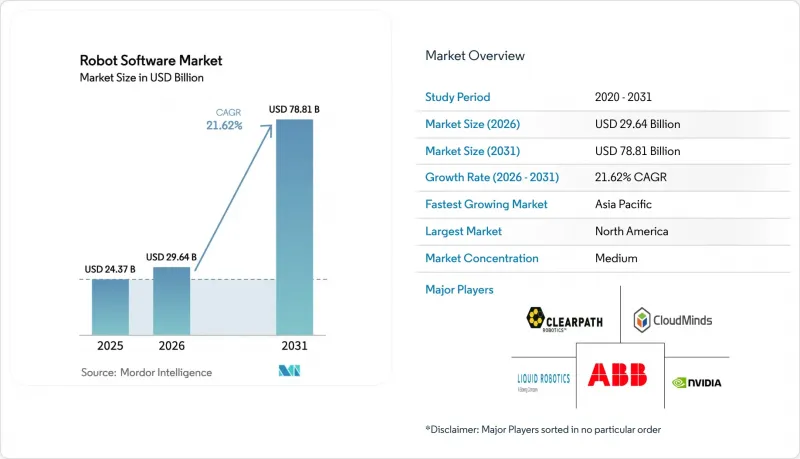
This report is Segmented by Software Type (Recognition, Simulation, Predictive Maintenance, and More), Robot Type (Industrial and Service), Deployment Model (On-Premise and Cloud and On-Demand), End-User Vertical (Automotive, Manufacturing, Healthcare, Transportation and Logistics, Retail and E-Commerce, and More), and Geography. The Market Forecasts are Provided in Terms of Value (USD).
Global Robot Software Market Trends and Insights
AI and ML Integration Boosts Robot Capability
Vision language action models now fuse perception and control, allowing robots to follow natural commands and adapt to unseen objects without retraining. The Jetson Thor module provides 2,000 TOPS of on-device compute, enabling humanoid robots to run multimodal models locally and prevent the 100 ms delays that jeopardize surgical precision. Intel RealSense SDK added depth-aware segmentation that lets collaborative robots differentiate a human hand from a workpiece, meeting ISO 10218-2 power-and-force thresholds. Manufacturers benefit because fewer labeled images are required, reducing dataset creation costs. The outcome is faster deployment of flexible cells that can switch product variants within an hour.
Rising Need for Automation and Safety
Aging workforces and low labor participation are structural realities, with Japan reporting a 370,000 manufacturing worker gap in 2025. The updated ISO 10218-1 sets torque and force limits that permit humans and robots to share spaces without cages, thereby increasing software complexity for real-time collision monitoring. UL 3300, the first dedicated safety standard for autonomous mobile robots, mandates redundant braking and lidar-based obstacle detection with a resolution of 0.1 m. Vendors that embed certified diagnostics and audit logging win share as risk-averse buyers aim to avoid recall costs. Smaller developers lacking compliance budgets are pivoting to platform partners for pre-validated stacks.
High Implementation Cost
Total ownership often exceeds USD 200,000 per cell once sensors, networks, and integration are counted, which 58% of manufacturers cited as the biggest hurdle in a 2025 survey. Thin-margin SMEs struggle to amortize expenses because they lack scale. Low-code tools shorten programming cycles, yet hardware and sensor bills are largely inelastic. Finance providers demand creditworthy counterparties, limiting leasing uptake in emerging markets. As interest rates trend higher, cash-flow-sensitive firms delay projects unless subsidies or tax credits offset upfront costs.
Other drivers and restraints analyzed in the detailed report include:
- Robot-as-a-Service Subscription Economics
- EU Safety-Driven ROS Virtualization Mandate (2027)
- Cyber-Security and Malware Threats
For complete list of drivers and restraints, kindly check the Table Of Contents.
Segment Analysis
Data management and analysis software held 34.74% of the 2025 base, demonstrating that users value fleet-wide telemetry aggregation for uptime and energy insights. This slice equated to roughly USD 10.3 billion of the robot software market size in 2025. Predictive maintenance algorithms reading vibration and current signatures now forecast bearing failures weeks ahead, letting procurement plan parts without expedite premiums. Standardized interfaces, such as OPC UA, simplify data extraction from mixed fleets, while transformer models detect anomaly patterns that were previously hidden in high-frequency time series. Communication management is expanding at a 21.98% CAGR because heterogeneous fleets dominate logistics centers where AMRs from several makers negotiate right of way in real time. VDA 5050, released in 2024, underpins this surge by defining a common message taxonomy. Recognition software is converging with transformer vision, enabling robots to achieve human-level detection accuracy. Simulation tools incorporate ISO safety templates, which shorten virtual commissioning. Edge inference is now compulsory in uptime-critical factories because cloud round trips breach deterministic budgets.
Product strategies are coalescing into platform bundles that merge orchestration, recognition, and predictive analytics. Vendors price these suites on a per-robot per-month basis, mirroring SaaS norms. Stand-alone point applications risk marginalization unless they integrate via open APIs. As competitive intensity rises, mergers focus on uniting simulation assets with runtime engines to control the full software lifecycle. The robot software market continues to reward products that convert raw sensor logs into actionable dashboards for line supervisors who lack data-science backgrounds.
Industrial robots owned 57.63% of deployments in 2025, equal to around USD 17.1 billion of robot software market size at that time. The share reflects deep entrenchment in automotive welding, painting, and battery pack assembly. Yet service robots are expanding at 23.1% annually, propelled by healthcare logistics, hospitality, and retail scanning. Intuitive Surgical's da Vinci platform performed more than two million procedures in 2024, validating clinical acceptance of machine assistance. Service robots must navigate unstructured spaces, interpret social cues, and comply with GDPR. Boston Dynamics' Spot quadruped now runs autonomous inspection in chemical plants via lidar and stereo fusion, highlighting how perception stacks migrate from labs to hazardous field sites.
Industrial units increasingly feature force-torque sensing, enabling safe human collaboration without cages. Modular designs decouple motion libraries from task logic so engineers swap end effectors without rewriting core code. Service platforms integrate cloud-based language models to enable voice commands at hotel counters. Cross-pollination is evident as Universal Robots ports its URScript environment to mobile bases, allowing integrators to blend manipulation and navigation within a single IDE. The robot software market benefits because each added use case translates into incremental license or subscription revenue rather than one-off sales.
Complete Report Scope:
- By Software Type
- Recognition Software
- Simulation Software
- Predictive Maintenance Software
- Data Management and Analysis Software
- Communication Management Software
- By Robot Type
- Industrial Robots
- Service Robots
- By Deployment Model
- On-Premise
- Cloud / On-Demand
- By End-user Vertical
- Automotive
- Manufacturing
- Healthcare
- Transportation and Logistics
- Retail and E-commerce
- IT and Telecommunications
- Government and Defense
- BFSI
- Aerospace and Defense
- Media and Entertainment
- Other End-user Verticals
- By Geography
- North America
- United States
- Canada
- Mexico
- South America
- Brazil
- Argentina
- Rest of South America
- Europe
- Germany
- United Kingdom
- France
- Italy
- Spain
- Rest of Europe
- Asia-Pacific
- China
- Japan
- India
- South Korea
- ASEAN
- Rest of Asia-Pacific
- Middle East and Africa
- Middle East
- Saudi Arabia
- United Arab Emirates
- Rest of Middle East
- Africa
- South Africa
- Nigeria
- Rest of Africa
- Middle East
- North America
Geography Analysis
North America held 38.73% revenue in 2025, buoyed by early automotive and semiconductor adoption plus a deep robotics talent pool anchored by MIT and Carnegie Mellon. The United States supplies the bulk of demand, with Mexico's nearshoring boom pulling in high-mix automation projects. Canada leverages AI research clusters to commercialize reinforcement learning that optimizes robot policy updates.
Asia-Pacific is the fastest climber with a 22.44% CAGR through 2031, propelled by China's plan to deploy 1 million humanoid robots by 2030 and India's subsidies covering up to 25% of capex for factory automation. Japan combats demographic headwinds with service robots in eldercare, while South Korea intersects automotive heritage with Boston Dynamics mobility know-how. ASEAN nations such as Vietnam attract electronics relocations, nudging small batch manufacturers toward cloud orchestration to compensate for labor gaps.
Europe's trajectory is shaped by safety and cybersecurity regulations that mandate virtual validation and prompt patching, thereby advantaging vendors with compliance expertise. Germany's automotive and machinery sectors still dominate installations, but Italy's SME-focused schemes favor low-code cobots. The United Kingdom and France channel public funds into simulation and AI labs that inform next-generation perception stacks. South America remains emergent, with Brazilian car plants piloting collaborative welding cells. The Middle East leans on logistics hubs in the United Arab Emirates that run AMR fleets in ports and free zones. Africa sees early pilots in mining and agro-processing, though bandwidth and capital bottlenecks slow scaling. Across regions, public incentives, broadband coverage, and security regimes shape uptake and vendor entry strategies.
- ABB Ltd.
- IBM Corporation
- NVIDIA Corporation
- Brain Corporation
- CloudMinds Technology Inc.
- Clearpath Robotics Inc.
- Liquid Robotics, Inc.
- AIBrain Inc.
- Furhat Robotics AB
- Neurala Inc.
- Energid Technologies Corporation
- H2O.ai Inc.
- Oxbotica Ltd.
- Anscer Robotics Pvt. Ltd.
- Quale Infotech Pvt. Ltd.
- Universal Robots A/S
- FANUC Corporation
- KUKA Aktiengesellschaft
- Yaskawa Electric Corporation
- Boston Dynamics Inc.
- Microsoft Corporation
- Amazon Web Services Inc.
Additional Benefits:
- The market estimate (ME) sheet in Excel format
- 3 months of analyst support
TABLE OF CONTENTS
1 INTRODUCTION
- 1.1 Study Assumptions and Market Definition
- 1.2 Scope of the Study
2 RESEARCH METHODOLOGY
3 EXECUTIVE SUMMARY
4 MARKET LANDSCAPE
- 4.1 Market Overview
- 4.2 Market Drivers
- 4.2.1 Rising Need for Automation and Safety
- 4.2.2 Rapid SME Adoption to Cut Labor / Energy Cost
- 4.2.3 AI/ML Integration Boosts Robot Capability
- 4.2.4 Low-/no-code Robot-app Platforms Expand Adoption
- 4.2.5 EU Safety-driven ROS Virtualization Mandate (2027)
- 4.2.6 Robot-as-a-Service Subscription Economics
- 4.3 Market Restraints
- 4.3.1 High Implementation Cost
- 4.3.2 Cyber-security and Malware Threats
- 4.3.3 Shortage of Safety-Certified Software Engineers
- 4.3.4 Vendor Lock-in from Proprietary OS Stacks
- 4.4 Industry Value Chain Analysis
- 4.5 Regulatory Landscape
- 4.6 Technological Outlook
- 4.7 Porter's Five Forces Analysis
- 4.7.1 Bargaining Power of Suppliers
- 4.7.2 Bargaining Power of Consumers
- 4.7.3 Threat of New Entrants
- 4.7.4 Threat of Substitutes
- 4.7.5 Intensity of Competitive Rivalry
- 4.8 Assessment of Macroeconomic Factors on the Market
- 4.9 Investment Analysis
5 MARKET SIZE AND GROWTH FORECASTS (VALUE)
- 5.1 By Software Type
- 5.1.1 Recognition Software
- 5.1.2 Simulation Software
- 5.1.3 Predictive Maintenance Software
- 5.1.4 Data Management and Analysis Software
- 5.1.5 Communication Management Software
- 5.2 By Robot Type
- 5.2.1 Industrial Robots
- 5.2.2 Service Robots
- 5.3 By Deployment Model
- 5.3.1 On-Premise
- 5.3.2 Cloud / On-Demand
- 5.4 By End-user Vertical
- 5.4.1 Automotive
- 5.4.2 Manufacturing
- 5.4.3 Healthcare
- 5.4.4 Transportation and Logistics
- 5.4.5 Retail and E-commerce
- 5.4.6 IT and Telecommunications
- 5.4.7 Government and Defense
- 5.4.8 BFSI
- 5.4.9 Aerospace and Defense
- 5.4.10 Media and Entertainment
- 5.4.11 Other End-user Verticals
- 5.5 By Geography
- 5.5.1 North America
- 5.5.1.1 United States
- 5.5.1.2 Canada
- 5.5.1.3 Mexico
- 5.5.2 South America
- 5.5.2.1 Brazil
- 5.5.2.2 Argentina
- 5.5.2.3 Rest of South America
- 5.5.3 Europe
- 5.5.3.1 Germany
- 5.5.3.2 United Kingdom
- 5.5.3.3 France
- 5.5.3.4 Italy
- 5.5.3.5 Spain
- 5.5.3.6 Rest of Europe
- 5.5.4 Asia-Pacific
- 5.5.4.1 China
- 5.5.4.2 Japan
- 5.5.4.3 India
- 5.5.4.4 South Korea
- 5.5.4.5 ASEAN
- 5.5.4.6 Rest of Asia-Pacific
- 5.5.5 Middle East and Africa
- 5.5.5.1 Middle East
- 5.5.5.1.1 Saudi Arabia
- 5.5.5.1.2 United Arab Emirates
- 5.5.5.1.3 Rest of Middle East
- 5.5.5.2 Africa
- 5.5.5.2.1 South Africa
- 5.5.5.2.2 Nigeria
- 5.5.5.2.3 Rest of Africa
- 5.5.5.1 Middle East
- 5.5.1 North America
6 COMPETITIVE LANDSCAPE
- 6.1 Market Concentration
- 6.2 Strategic Moves
- 6.3 Market Share Analysis
- 6.4 Company Profiles (includes Global level Overview, Market level overview, Core Segments, Financials as available, Strategic Information, Market Rank/Share for key companies, Products and Services, and Recent Developments)
- 6.4.1 ABB Ltd.
- 6.4.2 IBM Corporation
- 6.4.3 NVIDIA Corporation
- 6.4.4 Brain Corporation
- 6.4.5 CloudMinds Technology Inc.
- 6.4.6 Clearpath Robotics Inc.
- 6.4.7 Liquid Robotics, Inc.
- 6.4.8 AIBrain Inc.
- 6.4.9 Furhat Robotics AB
- 6.4.10 Neurala Inc.
- 6.4.11 Energid Technologies Corporation
- 6.4.12 H2O.ai Inc.
- 6.4.13 Oxbotica Ltd.
- 6.4.14 Anscer Robotics Pvt. Ltd.
- 6.4.15 Quale Infotech Pvt. Ltd.
- 6.4.16 Universal Robots A/S
- 6.4.17 FANUC Corporation
- 6.4.18 KUKA Aktiengesellschaft
- 6.4.19 Yaskawa Electric Corporation
- 6.4.20 Boston Dynamics Inc.
- 6.4.21 Microsoft Corporation
- 6.4.22 Amazon Web Services Inc.
7 MARKET OPPORTUNITIES AND FUTURE OUTLOOK
- 7.1 White-space and Unmet-need Assessment

