PUBLISHER: Global Market Insights Inc. | PRODUCT CODE: 2038414

PUBLISHER: Global Market Insights Inc. | PRODUCT CODE: 2038414
Solar Water Pumps Market Opportunity, Growth Drivers, Industry Trend Analysis, and Forecast 2026 - 2035
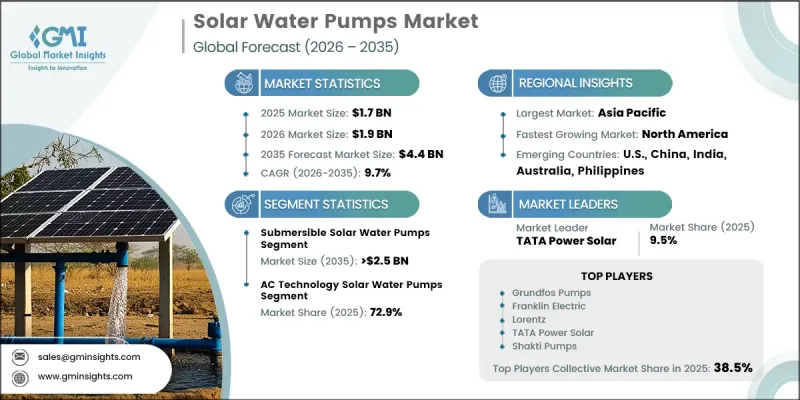
The Global Solar Water Pumps Market was valued at USD 1.7 billion in 2025 and is estimated to grow at a CAGR of 9.7% to reach USD 4.4 billion by 2035.
The industry is witnessing strong momentum, largely supported by government-backed subsidy programs aligned with renewable energy targets. Rising demand for sustainable irrigation solutions is accelerating adoption, particularly in regions where conventional electricity access remains limited. Agricultural dependence in such areas is driving the need for efficient water management systems that can improve productivity. Solar-powered pumping solutions are increasingly recognized for their ability to enhance irrigation efficiency while reducing operational costs. The growing focus on energy independence, coupled with environmental sustainability goals, is further strengthening market growth. Continuous technological advancements in photovoltaic systems and pump efficiency are improving system performance and reliability. In addition, financial incentives and policy support are encouraging broader deployment of these systems. Expanding interest in precision irrigation practices and the integration of advanced energy storage technologies are further contributing to the market's long-term expansion, positioning solar water pumps as a key solution for sustainable water management.
| Market Scope | |
|---|---|
| Start Year | 2025 |
| Forecast Year | 2026-2035 |
| Start Value | $1.7 Billion |
| Forecast Value | $4.4 Billion |
| CAGR | 9.7% |
Solar water pumps operate by converting solar energy into electricity through photovoltaic modules, which then power water pumping systems for various applications. These systems are widely recognized for their low maintenance requirements, cost efficiency, and environmentally friendly nature. Their ability to deliver reliable water supply while minimizing operational expenses is driving widespread adoption. Ongoing advancements in solar panel efficiency, intelligent pump control systems, and energy storage solutions are enhancing system effectiveness and supporting market growth.
The submersible solar water pumps segment is expected to reach USD 2.5 billion by 2035, driven by increasing adoption of solar-powered irrigation systems and rising awareness regarding water conservation. These systems offer advantages such as improved efficiency and the ability to extract water directly from sources, making them highly effective. The growing demand for sustainable water usage solutions and low-maintenance equipment is further supporting segment expansion.
The AC technology solar water pumps segment accounted for 72.9% share in 2025. Strong government support for renewable energy adoption and the integration of solar solutions into broader energy systems are contributing to segment growth. These systems provide an efficient and environmentally sustainable alternative to traditional power-driven pumps, improving operational performance while reducing environmental impact.
U.S. Solar Water Pumps Market reached USD 134.1 million in 2025, supported by favorable government initiatives aimed at promoting renewable energy adoption and reducing dependence on conventional energy sources. Increasing emphasis on sustainable water management practices is further strengthening market demand. Growing deployment of solar pumping systems in off-grid areas, along with rising adoption of advanced irrigation techniques, is enhancing the overall industry outlook.
Key companies operating in the Global Solar Water Pumps Market include Shakti Pumps, Tata Solar Power, Grundfos Pumps, Franklin Electric, Lorentz, Crompton Greaves, Aqua Group, Bright Solar, Ecozen, Jakson Group, Novergy Energy Solutions, Oswal, Surya International, Symtech Solar Group, US Solar Pumps, Alpex Power, EcoSoch, Lubi, Dankoff Solar, and Wenling Jintai Pump Factory. Companies in the solar water pumps market are focusing on innovation, strategic alliances, and geographic expansion to strengthen their competitive position. Many players are investing in advanced technologies to improve system efficiency, durability, and energy output. Partnerships with government bodies and agricultural organizations are helping companies expand their reach and increase product adoption. Firms are also enhancing their distribution networks and after-sales services to build long-term customer relationships.
Table of Contents
Chapter 1 Methodology & Scope
- 1.1 Research approach
- 1.2 Quality commitments
- 1.2.1 GMI AI policy & data integrity commitment
- 1.2.1.1 Source consistency protocol
- 1.2.1 GMI AI policy & data integrity commitment
- 1.3 Research trail & confidence scoring
- 1.3.1 Research trail components
- 1.3.2 Scoring components
- 1.4 Data collection
- 1.4.1 Partial list of primary sources
- 1.5 Data mining sources
- 1.5.1 Paid sources
- 1.5.1.1 Sources, by region
- 1.5.1 Paid sources
- 1.6 Base estimates and calculations
- 1.6.1 Base year calculation for any one approach
- 1.7 Market estimates & forecasts parameters
- 1.8 Forecast model
- 1.8.1 Quantified market impact analysis
- 1.8.1.1 Mathematical impact of growth parameters on forecast
- 1.8.1 Quantified market impact analysis
- 1.9 Research transparency addendum
- 1.9.1 Source attribution framework
- 1.9.2 Quality assurance metrics
- 1.9.3 Our commitment to trust
- 1.10 Market definitions
Chapter 2 Executive Summary
- 2.1 Industry synopsis, 2022 - 2035
- 2.1.1 Business trends
- 2.1.2 Product trends
- 2.1.3 Technology trends
- 2.1.4 Power rating trends
- 2.1.5 Application trends
- 2.1.6 Regional trends
Chapter 3 Industry Insights
- 3.1 Industry ecosystem analysis
- 3.1.1 Raw material availability & sourcing analysis
- 3.1.2 Manufacturing capacity assessment
- 3.1.3 Supply chain resilience & risk factors
- 3.1.4 Distribution network analysis
- 3.2 Industry impact forces
- 3.2.1 Growth drivers
- 3.2.2 Industry pitfalls & challenges
- 3.3 Regulatory landscape
- 3.4 Growth potential analysis
- 3.5 Porter's analysis
- 3.5.1 Bargaining power of suppliers
- 3.5.2 Bargaining power of buyers
- 3.5.3 Threat of new entrants
- 3.5.4 Threat of substitutes
- 3.6 PESTEL analysis
- 3.6.1 Political factors
- 3.6.2 Economic factors
- 3.6.3 Social factors
- 3.6.4 Technological factors
- 3.6.5 Legal factors
- 3.6.6 Environmental factors
- 3.7 Cost structure analysis of solar water pumps
- 3.8 Emerging opportunities & trends
- 3.9 Digitalization & IoT integration
- 3.10 Growth in untapped markets & applications
- 3.11 Investment analysis & future prospects
- 3.12 Price trend analysis (USD/Unit) (Driven by Primary Research)
- 3.12.1 By region (Driven by Primary Research)
- 3.12.2 By power rating (Driven by Primary Research)
- 3.13 Trade data analysis (Driven by Primary Research)
- 3.13.1 Import/export value trends (Driven by Primary Research)
- 3.13.2 Key trade corridors & tariff impact (Driven by Primary Research)
- 3.14 Impact of AI & Generative AI on the market (Driven by Primary Research)
- 3.14.1 AI-Driven production optimization (Driven by Primary Research)
- 3.14.2 Predictive maintenance & fault detection (Driven by Primary Research)
Chapter 4 Competitive Landscape, 2026
- 4.1 Introduction
- 4.2 Company market share analysis, by region, 2025
- 4.2.1 North America
- 4.2.2 Europe
- 4.2.3 Asia Pacific
- 4.2.4 Middle East & Africa
- 4.2.5 Latin America
- 4.3 Competitive positioning matrix
- 4.4 Key developments
- 4.4.1 Mergers & acquisitions
- 4.4.2 Partnerships & collaborations
- 4.4.3 New product launches
- 4.4.4 Expansion plans & funding
- 4.5 Company tier benchmarking
- 4.5.1 Tier classification criteria & qualifying thresholds
- 4.5.2 Tier positioning matrix by revenue, geography & innovation
Chapter 5 Market Size and Forecast, By Product, 2022 - 2035 (USD Million & Units)
- 5.1 Key trends
- 5.2 Submersible pump
- 5.3 Surface pump
Chapter 6 Market Size and Forecast, By Technology, 2022 - 2035 (USD Million & Units)
- 6.1 Key trends
- 6.2 AC pumps
- 6.3 DC pumps
Chapter 7 Market Size and Forecast, By Power Rating, 2022 - 2035 (USD Million & Units)
- 7.1 Key trends
- 7.2 ≤ 5 HP
- 7.3 > 5 HP - 10 HP
- 7.4 > 10 HP - 20 HP
- 7.5 > 20 HP
Chapter 8 Market Size and Forecast, By Application, 2022 - 2035 (USD Million & Units)
- 8.1 Key trends
- 8.2 Agriculture
- 8.3 Water supply
- 8.4 Others
Chapter 9 Market Size and Forecast, By Region, 2022 - 2035 (USD Million & Units)
- 9.1 Key trends
- 9.2 North America
- 9.2.1 U.S.
- 9.2.2 Canada
- 9.3 Europe
- 9.3.1 UK
- 9.3.2 France
- 9.3.3 Germany
- 9.3.4 Russia
- 9.3.5 Spain
- 9.3.6 Italy
- 9.3.7 Netherlands
- 9.3.8 Poland
- 9.3.9 Sweden
- 9.4 Asia Pacific
- 9.4.1 India
- 9.4.2 Australia
- 9.4.3 Philippines
- 9.4.4 Japan
- 9.4.5 New Zealand
- 9.4.6 Indonesia
- 9.4.7 Thailand
- 9.4.8 Malaysia
- 9.5 Middle East & Africa
- 9.5.1 Saudi Arabia
- 9.5.2 Iran
- 9.5.3 Egypt
- 9.5.4 Turkey
- 9.5.5 South Africa
- 9.6 Latin America
- 9.6.1 Brazil
- 9.6.2 Argentina
- 9.6.3 Peru
- 9.6.4 Mexico
Chapter 10 Company Profiles
- 10.1 Alpex Power
- 10.2 Aqua Group
- 10.3 Bright Solar
- 10.4 Crompton Greaves
- 10.5 Dankoff Solar
- 10.6 EcoSoch
- 10.7 Ecozen
- 10.8 Franklin Electric
- 10.9 Grundfos Pumps
- 10.10 Jakson Group
- 10.11 Lorentz
- 10.12 Lubi
- 10.13 Novergy Energy Solutions
- 10.14 Oswal
- 10.15 Shakti Pumps
- 10.16 Surya International
- 10.17 Symtech Solar Group
- 10.18 TATA Solar Power
- 10.19 US Solar Pumps
- 10.20 Wenling Jintai Pump Factory

