PUBLISHER: Global Market Insights Inc. | PRODUCT CODE: 2038421

PUBLISHER: Global Market Insights Inc. | PRODUCT CODE: 2038421
Oil Immersed Shunt Reactor Market Opportunity, Growth Drivers, Industry Trend Analysis, and Forecast 2026 - 2035
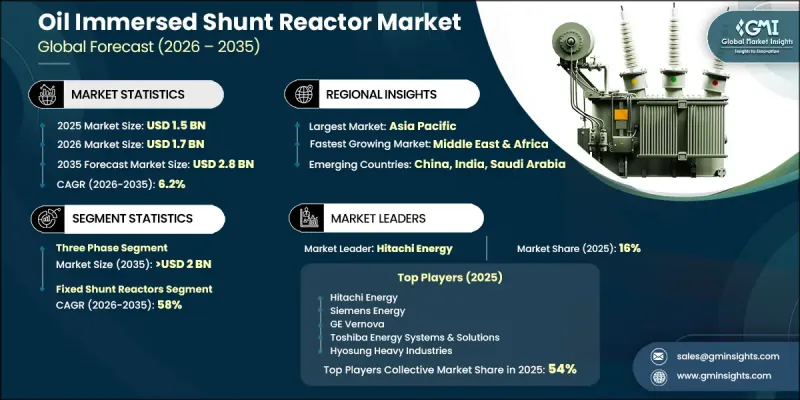
The Global Oil Immersed Shunt Reactor Market was valued at USD 1.5 billion in 2025 and is estimated to grow at a CAGR of 6.2% to reach USD 2.8 billion by 2035.
Market expansion is driven by rising global electricity consumption, large-scale grid modernization programs, and the accelerating transition toward renewable energy integration. Increasing deployment of advanced transmission infrastructure is strengthening the need for voltage control and reactive power management solutions, where oil immersed shunt reactors play a critical role. Continuous improvements in insulation systems and cooling technologies are enhancing the operational efficiency, reliability, and service life of these reactors. In parallel, stricter environmental regulations are encouraging the development of eco-efficient designs and materials, supporting sustainable power infrastructure development. Rapid urban expansion and industrial growth, particularly across emerging economies, are further increasing demand for stable and efficient power transmission systems. Developed economies are also focusing on replacing aging grid infrastructure with advanced solutions to improve performance and reliability. Additionally, digital monitoring technologies and smart grid integration are improving system optimization, while increased investments in high-voltage transmission networks are reinforcing long-distance power flow stability and overall grid resilience.
| Market Scope | |
|---|---|
| Start Year | 2025 |
| Forecast Year | 2026-2035 |
| Start Value | $1.5 Billion |
| Forecast Value | $2.8 Billion |
| CAGR | 6.2% |
The three phase oil immersed shunt reactor segment is projected to reach USD 2 billion by 2035. Market growth in this category is primarily driven by expanding grid interconnections, renewable energy integration, and rising demand for efficient high-voltage transmission systems. These reactors are widely preferred in utility-scale and heavy industrial applications due to their strong performance under high-load conditions and improved system stability.
The fixed shunt reactors segment accounted for a 58% share in 2025 and is anticipated to grow at a CAGR of 5.5% through 2035. This segment's growth is supported by rising investments in transmission infrastructure and the increasing penetration of renewable energy sources, which require advanced voltage regulation technologies. The demand for improved grid stability and reliable power delivery continues to drive adoption across utility networks worldwide.
U.S. Oil Immersed Shunt Reactor Market was valued at USD 191.8 million in 2025 and is expected to reach USD 290 million by 2035. Growth is being driven by the ongoing modernization of electrical grids and the expansion of renewable energy capacity. The increasing adoption of wind and solar power is further boosting demand for reactive power compensation solutions to ensure grid stability. At the same time, Asia Pacific is witnessing rapid market expansion due to strong infrastructure development, rising energy consumption, and large-scale grid upgrades across countries with increasing transmission network requirements.
Key companies operating in the Global Oil Immersed Shunt Reactor Market include Siemens Energy, Hitachi Energy, GE Vernova, Fuji Electric, Hyosung Heavy Industries, Toshiba Energy Systems & Solutions, CG Power & Industrial Solutions, SGB SMIT, Trench Group, Nissin Electric, Prolec Energy, WEG, GETRA, Coil Innovation, Pennsylvania Transformer, TMC Transformers Manufacturing Company, Phoenix Electric, Shrihans Electricals, GBE, and HICO America. Companies in the oil immersed shunt reactor market are strengthening their market position through strategic partnerships, technological innovation, and increased investment in research and development. Manufacturers are focusing on improving reactor efficiency, thermal performance, and insulation systems to enhance operational reliability. Expansion of production capacity and localization strategies are helping firms meet rising regional demand more effectively. Digitalization and integration of smart monitoring systems are being adopted to enable predictive maintenance and improved asset management. Companies are also prioritizing eco-friendly designs and sustainable materials to align with global environmental regulations.
Table of Contents
Chapter 1 Methodology & Scope
- 1.1 Research approach
- 1.2 Quality commitment
- 1.2.1 GMI AI policy & data integrity commitment
- 1.2.1.1 Source consistency protocol
- 1.2.1 GMI AI policy & data integrity commitment
- 1.3 Research Trail & Confidence Scoring
- 1.3.1 Research Trail Components
- 1.3.2 Scoring Components
- 1.4 Data Collection
- 1.4.1 Partial list of primary sources
- 1.5 Data mining sources
- 1.5.1 Paid sources
- 1.5.1.1 Sources, by region
- 1.5.1 Paid sources
- 1.6 Base estimates and calculations
- 1.6.1 Base year calculation for any one approach
- 1.7 Forecast model
- 1.8 Research transparency addendum
- 1.8.1 Source attribution framework
- 1.8.2 Quality assurance metrics
- 1.8.3 Our commitment to trust
- 1.8.3.1 Market definitions
Chapter 2 Executive Summary
- 2.1 Industry synopsis, 2022 - 2035
- 2.2 Business trends
- 2.3 Phase trends
- 2.4 Product trends
- 2.5 End use trends
- 2.6 Regional trends
Chapter 3 Industry Insights
- 3.1 Industry ecosystem analysis
- 3.2 Regulatory landscape
- 3.3 Industry impact forces
- 3.3.1 Growth drivers
- 3.3.2 Industry pitfalls & challenges
- 3.4 Growth potential analysis
- 3.5 Porter's analysis
- 3.5.1 Bargaining power of suppliers
- 3.5.2 Bargaining power of buyers
- 3.5.3 Threat of new entrants
- 3.5.4 Threat of substitutes
- 3.6 PESTEL analysis
- 3.7 Cost structure analysis of shunt reactors
- 3.8 Trade data analysis (Driven by Primary Research)
- 3.8.1 Import/export value trends (Driven by Primary Research)
- 3.8.2 Key trade corridors & tariff impact (Driven by Primary Research)
- 3.9 Production capacity & utilization (Driven by Primary Research)
- 3.9.1 Production capacity by region (Driven by Primary Research)
- 3.9.2 Utilization rates and expansion pipeline (Driven by Primary Research)
- 3.10 Impact of AI & generative AI on the market [SOLUTION CORE]
- 3.10.1 AI-driven disruption of existing business models
- 3.10.2 GenAI use cases & adoption roadmap by segment
- 3.10.2.1 Predictive maintenance & fault detection
- 3.10.2.2 Digital twin simulation & testing
- 3.10.3 Risks, limitations & regulatory considerations
- 3.11 Emerging opportunities & trends
- 3.12 Investment analysis & future outlook
Chapter 4 Competitive Landscape, 2026
- 4.1 Introduction
- 4.2 Company market share analysis, by region, 2025
- 4.2.1 North America
- 4.2.2 Europe
- 4.2.3 Asia Pacific
- 4.2.4 Middle East & Africa
- 4.2.5 Latin America
- 4.3 Competitive positioning matrix
- 4.4 Key Developments
- 4.4.1 Mergers & acquisitions
- 4.4.2 Partnerships & collaborations
- 4.4.3 New product launches
- 4.4.4 Expansion plans and funding
Chapter 5 Market Size and Forecast, By Phase, 2022 - 2035 (USD Million)
- 5.1 Key trends
- 5.2 Single phase
- 5.3 Three phase
Chapter 6 Market Size and Forecast, By Product, 2022 - 2035 (USD Million)
- 6.1 Key trends
- 6.2 Fixed shunt reactors
- 6.3 Variable shunt reactors
Chapter 7 Market Size and Forecast, By End Use, 2022 - 2035 (USD Million)
- 7.1 Key trends
- 7.2 Electric utility
- 7.3 Renewable energy
Chapter 8 Market Size and Forecast, By Region, 2022 - 2035 (USD Million)
- 8.1 Key trends
- 8.2 North America
- 8.2.1 U.S.
- 8.2.2 Canada
- 8.3 Europe
- 8.3.1 UK
- 8.3.2 Germany
- 8.3.3 France
- 8.3.4 Italy
- 8.3.5 Russia
- 8.4 Asia Pacific
- 8.4.1 China
- 8.4.2 India
- 8.4.3 Japan
- 8.4.4 Australia
- 8.5 Middle East & Africa
- 8.5.1 Saudi Arabia
- 8.5.2 UAE
- 8.5.3 Qatar
- 8.5.4 South Africa
- 8.6 Latin America
- 8.6.1 Brazil
- 8.6.2 Argentina
Chapter 9 Company Profiles
- 9.1 CG Power & Industrial Solutions
- 9.2 Coil Innovation
- 9.3 Fuji Electric
- 9.4 GE Vernova
- 9.5 GBE
- 9.6 GETRA
- 9.7 HICO America
- 9.8 Hitachi Energy
- 9.9 Hyosung Heavy Industries
- 9.10 Nissin Electric
- 9.11 Pennsylvania Transformer
- 9.12 Phoenix Electric
- 9.13 Prolec Energy
- 9.14 SGB SMIT
- 9.15 Shrihans Electricals
- 9.16 Siemens Energy
- 9.17 TMC Transformers Manufacturing Company
- 9.18 Toshiba Energy Systems & Solutions
- 9.19 Trench Group
- 9.20 WEG

