PUBLISHER: Global Market Insights Inc. | PRODUCT CODE: 2038469

PUBLISHER: Global Market Insights Inc. | PRODUCT CODE: 2038469
Barley Market Opportunity, Growth Drivers, Industry Trend Analysis, and Forecast 2026 - 2035
The Global Barley Market was valued at USD 22.1 billion in 2025 and is estimated to grow at a CAGR of 3.2% to reach USD 30.1 billion by 2035.
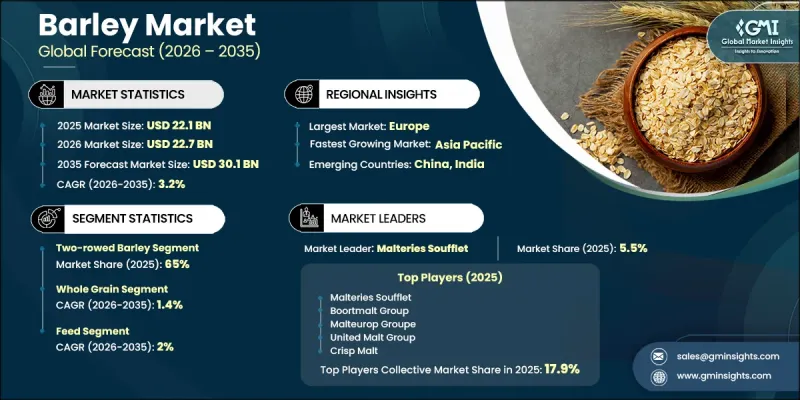
The market is showing steady growth, supported by shifting demand across brewing, food processing, and animal feed industries. One of the most influential trends is the rising requirement for premium malting barley, particularly from the expanding craft and specialty beer segment. Barley is increasingly recognized for its nutritional benefits, especially its soluble fiber and beta-glucan content, leading to wider incorporation into cereals, snacks, and functional beverages targeted at health-focused consumers. This demand is particularly strong in urban regions where plant-based and heart-supportive diets are gaining traction, further broadening barley's role in the global food ecosystem. Breweries are increasingly seeking differentiated raw material inputs to create unique taste profiles, which is encouraging farmers to cultivate specialized malting barley varieties with defined protein and enzyme characteristics. This evolution is strengthening collaboration across the supply chain, especially in regions such as North America and Europe. At the same time, barley's positioning as a functional ingredient is gaining momentum, as food manufacturers expand its use in clean-label and wellness-oriented products.
| Market Scope | |
|---|---|
| Start Year | 2025 |
| Forecast Year | 2026-2035 |
| Start Value | $22.1 Billion |
| Forecast Value | $30.1 Billion |
| CAGR | 3.2% |
The two-row barley segment held a 65% share in 2025 and is expected to grow at a CAGR of 3.6% through 2035. Its dominance is primarily attributed to its uniform kernel size and comparatively lower protein levels, making it highly suitable for malting and brewing applications. This consistency supports efficient processing and ensures stable quality output, reinforcing its strong preference across brewing industries.
The whole grain segment accounted for USD 9.9 billion in 2025 and is projected to grow at a CAGR of 1.4% between 2026 and 2035. Demand for whole grain and pearled barley is increasing as consumers continue to shift toward healthier eating habits. These forms of barley are widely used in food products due to their nutritional profile and compatibility with wellness-oriented diets.
North America Barley Market is expected to grow at a CAGR of 2% during 2026 to 2035. Regional demand is primarily supported by the brewing and livestock feed industries. The United States and Canada remain major producers, benefiting from advanced agricultural practices and well-established supply chain systems that enable consistent production of high-quality malting barley. Market dynamics are increasingly influenced by climate variations, changing beer consumption patterns, and rising interest in specialty and alternative barley-based food products across the value chain.
Major players operating in the Global Barley Industry include: Malteries Soufflet, Boortmalt Group, Malteurop Groupe, Crisp Malt, Muntons Plc, Simpsons Malt, Rahr Malting, Viking Malt, Weyermann, Bestmalz/Palatia Malz, Dingemans Malt, Castle Malting, Malt Products Corporation, Briess Malt & Ingredients, and Maltexco S.A. Key strategies adopted by companies in the Barley Market focus on strengthening seed development programs to produce high-yield and disease-resistant barley varieties, particularly those optimized for malting and brewing applications. Firms are investing in advanced agricultural technologies and precision farming methods to improve crop quality and productivity. Strategic partnerships with breweries and food manufacturers are expanding long-term supply agreements and ensuring stable demand. Companies are also enhancing supply chain integration by investing in storage, logistics, and processing infrastructure to maintain grain quality. Sustainability initiatives such as climate-resilient farming practices and reduced chemical usage are gaining traction. Additionally, market players are expanding geographically through acquisitions and joint ventures while increasing research efforts to develop specialty barley varieties that meet evolving consumer and industrial requirements.
Table of Contents
Chapter 1 Methodology & Scope
- 1.1 Research approach
- 1.2 Quality Commitments
- 1.2.1 GMI AI policy & data integrity commitment
- 1.2.1.1 Source consistency protocol
- 1.2.1 GMI AI policy & data integrity commitment
- 1.3 Research Trail & Confidence Scoring
- 1.3.1 Research Trail Components
- 1.3.2 Scoring Components
- 1.4 Data Collection
- 1.4.1 Partial list of primary sources
- 1.5 Data mining sources
- 1.5.1 Paid sources
- 1.5.1.1 Sources, by region
- 1.5.1 Paid sources
- 1.6 Base estimates and calculations
- 1.6.1 Base year calculation for any one approach
- 1.7 Forecast model
- 1.7.1 Quantified market impact analysis
- 1.7.1.1 Mathematical impact of growth parameters on forecast
- 1.7.1 Quantified market impact analysis
- 1.8 Research transparency addendum
- 1.8.1 Source attribution framework
- 1.8.2 Quality assurance metrics
- 1.8.3 Our commitment to trust
Chapter 2 Executive Summary
- 2.1 Industry 360° synopsis
- 2.2 Key market trends
- 2.2.1 Regional
- 2.2.2 Barley Type
- 2.2.3 Product Form
- 2.2.4 Application
- 2.3 TAM Analysis, 2025-2035
- 2.4 CXO perspectives: Strategic imperatives
Chapter 3 Industry Insights
- 3.1 Industry ecosystem analysis
- 3.1.1 Supplier landscape
- 3.1.2 Profit margin
- 3.1.3 Value addition at each stage
- 3.1.4 Factor affecting the value chain
- 3.1.5 Disruptions
- 3.2 Industry impact forces
- 3.2.1 Growth drivers
- 3.2.2 Industry pitfalls and challenges
- 3.2.3 Market opportunities
- 3.3 Growth potential analysis
- 3.4 Regulatory landscape
- 3.4.1 North America
- 3.4.2 Europe
- 3.4.3 Asia Pacific
- 3.4.4 Latin America
- 3.4.5 Middle East & Africa
- 3.5 Porter's analysis
- 3.6 PESTEL analysis
- 3.7 Price trends
- 3.7.1 By region
- 3.7.2 By barley
- 3.8 Future market trends
- 3.9 Technology and Innovation landscape
- 3.9.1 Current technological trends
- 3.9.2 Emerging technologies
- 3.10 Patent Landscape
- 3.11 Trade statistics (HS code)
- 3.11.1 Major importing countries
- 3.11.2 Major exporting countries
- 3.12 Sustainability and environmental aspects
- 3.12.1 Sustainable practices
- 3.12.2 Waste reduction strategies
- 3.12.3 Energy efficiency in production
- 3.12.4 Eco-friendly initiatives
Chapter 4 Competitive Landscape, 2025
- 4.1 Introduction
- 4.2 Company market share analysis
- 4.2.1 By region
- 4.2.2 North America
- 4.2.3 Europe
- 4.2.4 Asia Pacific
- 4.2.5 LATAM
- 4.2.6 MEA
- 4.3 Company matrix analysis
- 4.4 Competitive analysis of major market players
- 4.5 Competitive positioning matrix
- 4.6 Key developments
- 4.6.1 Mergers & acquisitions
- 4.6.2 Partnerships & collaborations
- 4.6.3 New Product Launches
- 4.6.4 Expansion Plans
Chapter 5 Market Estimates and Forecast, By Barley Type, 2022-2035 (USD Billion) (Kilo Tons)
- 5.1 Key trends
- 5.2 Six-Rowed Barley
- 5.3 Two-Rowed Barley
- 5.4 Hull-less (Naked) Barley
Chapter 6 Market Estimates and Forecast, By Source, 2022-2035 (USD Billion) (Kilo Tons)
- 6.1 Key trends
- 6.2 Whole Grain
- 6.3 Pearled/Pot Barley
- 6.4 Barley Flour
- 6.5 Barley Flakes
- 6.6 Malted Barley
- 6.7 Barley Bran
Chapter 7 Market Estimates and Forecast, By Application, 2022-2035 (USD Billion) (Kilo Tons)
- 7.1 Key trends
- 7.2 Food
- 7.3 Feed
- 7.4 Beverages/Malting
- 7.5 Others
Chapter 8 Market Estimates and Forecast, By Region, 2022-2035 (USD Billion) (Kilo Tons)
- 8.1 Key trends
- 8.2 North America
- 8.2.1 U.S.
- 8.2.2 Canada
- 8.3 Europe
- 8.3.1 Germany
- 8.3.2 UK
- 8.3.3 France
- 8.3.4 Spain
- 8.3.5 Italy
- 8.3.6 Rest of Europe
- 8.4 Asia Pacific
- 8.4.1 China
- 8.4.2 India
- 8.4.3 Japan
- 8.4.4 Australia
- 8.4.5 South Korea
- 8.4.6 Rest of Asia Pacific
- 8.5 Latin America
- 8.5.1 Brazil
- 8.5.2 Mexico
- 8.5.3 Argentina
- 8.5.4 Rest of Latin America
- 8.6 Middle East and Africa
- 8.6.1 Saudi Arabia
- 8.6.2 South Africa
- 8.6.3 UAE
- 8.6.4 Rest of Middle East and Africa
Chapter 9 Company Profiles
- 9.1 Malteries Soufflet
- 9.2 Boortmalt Group
- 9.3 Malteurop Groupe
- 9.4 Crisp Malt
- 9.5 Muntons Plc
- 9.6 Simpsons Malt
- 9.7 Rahr Malting
- 9.8 Viking Malt
- 9.9 Weyermann
- 9.10 Bestmalz/Palatia Malz
- 9.11 Dingemans Malt
- 9.12 Castle Malting
- 9.13 Malt Products Corporation
- 9.14 Briess Malt & Ingredients
- 9.15 Maltexco S.A.

