PUBLISHER: Global Market Insights Inc. | PRODUCT CODE: 2038475

PUBLISHER: Global Market Insights Inc. | PRODUCT CODE: 2038475
Smart Refrigerator Market Opportunity, Growth Drivers, Industry Trend Analysis, and Forecast 2026 - 2035
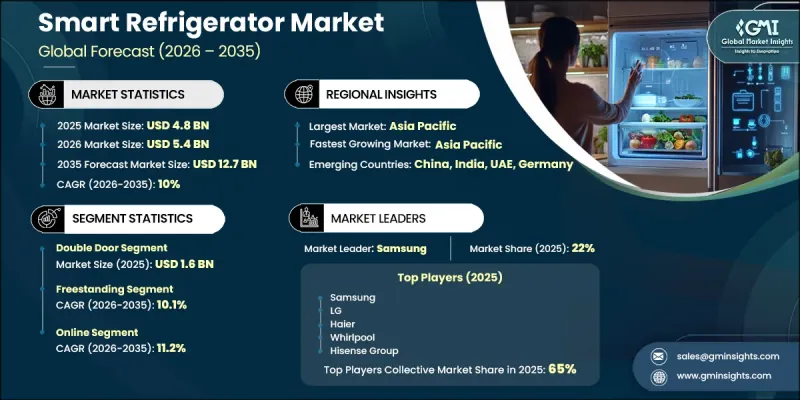
The Global Smart Refrigerator Market was valued at USD 4.8 billion in 2025 and is estimated to grow at a CAGR of 10% to reach USD 12.7 billion by 2035.
The accelerating adoption of smart home ecosystems is one of the leading factors driving this market's growth. With more homes integrating connected devices such as smart speakers, thermostats, and lighting systems, consumers are increasingly drawn to smart appliances that enhance convenience and energy efficiency. Smart refrigerators, equipped with Wi-Fi connectivity, app-based controls, and voice-command functionality, allow users to manage food storage, energy consumption, and remote monitoring with ease. Their seamless integration into connected home networks enables automated, personalized, and energy-efficient household management. This evolution toward interconnected living is propelling the demand for intelligent kitchen appliances, especially among tech-savvy and younger consumers. Additionally, the rollout of affordable IoT components and wider internet accessibility has made advanced features more attainable, even in mid-range appliances. The introduction of universal communication standards across devices has further enhanced compatibility among different brands, encouraging adoption across global markets.
| Market Scope | |
|---|---|
| Start Year | 2025 |
| Forecast Year | 2026-2035 |
| Start Value | $4.8 Billion |
| Forecast Value | $12.7 Billion |
| CAGR | 10% |
In 2025, the double-door segment generated USD 1.6 billion. These models are increasingly preferred for their large storage capacity, improved organization, and user-friendly features. Their design allows consumers to separate and efficiently manage refrigerated and frozen goods, catering to both small and large households. Modern double-door models are enhanced with smart features such as humidity control, customizable shelving, and food tracking systems. Through AI-enabled functionalities, these appliances can monitor freshness, suggest storage arrangements, and reduce food wastage, aligning with consumer preferences for convenience and sustainability.
The freestanding segment held a 92% share in 2025. The flexibility of freestanding smart refrigerators makes them an ideal option for residential and commercial spaces where mobility and easy installation are key factors. They do not require structural modifications or built-in cabinetry, which makes them cost-effective and adaptable to diverse layouts, including rental homes and urban apartments. Their convenience in placement and portability continues to make them the preferred choice over built-in alternatives, especially in dynamic urban living environments.
U.S. Smart Refrigerator Market held 80% share, generating USD 1.2 billion in 2025. The country remains at the forefront of smart appliance innovation due to the high adoption of connected technologies, energy-efficient solutions, and sustainability-driven product design. A digitally aware and youthful consumer base is propelling the market forward, supported by a mature retail ecosystem that offers a wide selection of brands and advanced features. The increasing emphasis on energy conservation and connected living has positioned the U.S. as a major market for smart refrigerators in North America.
Key players operating in the Global Smart Refrigerator Industry include Samsung Electronics, LG Electronics, Whirlpool, Bosch Home Appliances, Haier Smart Home, GE Appliances, Panasonic, Siemens Home Appliances, Sharp Corporation, Fisher & Paykel Appliances, Hisense Group, Sony, Electrolux, Miele & Cie., and Beko. Companies in the Smart Refrigerator Market are strengthening their presence through innovation, connectivity, and strategic collaborations. Many leading manufacturers are investing heavily in artificial intelligence, IoT integration, and machine learning to improve user interaction, energy management, and predictive maintenance. Expanding partnerships with smart home technology providers ensures compatibility across ecosystems and enhances the consumer experience. Firms are also focusing on sustainable design, developing energy-efficient models that comply with global energy standards.
Table of Contents
Chapter 1 Methodology and scope
- 1.1 Research approach
- 1.2 Quality Commitments
- 1.2.1 GMI AI policy & data integrity commitment
- 1.2.1.1 Source consistency protocol
- 1.2.1 GMI AI policy & data integrity commitment
- 1.3 Research Trail & Confidence Scoring
- 1.3.1 Research Trail Components
- 1.3.2 Scoring Components
- 1.4 Data Collection
- 1.4.1 Partial list of primary sources
- 1.5 Data mining sources
- 1.5.1 Paid sources
- 1.5.1.1 Sources, by region
- 1.5.1 Paid sources
- 1.6 Base estimates and calculations
- 1.6.1 Base year calculation for any one approach
- 1.7 Forecast model
- 1.7.1 Quantified market impact analysis
- 1.7.1.1 Mathematical impact of growth parameters on forecast
- 1.7.1 Quantified market impact analysis
- 1.8 Research transparency addendum
- 1.8.1 Source attribution framework
- 1.8.2 Quality assurance metrics
- 1.8.3 Our commitment to trust
Chapter 2 Executive summary
- 2.1 Industry 360° synopsis
- 2.2 Key market trends
- 2.2.1 Regional
- 2.2.2 Product type
- 2.2.3 Installation type
- 2.2.4 Capacity
- 2.2.5 Price
- 2.2.6 End user
- 2.2.7 Distribution channel
Chapter 3 Industry insights
- 3.1 Industry ecosystem analysis
- 3.1.1 Supplier landscape
- 3.1.2 Profit margin
- 3.1.3 Value addition at each stage
- 3.1.4 Factor affecting the value chain
- 3.1.5 Disruptions
- 3.2 Industry impact forces
- 3.2.1 Growth drivers
- 3.2.2 Industry pitfalls & challenges
- 3.2.3 Opportunities
- 3.3 Growth potential analysis
- 3.4 Future market trends
- 3.5 Technology and innovation landscape
- 3.5.1 Current technological trends
- 3.5.2 Emerging technologies
- 3.6 Pricing analysis (driven by primary research)
- 3.6.1 Historical price trend analysis
- 3.6.2 Pricing strategy by player type (premium / value / cost-plus)
- 3.6.3 Import vs domestic price differential
- 3.7 Regulatory framework
- 3.7.1 North America
- 3.7.2 Europe
- 3.7.3 Asia Pacific
- 3.7.4 Latin America
- 3.7.5 Middle East and Africa
- 3.8 Trade data analysis (HS Code 8418)
- 3.8.1 Import/Export Volume & Value Trends
- 3.8.2 Key Trade Corridors & Tariff Impact
- 3.8.3 Top Exporting Countries
- 3.8.4 Top Importing Countries
- 3.8.5 Trade Regulations & Customs Classification
- 3.9 Impact of AI & generative ai on the market
- 3.9.1 AI-driven disruption of traditional business models
- 3.9.2 GenAI use cases & adoption roadmap by customer segment
- 3.9.3 Risks, limitations & regulatory considerations
- 3.9.4 AI-enabled smart home ecosystem integration
- 3.10 Porter's five forces analysis
- 3.11 PESTEL analysis
- 3.12 Consumer behavior analysis
- 3.12.1 Purchasing patterns
- 3.12.2 Preference analysis
- 3.12.3 Regional variations in consumer behavior
- 3.12.4 Impact of e-commerce on buying decisions
Chapter 4 Competitive landscape, 2025
- 4.1 Introduction
- 4.2 Company market share analysis
- 4.2.1 North America
- 4.2.2 Europe
- 4.2.3 Asia Pacific
- 4.2.4 Latin America
- 4.2.5 MEA
- 4.3 Company matrix analysis
- 4.4 Competitive analysis of major market players
- 4.5 Competitive positioning matrix
- 4.6 Key developments
- 4.6.1 Mergers & acquisitions
- 4.6.2 Partnerships & collaborations
- 4.6.3 New product launches
- 4.6.4 Expansion plans
Chapter 5 Market Estimates & Forecast, By Product Type, 2022 - 2035 ($Billion, Thousand Units)
- 5.1 Key trends
- 5.2 Single door
- 5.3 Double door
- 5.4 French door
- 5.5 Door-in-door
- 5.6 Side by side
Chapter 6 Market Estimates & Forecast, By Installation Type, 2022 - 2035 ($Billion, Thousand Units)
- 6.1 Key trends
- 6.2 Countertop
- 6.3 Freestanding
Chapter 7 Market Estimates & Forecast, By Capacity, 2022 - 2035 ($Billion, Thousand Units)
- 7.1 Key trends
- 7.2 Small (10-19 cubic feet)
- 7.3 Medium (20-29 cubic feet)
- 7.4 Large (30+ cubic feet)
Chapter 8 Market Estimates & Forecast, By Price, 2022 - 2035 ($Billion, Thousand Units)
- 8.1 Key trends
- 8.2 Low
- 8.3 Medium
- 8.4 High
Chapter 9 Market Estimates & Forecast, By End User, 2022 - 2035 ($Billion, Thousand Units)
- 9.1 Key trends
- 9.2 Residential
- 9.3 Commercial
- 9.3.1 Hotels & restaurants
- 9.3.2 Food & beverage retail
- 9.3.3 Pharmacy
- 9.3.4 Healthcare
- 9.3.5 Others (hostel, institution, etc.)
Chapter 10 Market Estimates & Forecast, By Distribution Channel, 2022 - 2035 ($Billion, Thousand Units)
- 10.1 Key trends
- 10.2 Online
- 10.2.1 E-commerce
- 10.2.2 Company websites
- 10.3 Offline
- 10.3.1 Supermarkets/hypermarket
- 10.3.2 Specialty retail stores
- 10.3.3 Others (independent retailer etc.)
Chapter 11 Market Estimates & Forecast, By Region, 2022 - 2035 ($Billion, Thousand Units)
- 11.1 Key trends
- 11.2 North America
- 11.2.1 U.S.
- 11.2.2 Canada
- 11.3 Europe
- 11.3.1 Germany
- 11.3.2 UK
- 11.3.3 France
- 11.3.4 Spain
- 11.3.5 Italy
- 11.3.6 Netherlands
- 11.4 Asia Pacific
- 11.4.1 China
- 11.4.2 Japan
- 11.4.3 India
- 11.4.4 Australia
- 11.4.5 South Korea
- 11.5 Latin America
- 11.5.1 Brazil
- 11.5.2 Mexico
- 11.5.3 Argentina
- 11.6 MEA
- 11.6.1 South Africa
- 11.6.2 Saudi Arabia
- 11.6.3 UAE
Chapter 12 Company Profiles
- 12.1 Top Global Players
- 12.1.1 Bosch
- 12.1.2 Electrolux
- 12.1.3 Haier
- 12.1.4 Hisense
- 12.1.5 LG Electronics
- 12.1.6 Midea
- 12.1.7 Panasonic
- 12.1.8 Samsung Electronics
- 12.1.9 Whirlpool
- 12.2 Regional Key Players
- 12.2.1 Godrej Appliances
- 12.2.2 Hitachi Appliances
- 12.2.3 Sharp Corporation
- 12.2.4 TCL Corporation
- 12.2.5 Vestel
- 12.2.6 Voltas Beko
- 12.3 Emerging and Specialized Players
- 12.3.1 Bertazzoni
- 12.3.2 Changhong
- 12.3.3 Gram Commercial
- 12.3.4 Gree Electric Appliances
- 12.3.5 Skyworth
- 12.3.6 Viking Range

