PUBLISHER: Global Market Insights Inc. | PRODUCT CODE: 2038636

PUBLISHER: Global Market Insights Inc. | PRODUCT CODE: 2038636
Wax Market Opportunity, Growth Drivers, Industry Trend Analysis, and Forecast 2026 - 2035
The Global Wax Market was valued at USD 11.2 billion in 2025 and is estimated to grow at a CAGR of 3.6% to reach USD 16 billion by 2035.
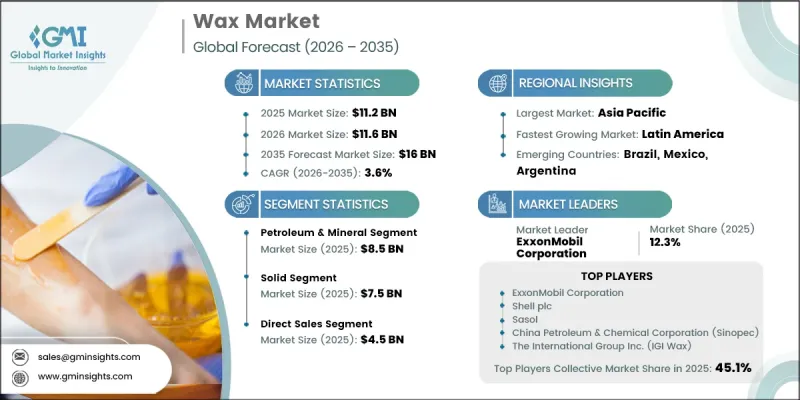
Market growth is supported by steady demand from packaging, personal care, industrial manufacturing, and consumer goods sectors. Wax materials, which include a broad category of organic substances in solid or semi-solid form, soften or melt at relatively low temperatures and are valued for properties such as moisture resistance, lubrication, and structural reinforcement. These materials are produced through petroleum refining, extraction from natural sources such as plants and animals, and synthetic manufacturing processes designed to achieve specific performance characteristics. Their ability to form protective coatings that improve durability, enhance surface appearance, and act as moisture barriers makes them widely applicable across industries. Rising consumption in packaging materials, cosmetics, adhesives, and industrial processing is further supporting consistent demand. Expanding manufacturing activity and ongoing product innovation are reinforcing market stability, while shifting preferences toward sustainable and high-performance materials are shaping procurement patterns. Continuous demand across end-use industries is ensuring steady growth for both established producers and new market entrants as supply chains adapt to evolving application requirements.
| Market Scope | |
|---|---|
| Start Year | 2025 |
| Forecast Year | 2026-2035 |
| Start Value | $11.2 Billion |
| Forecast Value | $16 Billion |
| CAGR | 3.6% |
The petroleum and mineral wax segment accounted for USD 8.5 billion in 2025. This segment continues to evolve as refining output patterns influence availability, while strong demand persists from packaging, rubber processing, and industrial coating applications. Its widespread use is supported by consistent performance characteristics and long-established integration across multiple industrial processes.
The candle segment reached USD 3.8 billion in 2025. Demand remains stable due to its extensive use in candles, packaging materials, wood treatment products, fire-log coatings, and adhesive and rubber applications. Its functional properties, including barrier protection, adhesion support, and structural stability, continue to sustain its industrial relevance.
North America Wax Market is expected to grow from USD 2.2 billion in 2025 to USD 3.4 billion by 2035. Growth in the region is driven by steady demand from packaging, cosmetics, and industrial applications, supported by strong manufacturing activity and rising interest in sustainable materials. The United States plays a key role in maintaining quality standards and encouraging increased adoption of bio-based wax alternatives in personal care and specialty applications.
Key players operating in the Wax Industry include ExxonMobil Corporation, Shell plc, TotalEnergies SE, BASF SE, Sasol, PetroChina (CNPC), Sinopec, Lukoil, Petrobras, The International Group Inc. (IGI Wax), Numaligarh Refinery Limited (NRL), Blayson Group Limited, and HCI Wax. Companies in the wax market are focusing on expanding production capabilities and optimizing refining processes to ensure stable supply and cost efficiency. Strategic investments in bio-based and sustainable wax solutions are being prioritized to align with environmental regulations and shifting consumer preferences. Manufacturers are strengthening supply chain integration through long-term sourcing agreements and regional production facilities. Product innovation efforts are centered on improving performance characteristics such as durability, thermal stability, and application flexibility across industries. Firms are also enhancing collaborations with end-use sectors like packaging and personal care to develop customized wax formulations.
Table of Contents
Chapter 1 Methodology & Scope
- 1.1 Market scope and definition
- 1.2 Research design
- 1.2.1 Research approach
- 1.2.2 Data collection methods
- 1.3 Data mining sources
- 1.3.1 Global
- 1.3.2 Regional/Country
- 1.4 Base estimates and calculations
- 1.4.1 Base year calculation
- 1.4.2 Key trends for market estimation
- 1.5 Primary research and validation
- 1.5.1 Primary sources
- 1.6 Forecast model
- 1.7 Research assumptions and limitations
Chapter 2 Executive Summary
- 2.1 Industry 360° synopsis
- 2.2 Key market trends
- 2.2.1 Product
- 2.2.2 Form
- 2.2.3 Application
- 2.2.4 Distribution Channel
- 2.2.5 Regional
- 2.3 TAM Analysis, 2026-2035
- 2.4 CXO perspectives: Strategic imperatives
- 2.5 Future outlook and strategic recommendations
Chapter 3 Industry Insights
- 3.1 Industry ecosystem analysis
- 3.1.1 Supplier landscape
- 3.1.2 Profit margin
- 3.1.3 Value addition at each stage
- 3.1.4 Factor affecting the value chain
- 3.1.5 Disruptions
- 3.2 Industry impact forces
- 3.2.1 Growth drivers
- 3.2.1.1 Growing demand for protective and moisture-resistant packaging solutions.
- 3.2.1.2 Increasing use of waxes in cosmetics and personal care formulations.
- 3.2.1.3 Rising adoption of sustainable and bio-based wax alternatives.
- 3.2.2 Pitfalls/challenge
- 3.2.2.1 Volatility in crude oil and natural feedstock prices affecting production costs.
- 3.2.2.2 Regulatory pressures limiting conventional wax types in certain applications
- 3.2.3 Opportunities
- 3.2.3.1 Expansion of natural and synthetic wax applications in emerging markets.
- 3.2.3.2 Development of high-performance waxes for specialized industrial uses
- 3.2.1 Growth drivers
- 3.3 Growth potential analysis
- 3.4 Regulatory landscape
- 3.4.1 North America
- 3.4.2 Europe
- 3.4.3 Asia Pacific
- 3.4.4 Latin America
- 3.4.5 Middle East & Africa
- 3.5 Porter's analysis
- 3.6 PESTEL analysis
- 3.7 Technology and innovation landscape
- 3.7.1 Current technological trends
- 3.7.2 Emerging technologies
- 3.8 Price trends
- 3.8.1 By region
- 3.8.2 By product
- 3.9 Future market trends
- 3.10 Patent landscape
- 3.11 Trade statistics (HS code)
- 3.11.1 Major importing countries
- 3.11.2 Major exporting countries
- 3.12 Sustainability and environmental aspects
- 3.12.1 Sustainable practices
- 3.12.2 Waste reduction strategies
- 3.12.3 Energy efficiency in production
- 3.12.4 Eco-friendly initiatives
- 3.13 Carbon footprint consideration
Chapter 4 Competitive Landscape, 2025
- 4.1 Introduction
- 4.2 Company market share analysis
- 4.2.1 By region
- 4.2.1.1 North America
- 4.2.1.2 Europe
- 4.2.1.3 Asia Pacific
- 4.2.1.4 LATAM
- 4.2.1.5 MEA
- 4.2.1 By region
- 4.3 Company matrix analysis
- 4.4 Competitive analysis of major market players
- 4.5 Competitive positioning matrix
- 4.6 Key developments
- 4.6.1 Mergers & acquisitions
- 4.6.2 Partnerships & collaborations
- 4.6.3 New product launches
- 4.6.4 Expansion plans
Chapter 5 Market Estimates and Forecast, By Product, 2022-2035 (USD Billion) (Kilo Tons)
- 5.1 Key trends
- 5.2 Petroleum & mineral
- 5.2.1 Paraffin
- 5.2.2 Microcrystalline
- 5.2.3 Petrolatum
- 5.3 Synthetic
- 5.3.1 GTL waxes
- 5.3.2 Polymer waxes
- 5.4 Natural
- 5.4.1 Beeswax
- 5.4.2 Vegetable wax
Chapter 6 Market Estimates and Forecast, By Form, 2022-2035 (USD Billion) (Kilo Tons)
- 6.1 Key trends
- 6.2 Solid
- 6.3 Liquid
- 6.4 Powder
- 6.5 Emulsion
Chapter 7 Market Estimates and Forecast, By Application, 2022-2035 (USD Billion) (Kilo Tons)
- 7.1 Key trends
- 7.2 Candles
- 7.3 Packaging
- 7.4 Wood & fire-logs
- 7.5 Rubber & adhesives
- 7.6 Cosmetics
- 7.7 Pharmaceuticals
- 7.8 Plastic
- 7.9 Other
Chapter 8 Market Estimates and Forecast, By Distribution Channel, 2022-2035 (USD Billion) (Kilo Tons)
- 8.1 Key trends
- 8.2 Direct sales
- 8.3 Distributors & wholesalers
- 8.4 Online/E-commerce platforms
- 8.5 Others
Chapter 9 Market Estimates and Forecast, By Region, 2022-2035 (USD Billion) (Kilo Tons)
- 9.1 Key trends
- 9.2 North America
- 9.2.1 U.S.
- 9.2.2 Canada
- 9.3 Europe
- 9.3.1 Germany
- 9.3.2 UK
- 9.3.3 France
- 9.3.4 Spain
- 9.3.5 Italy
- 9.3.6 Rest of Europe
- 9.4 Asia Pacific
- 9.4.1 China
- 9.4.2 India
- 9.4.3 Japan
- 9.4.4 Australia
- 9.4.5 South Korea
- 9.4.6 Rest of Asia Pacific
- 9.5 Latin America
- 9.5.1 Brazil
- 9.5.2 Mexico
- 9.5.3 Argentina
- 9.5.4 Rest of Latin America
- 9.6 Middle East and Africa
- 9.6.1 Saudi Arabia
- 9.6.2 South Africa
- 9.6.3 UAE
- 9.6.4 Rest of Middle East and Africa
Chapter 10 Company Profiles
- 10.1 ExxonMobil Corporation
- 10.2 China Petroleum & Chemical Corporation (Sinopec)
- 10.3 Shell plc
- 10.4 Sasol
- 10.5 The International Group Inc. (IGI Wax)
- 10.6 Petroleo Brasileiro S.A. (Petrobras)
- 10.7 China National Petroleum Corporation (CNPC)
- 10.8 Lukoil
- 10.9 TotalEnergies SE
- 10.10 Numaligarh Refinery Limited (NRL)
- 10.11 HCI Wax
- 10.12 Blayson Group Limited
- 10.13 BASF SE

