
PUBLISHER: Global Market Insights Inc. | PRODUCT CODE: 2038637

PUBLISHER: Global Market Insights Inc. | PRODUCT CODE: 2038637
Lingerie Market Opportunity, Growth Drivers, Industry Trend Analysis, and Forecast 2026 - 2035
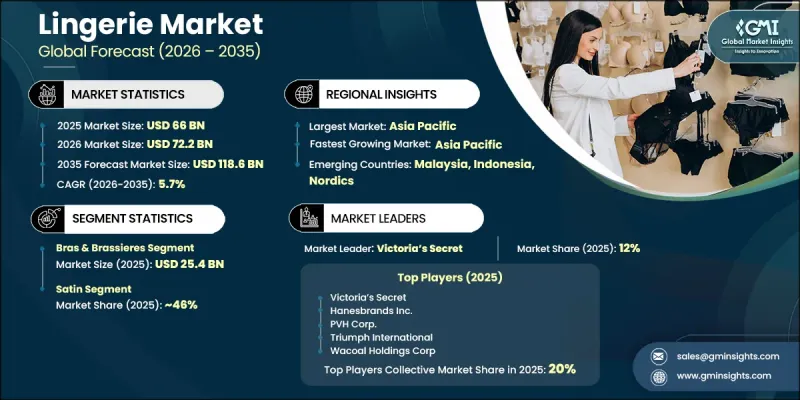
The Global Lingerie Market was valued at USD 66 billion in 2025 and is estimated to grow at a CAGR of 5.7% to reach USD 118.6 billion by 2035.
Market expansion is strongly influenced by a clear shift in consumer preference toward comfort-led and functional intimate wear. Modern buyers are placing greater importance on comfort, breathability, and fabric performance rather than focusing solely on visual appeal. This shift has prompted manufacturers to redesign lingerie collections with softer textiles, seamless construction techniques, and adaptive fits that support everyday usage. The increasing normalization of casual dressing styles, along with lifestyle changes and remote or hybrid work structures, has further accelerated demand for versatile lingerie solutions that function across multiple settings. As a result, lingerie is increasingly viewed as a core wardrobe essential rather than a discretionary fashion category. At the same time, the rapid expansion of online retail channels is reshaping purchasing behavior by enabling wider product accessibility, inclusive sizing options, and discreet shopping experiences. Digital enhancements such as virtual fitting tools and personalized recommendations are also improving customer confidence. Additionally, direct-to-consumer models are strengthening brand engagement and improving profitability, while simultaneously lowering entry barriers for emerging players and intensifying competition across global markets.
| Market Scope | |
|---|---|
| Start Year | 2025 |
| Forecast Year | 2026-2035 |
| Start Value | $66 Billion |
| Forecast Value | $118.6 Billion |
| CAGR | 5.7% |
In 2025, the bras and brassieres segment accounted for USD 25.4 billion. This leadership position is attributed to their essential role in daily apparel use and consistent demand across diverse age groups. Frequent replacement cycles, combined with continuous innovation in support, comfort, and ergonomic design, further reinforce this category's strength. Manufacturers are increasingly investing in advanced fabrics, seamless designs, and inclusive sizing solutions to enhance overall wearability. As a result, bras and brassieres continue to be considered a necessity-driven segment, maintaining steady demand even during broader shifts in retail consumption patterns.
The satin segment held 46% share in 2025. Satin remains highly preferred due to its blend of visual elegance and comfort-driven appeal. Its smooth surface texture, soft drape, and subtle sheen contribute to its perception as a premium material within intimate wear collections. Consumer perception strongly associates satin with luxury, comfort, and refined aesthetics, which has helped sustain its demand across both everyday lingerie and occasion-focused products.
Asia Pacific Lingerie Market held a 44% share in 2025 and is projected to grow at a CAGR of 6% through 2035. Within this region, China held a dominant position due to its large consumer base, rapid urbanization, and evolving lifestyle preferences. Increasing exposure to international fashion trends and a modernizing retail ecosystem have significantly reshaped purchasing behavior. Consumers are becoming more attentive to fit, comfort, and design quality, which is encouraging brands to expand their offerings across multiple price tiers and style categories to meet diversified demand.
Major players operating in the Global Lingerie Industry include Victoria's Secret, Triumph International, Hanesbrands Inc., Savage X Fenty, La Perla, Chantelle Group, Hunkemoller, Wacoal Holdings Corp., ThirdLove, Intimissimi, Aubade, Lise Charmel, PVH Corp., Adore Me, and Agent Provocateur. Key strategies adopted by companies in the Lingerie Market include expanding inclusive sizing portfolios to reach broader consumer segments, investing in advanced fabric innovation focused on comfort and breathability, and strengthening omnichannel retail presence to integrate online and offline shopping experiences. Brands are increasingly leveraging direct-to-consumer models to improve margins and enhance customer relationships. Personalization through AI-based fitting tools and recommendation systems is also gaining traction to improve conversion rates. Additionally, companies are focusing on sustainable material sourcing and eco-friendly production processes to align with evolving consumer values.
Table of Contents
Chapter 1 Methodology and Scope
- 1.1 Research approach
- 1.2 Quality Commitments
- 1.2.1 GMI AI policy & data integrity commitment
- 1.2.1.1 Source consistency protocol
- 1.2.1 GMI AI policy & data integrity commitment
- 1.3 Research Trail & Confidence Scoring
- 1.3.1 Research Trail Components
- 1.3.2 Scoring Components
- 1.4 Data Collection
- 1.4.1 Partial list of primary sources
- 1.5 Data mining sources
- 1.5.1 Paid sources
- 1.5.1.1 Sources, by region
- 1.5.1 Paid sources
- 1.6 Base estimates and calculations
- 1.6.1 Base year calculation for any one approach
- 1.7 Forecast model
- 1.7.1 Quantified market impact analysis
- 1.7.1.1 Mathematical impact of growth parameters on forecast
- 1.7.1 Quantified market impact analysis
- 1.8 Research transparency addendum
- 1.8.1 Source attribution framework
- 1.8.2 Quality assurance metrics
- 1.8.3 Our commitment to trust
Chapter 2 Executive Summary
- 2.1 Industry 360° synopsis
- 2.2 Key market trends
- 2.2.1 Regional
- 2.2.2 Product type
- 2.2.3 Material
- 2.2.4 Price
- 2.2.5 Age group
- 2.2.6 Distribution channel
Chapter 3 Industry Insights
- 3.1 Industry ecosystem analysis
- 3.1.1 Factors affecting the value chain
- 3.1.2 Profit margin analysis
- 3.1.3 Disruptions
- 3.1.4 Future outlook
- 3.1.5 Manufacturers
- 3.1.6 Distributors
- 3.1.7 Retailers
- 3.2 Impact forces
- 3.2.1 Growth drivers
- 3.2.2 Industry pitfalls & challenges
- 3.3 Technology & innovation landscape
- 3.4 Growth potential analysis
- 3.5 Regulatory framework
- 3.6 Pricing analysis (driven by primary research)
- 3.6.1 Historical price trend analysis
- 3.6.2 Pricing strategy by player type (premium vs mid-range vs economy)
- 3.6.3 Price variation by country
- 3.7 Porter's analysis
- 3.8 PESTEL analysis
- 3.9 Consumer behavior analysis
- 3.10 Trade data analysis - HS Code: 6108 (briefs, panties, robes - knitted) (driven by paid database)
- 3.10.1 Import & export volume & value trends
- 3.10.2 Key trade corridors & tariff impact
- 3.11 Impact of AI & generative AI on the market
- 3.11.1 AI-driven disruption of traditional retail models
- 3.11.2 GenAI use cases (virtual fitting rooms, personalized recommendations, design automation)
- 3.11.3 Risks, limitations & regulatory considerations
Chapter 4 Competitive Landscape, 2025
- 4.1 Introduction
- 4.2 Company market share analysis
- 4.3 Company market share analysis
- 4.3.1 By region
- 4.3.1.1 North America
- 4.3.1.2 Europe
- 4.3.1.3 Asia Pacific
- 4.3.1.4 Latin America
- 4.3.1.5 Middle East and Africa
- 4.3.1 By region
- 4.4 Competitive analysis of major market players
- 4.5 Competitive positioning matrix
- 4.6 Key developments
- 4.6.1 Mergers & acquisitions
- 4.6.2 Partnerships & collaborations
- 4.6.3 New product launches
- 4.6.4 Expansion plans
Chapter 5 Market Estimates and Forecast, By Product Type, 2022 - 2035 (USD Billion) (Thousand Units)
- 5.1 Key trends
- 5.2 Bras & Brassieres
- 5.2.1 Wired Bras
- 5.2.2 Wireless Bras
- 5.2.3 Sports Bras
- 5.2.4 Nursing Bras
- 5.2.5 Bralettes
- 5.3 Panties & Briefs
- 5.3.1 Bikini
- 5.3.2 Thong
- 5.3.3 Boyshort
- 5.3.4 Hipster
- 5.3.5 High-Waisted Briefs
- 5.4 Shapewear
- 5.4.1 Bodysuits
- 5.4.2 Control Briefs
- 5.4.3 Waist Cinchers
- 5.4.4 Thigh Shapers
- 5.5 Sleepwear & Loungewear
- 5.5.1 Babydolls & chemises
- 5.5.2 Camisoles
- 5.5.3 Nightgowns
- 5.5.4 Robes & Kimonos
- 5.6 Bodysuits & Teddies
- 5.7 Others (corsets, bustiers, hosiery, garters)
Chapter 6 Market Estimates and Forecast, By Material, 2022 - 2035 (USD Billion) (Thousand Units)
- 6.1 Key trends
- 6.2 Cotton
- 6.2.1 Organic Cotton
- 6.2.2 Conventional Cotton
- 6.3 Synthetic Fabrics
- 6.3.1 Nylon
- 6.3.2 Polyester
- 6.3.3 Spandex & Elastane
- 6.3.4 Microfiber
- 6.4 Lace
- 6.5 Silk
- 6.6 Satin
- 6.7 Others (bamboo, modal, innovative blends)
Chapter 7 Market Estimates and Forecast, By Price, 2022 - 2035 (USD Billion) (Thousand Units)
- 7.1 Key trends
- 7.2 Low
- 7.3 Medium
- 7.4 High
Chapter 8 Market Estimates and Forecast, By Age Group, 2022 - 2035 (USD Billion) (Thousand Units)
- 8.1 Key trends
- 8.2 18-24 Years
- 8.3 25-44 Years
- 8.4 45+ Years
Chapter 9 Market Estimates and Forecast, By Distribution Channel, 2022 - 2035 (USD Billion) (Thousand Units)
- 9.1 Key trends
- 9.2 Online channels
- 9.2.1 E-commerce
- 9.2.2 Company websites
- 9.3 Offline channels
- 9.3.1 Specialty lingerie stores
- 9.3.2 Department stores
- 9.3.3 Flagship stores
- 9.3.4 Others
Chapter 10 Market Estimates and Forecast, By Region, 2022 - 2035 (USD Billion) (Thousand Units)
- 10.1 Key trends
- 10.2 North America
- 10.2.1 U.S.
- 10.2.2 Canada
- 10.3 Europe
- 10.3.1 Germany
- 10.3.2 UK
- 10.3.3 France
- 10.3.4 Italy
- 10.3.5 Spain
- 10.4 Asia Pacific
- 10.4.1 China
- 10.4.2 Japan
- 10.4.3 India
- 10.4.4 Australia
- 10.4.5 South Korea
- 10.5 Latin America
- 10.5.1 Brazil
- 10.5.2 Mexico
- 10.5.3 Argentina
- 10.6 Middle East and Africa
- 10.6.1 South Africa
- 10.6.2 Saudi Arabia
- 10.6.3 UAE
Chapter 11 Company Profiles
- 11.1 Adore Me
- 11.2 Agent Provocateur
- 11.3 Aubade
- 11.4 Chantelle Group
- 11.5 Hanesbrands Inc.
- 11.6 Hunkemoller
- 11.7 Intimissimi
- 11.8 La Perla
- 11.9 Lise Charmel
- 11.10 PVH Corp.
- 11.11 Savage X Fenty
- 11.12 ThirdLove
- 11.13 Triumph International
- 11.14 Victoria's Secret
- 11.15 Wacoal Holdings Corp.

