PUBLISHER: Global Market Insights Inc. | PRODUCT CODE: 2038663

PUBLISHER: Global Market Insights Inc. | PRODUCT CODE: 2038663
Recombinant Proteins Market Opportunity, Growth Drivers, Industry Trend Analysis, and Forecast 2026 - 2035
The Global Recombinant Proteins Market was valued at USD 2.5 billion in 2025 and is estimated to grow at a CAGR of 9.3% to reach USD 5.7 billion by 2035.
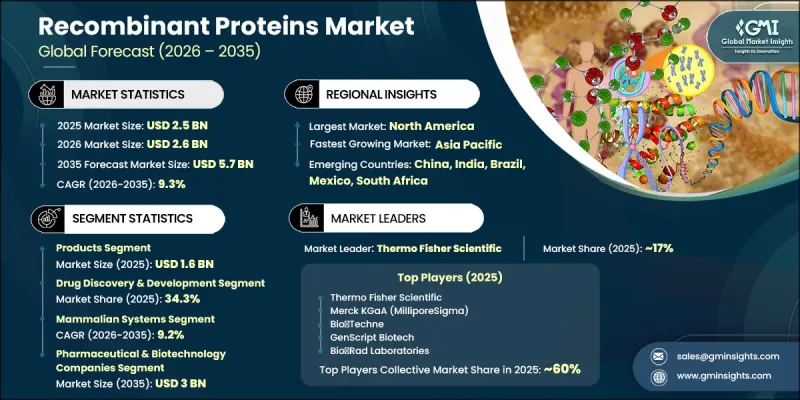
Growth is driven by the increasing use of therapeutic proteins in treating chronic and life-threatening conditions, including cancer, diabetes, and autoimmune diseases. A rising global geriatric population, along with a higher burden of chronic illnesses, is further accelerating demand for innovative treatment approaches. Recombinant proteins are engineered through DNA recombination techniques and produced using host systems such as bacterial, yeast, or mammalian cells, enabling large-scale production of targeted proteins that are otherwise difficult to extract naturally. These proteins are widely applied across therapeutics, diagnostics, and research activities due to their precision, scalability, and reliability. Continuous advancements in biotechnology, combined with expanding applications in drug development and personalized medicine, are strengthening their importance in modern healthcare systems. Increasing investment in research infrastructure and growing adoption of biologics are further reinforcing market growth.
| Market Scope | |
|---|---|
| Start Year | 2025 |
| Forecast Year | 2026-2035 |
| Start Value | $2.5 Billion |
| Forecast Value | $5.7 Billion |
| CAGR | 9.3% |
The products segment reached USD 1.6 billion in 2025. Strong demand is supported by the widespread use of recombinant proteins across pharmaceutical, biotechnology, and research applications. Growing reliance on biologic-based therapies is further driving product adoption. Continuous improvements in protein engineering are also enabling the development of more stable and functionally enhanced protein products, supporting sustained market dominance.
The drug discovery and development segment held 34.3% share in 2025. This segment includes biologics, vaccines, and cell and gene therapy applications. Recombinant proteins are widely used in multiple stages of drug development, including target identification, validation, and clinical evaluation. Their role in studying biological mechanisms and supporting therapeutic innovation is driving strong demand. Increasing focus on personalized treatment approaches, along with rising chronic disease prevalence, is further strengthening the importance of recombinant proteins in pharmaceutical research and development activities.
North America Recombinant Proteins Market accounted for 48.4% share in 2025, maintaining its leading position. The region benefits from a strong biotechnology and pharmaceutical ecosystem that supports innovation in protein-based therapies. A well-established healthcare infrastructure and high prevalence of chronic diseases continue to drive demand for advanced treatment solutions. Strong regulatory systems, along with significant investment in research and development, further support market expansion. Growing emphasis on precision medicine is also contributing to sustained regional growth.
Key companies operating in the Global Recombinant Proteins Market include Thermo Fisher Scientific, Merck KGaA (MilliporeSigma), GenScript Biotech, Bio-Techne, Sino Biological, ACROBiosystems Group, Abnova, Proteintech Group, RayBiotech, Creative BioMart, BPS Bioscience, ProteoGenix, Bio-Rad Laboratories, and Miltenyi Biotec. Companies in the Recombinant Proteins Market are strengthening their position through continuous innovation in protein engineering and expansion of product portfolios. They are investing in advanced manufacturing technologies to improve production efficiency and scalability. Strategic collaborations with pharmaceutical and biotechnology firms are enhancing research capabilities and accelerating product development. Many players are focusing on expanding their global distribution networks to improve market access. In addition, companies are increasing investment in GMP-compliant production facilities to ensure product quality and regulatory compliance.
Table of Contents
Chapter 1 Methodology and Scope
- 1.1 Market scope and definition
- 1.2 Research approach
- 1.3 Quality commitments
- 1.3.1 GMI AI policy and data integrity commitment
- 1.3.1.1 Source consistency protocol
- 1.3.1 GMI AI policy and data integrity commitment
- 1.4 Research trail and confidence scoring
- 1.4.1 Research trail components
- 1.4.2 Scoring components
- 1.5 Data collection
- 1.5.1 Partial list of primary sources
- 1.6 Data mining sources
- 1.6.1 Paid sources
- 1.6.1.1 Sources, by region
- 1.6.1 Paid sources
- 1.7 Base estimates and calculations
- 1.7.1 Revenue share analysis
- 1.7.2 Base year calculation
- 1.8 Forecast model
- 1.9 Research transparency addendum
- 1.9.1 Source attribution framework
- 1.9.2 Quality assurance metrics
- 1.9.3 Our commitment to trust
Chapter 2 Executive Summary
- 2.1 Industry 360° synopsis
- 2.2 Key market trends
- 2.2.1 Regional trends
- 2.2.2 Products & services trends
- 2.2.3 Application trends
- 2.2.4 Host-cell trends
- 2.2.5 End use trends
- 2.3 CXO perspectives: Strategic imperatives
Chapter 3 Industry Insights
- 3.1 Industry ecosystem analysis
- 3.2 Industry impact forces
- 3.2.1 Growth drivers
- 3.2.1.1 Increasing demand for biopharmaceuticals and therapeutic proteins
- 3.2.1.2 Advancements in protein engineering
- 3.2.1.3 Growing prevalence of chronic and infectious diseases
- 3.2.2 Industry pitfalls & challenges
- 3.2.2.1 High production costs
- 3.2.2.2 Stringent regulatory requirements
- 3.2.3 Market opportunities
- 3.2.3.1 Expansion of personalized medicine and precision protein therapeutics
- 3.2.3.2 Growing outsourcing to specialized protein service providers
- 3.2.1 Growth drivers
- 3.3 Growth potential analysis
- 3.4 Regulatory landscape (Driven by Primary Research)
- 3.4.1 North America
- 3.4.1.1 U.S.
- 3.4.1.2 Canada
- 3.4.2 Europe
- 3.4.3 Asia Pacific
- 3.4.1 North America
- 3.5 Technology and innovation landscape (Driven by Primary Research)
- 3.5.1 Current technologies
- 3.5.2 Emerging technologies
- 3.6 Investment and funding landscape (Driven by Primary Research)
- 3.7 Impact of AI/ gen AI on the market (Driven by Primary Research)
- 3.8 Patent analysis (Driven by Primary Research)
- 3.9 Pricing analysis (Driven by Primary Research)
- 3.10 Porter's analysis
- 3.11 PESTEL analysis
Chapter 4 Competitive Landscape, 2025
- 4.1 Introduction
- 4.2 Company market share analysis
- 4.3 Company matrix analysis
- 4.4 Competitive analysis of major market players
- 4.5 Competitive positioning matrix
- 4.6 Key developments
- 4.6.1 Merger and acquisition
- 4.6.2 Partnership and collaboration
- 4.6.3 New product launches
- 4.6.4 Expansion plans
Chapter 5 Market Estimates and Forecast, By Products & Services, 2022 - 2035 ($ Mn)
- 5.1 Key trends
- 5.2 Products
- 5.2.1 Cytokines & growth factors
- 5.2.1.1 Interferons (IFNs)
- 5.2.1.2 Interleukins (ILs)
- 5.2.1.3 Other cytokines & growth factors
- 5.2.2 Antibodies
- 5.2.3 Immune checkpoint proteins
- 5.2.4 Virus antigens
- 5.2.5 Enzymes
- 5.2.5.1 Kinases
- 5.2.5.2 Metabolic enzymes
- 5.2.5.3 Other enzymes
- 5.2.6 Recombinant regulatory proteins
- 5.2.7 Hormones
- 5.2.8 Other products
- 5.2.1 Cytokines & growth factors
- 5.3 Production services
Chapter 6 Market Estimates and Forecast, By Application, 2022 - 2035 ($ Mn)
- 6.1 Key trends
- 6.2 Drug discovery & development
- 6.2.1 Biologics
- 6.2.2 Vaccines
- 6.2.3 Cell & gene therapies
- 6.3 Research
- 6.4 Diagnostics
- 6.5 Other applications
Chapter 7 Market Estimates and Forecast, By Host-cell, 2022 - 2035 ($ Mn)
- 7.1 Key trends
- 7.2 Mammalian systems
- 7.3 Insect cells
- 7.4 Yeast & fungi
- 7.5 Bacterial cells
- 7.6 Other host-cells
Chapter 8 Market Estimates and Forecast, By End Use, 2022 - 2035 ($ Mn)
- 8.1 Key trends
- 8.2 Pharmaceutical & biotechnology companies
- 8.3 Academic & research institutes
- 8.4 Contract research organizations (CRO's)
- 8.5 Other end users
Chapter 9 Market Estimates and Forecast, By Region, 2022 - 2035 ($ Mn)
- 9.1 Key trends
- 9.2 North America
- 9.2.1 U.S.
- 9.2.2 Canada
- 9.3 Europe
- 9.3.1 Germany
- 9.3.2 UK
- 9.3.3 France
- 9.3.4 Spain
- 9.3.5 Italy
- 9.3.6 Netherlands
- 9.4 Asia Pacific
- 9.4.1 China
- 9.4.2 Japan
- 9.4.3 India
- 9.4.4 Australia
- 9.4.5 South Korea
- 9.5 Latin America
- 9.5.1 Brazil
- 9.5.2 Mexico
- 9.5.3 Argentina
- 9.6 Middle East and Africa
- 9.6.1 South Africa
- 9.6.2 Saudi Arabia
- 9.6.3 UAE
Chapter 10 Company Profiles
- 10.1 Abnova
- 10.2 ACROBiosystems Group
- 10.3 Bio Rad Laboratories
- 10.4 Bio Techne
- 10.5 BPS Bioscience
- 10.6 Creative BioMart
- 10.7 GenScript Biotech
- 10.8 Merck KGaA (MilliporeSigma)
- 10.9 Miltenyi Biotec
- 10.10 Proteintech Group
- 10.11 ProteoGenix
- 10.12 RayBiotech
- 10.13 Sino Biological
- 10.14 Thermo Fisher Scientific

