PUBLISHER: Global Market Insights Inc. | PRODUCT CODE: 2038682

PUBLISHER: Global Market Insights Inc. | PRODUCT CODE: 2038682
Asia Pacific Smart Mirror Market Opportunity, Growth Drivers, Industry Trend Analysis, and Forecast 2026 - 2035
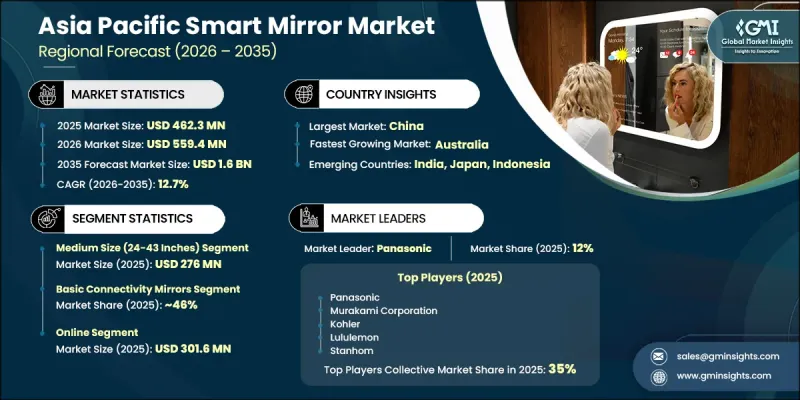
Asia Pacific Smart Mirror Market was valued at USD 462.3 million in 2025 and is estimated to grow at a CAGR of 12.7% to reach USD 1.6 billion by 2035.
Urban consumers are increasingly prioritizing convenience, connectivity, and enhanced living experiences, driving demand for multifunctional home devices. Smart mirrors are gaining traction as they combine traditional reflective surfaces with digital capabilities that improve daily routines. Consumers are increasingly expecting home products to integrate seamlessly into their lifestyles, offering personalization, information access, and improved functionality. At the same time, rising focus on home aesthetics and premium living experiences is encouraging the adoption of advanced home fixtures. Smart mirrors are being positioned as lifestyle-enhancing products that blend technology with interior design, making them an integral part of modern smart homes. Increasing awareness of health, fitness, and wellness is further supporting demand, as consumers incorporate technology-enabled tools into their daily personal care routines.
| Market Scope | |
|---|---|
| Start Year | 2025 |
| Forecast Year | 2026-2035 |
| Start Value | $462.3 Million |
| Forecast Value | $1.6 Billion |
| CAGR | 12.7% |
The Asia Pacific smart mirror market is also influenced by rising expectations around home premiumization and lifestyle enhancement. Consumers are increasingly investing in products that reflect modern living standards while improving convenience and visual appeal. Smart mirrors are being perceived not just as functional devices but as part of broader home transformation trends that emphasize comfort, status, and technological readiness. Growing digital awareness and lifestyle-focused consumption patterns are further reinforcing market expansion across the region.
The medium-sized smart mirrors segment, ranging from 24 to 43 inches, generated USD 276 million in 2025. This segment continues to gain popularity due to its balanced design, offering sufficient display space for interactive features while remaining suitable for residential and compact commercial environments. Its versatility allows integration into bathrooms, bedrooms, and personal fitness areas without overwhelming interior spaces, making it a preferred choice for a wide range of users.
The basic connectivity mirrors segment accounted for 46% share in 2025. These mirrors are designed to provide essential smart functions while maintaining a simple and intuitive user experience. They typically support basic wireless connectivity, enabling users to access information such as time, notifications, and weather updates. Their ease of use and affordability make them attractive to consumers seeking entry-level smart home solutions without complex features.
China Smart Mirror Market held a 38.1% share, generating USD 207 million in 2025. Market growth in the country is supported by rapid urban development, increasing consumer focus on personal grooming, and rising adoption of smart home technologies. Changing lifestyles, along with greater awareness of wellness and personal care, are influencing purchasing behavior. Additionally, digital influence through social media platforms and evolving beauty standards is shaping consumer expectations, further driving demand for innovative and technology-driven home solutions.
Key companies operating in the Asia Pacific Smart Mirror Market include Panasonic, Kohler, Electric Mirror, Murakami Corporation, Lululemon, FORME Life, Tempo, Vaha Technologies, NordicTrack Vault, Portl, Vercon, Chalaat Mirror, Innova Mirror, MirroCool, and Stanhom. Companies in the Asia Pacific Smart Mirror Market are focusing on technological innovation and product differentiation to strengthen their market presence. They are integrating advanced connectivity features, interactive interfaces, and personalized user experiences to enhance product value. Expanding applications across residential and fitness environments is helping companies broaden their customer base. Strategic partnerships with technology providers and lifestyle brands are supporting product development and market expansion. Firms are also investing in design improvements to align with modern interior aesthetics. Additionally, increasing focus on affordability, digital integration, and smart home compatibility is enabling companies to capture a wider consumer segment while reinforcing long-term growth potential.
Table of Contents
Chapter 1 Methodology and Scope
- 1.1 Market scope and definition
- 1.2 Research design
- 1.2.1 Research approach
- 1.2.2 Data collection methods
- 1.3 Data mining sources
- 1.3.1 Country
- 1.4 Base estimates and calculations
- 1.4.1 Base year calculation
- 1.4.2 Key trends for market estimation
- 1.5 Primary research and validation
- 1.5.1 Primary sources
- 1.6 Forecast model
- 1.7 Research assumptions and limitations
Chapter 2 Executive Summary
- 2.1 Industry 360° synopsis
- 2.2 Key market trends
- 2.2.1 Country
- 2.2.2 Size
- 2.2.3 Technology integration
- 2.2.4 Application
- 2.2.5 Price range
- 2.2.6 Distribution channel
Chapter 3 Industry Insights
- 3.1 Industry ecosystem analysis
- 3.1.1 Supplier landscape
- 3.1.2 Profit margin
- 3.1.3 Value addition at each stage
- 3.1.4 Factor affecting the value chain
- 3.2 Industry impact forces
- 3.2.1 Growth drivers
- 3.2.1.1 The increasing adoption of advanced technologies in the retail and automotive sectors
- 3.2.1.2 Growing demand for connected devices and smart home solutions
- 3.2.2 Industry pitfalls & challenges
- 3.2.2.1 High initial costs of smart mirrors remain a significant barrier to adoption
- 3.2.2.2 Concerns regarding data privacy and security hinder market growth
- 3.2.3 Opportunities
- 3.2.3.1 Advancements in artificial intelligence and augmented reality technologies
- 3.2.3.2 Increasing focus on energy-efficient and eco-friendly solutions
- 3.2.1 Growth drivers
- 3.3 Growth potential analysis
- 3.4 Future market trends
- 3.5 Technology and innovation landscape
- 3.5.1 Current technological trends
- 3.5.2 Emerging technologies
- 3.6 Price trends
- 3.6.1 By country
- 3.6.2 By size
- 3.7 Regulatory landscape
- 3.7.1 Standards and compliance requirements
- 3.7.2 Regional regulatory frameworks
- 3.7.3 Certification standards
- 3.8 Porter's analysis
- 3.9 PESTEL analysis
- 3.10 Pricing analysis (driven by primary research)
- 3.10.1 Historical price trend analysis (2022-2025)
- 3.10.2 Pricing strategy by player type (premium / value / cost-plus)
- 3.10.3 Price variation by technology tier
- 3.10.4 Country-level price positioning
- 3.11 Trade data analysis - HS Code: 7009.92 (glass mirrors, framed) (driven by paid data base)
- 3.11.1 Import/export volume & value trends (2022-2025)
- 3.11.2 Key trade corridors & tariff impact (China-SEA, Japan-Australia, etc.)
- 3.11.3 Intra-APAC trade flows
- 3.11.4 Trade policy impact on market dynamics
- 3.12 Impact of AI & generative AI on the market
- 3.12.1 AI-driven disruption of existing business models
- 3.12.2 GenAI use cases & adoption roadmap by segment
- 3.12.3 Risks, limitations & regulatory considerations
- 3.13 Infrastructure & deployment landscape (driven by primary research)
- 3.13.1 Deployment penetration by region & buyer segment
- 3.13.2 Scalability constraints & infrastructure investment trends
Chapter 4 Competitive Landscape, 2025
- 4.1 Introduction
- 4.2 Company market share analysis
- 4.2.1 By country
- 4.2.1.1 China
- 4.2.1.2 India
- 4.2.1.3 Japan
- 4.2.1.4 South Korea
- 4.2.1.5 Australia
- 4.2.1.6 Malaysia
- 4.2.1.7 Indonesia
- 4.2.1 By country
- 4.3 Company matrix analysis
- 4.4 Competitive analysis of major market players
- 4.5 Competitive positioning matrix
- 4.6 Key developments
- 4.6.1 Mergers & acquisitions
- 4.6.2 Partnerships & collaborations
- 4.6.3 New product launches
- 4.6.4 Expansion plans
Chapter 5 Market Estimates and Forecast, By Size, 2022 - 2035 (USD Million) (Thousand Units)
- 5.1 Key trends
- 5.2 Small size (24 inches)
- 5.3 Medium size (24-43 inches)
- 5.4 Large size (>43 inches)
Chapter 6 Market Estimates and Forecast, By Technology Integration, 2022 - 2035 (USD Million) (Thousand Units)
- 6.1 Key trends
- 6.2 Basic connectivity mirrors
- 6.2.1 Wi-Fi/Bluetooth enabled
- 6.2.2 Mobile app control
- 6.2.3 Voice assistant integration
- 6.3 AI-powered smart mirrors
- 6.3.1 Facial recognition & personalization
- 6.3.2 Health monitoring & analytics
- 6.3.3 Predictive recommendations
- 6.4 AR-enabled advanced mirrors
- 6.4.1 Virtual try-on
- 6.4.2 Interactive fitness coaching
- 6.4.3 Holographic displays
Chapter 7 Market Estimates and Forecast, By Application, 2022 - 2035 (USD Million) (Thousand Units)
- 7.1 Key trends
- 7.2 Residential
- 7.3 Commercial
- 7.3.1 Retail stores
- 7.3.2 Hospitality
- 7.3.3 Office
- 7.3.4 Shopping malls
- 7.3.5 Fitness & wellness centre
- 7.3.6 Others (salons, etc.)
Chapter 8 Market Estimates and Forecast, By Price Range, 2022 - 2035 (USD Million) (Thousand Units)
- 8.1 Key trends
- 8.2 Budget segment (< USD 500)
- 8.3 Mid-range segment (USD 500-$1,500)
- 8.4 Premium segment (>USD 1,500)
Chapter 9 Market Estimates and Forecast, By Distribution Channel, 2022 - 2035 (USD Million) (Thousand Units)
- 9.1 Key trends
- 9.2 Online
- 9.2.1 E-commerce
- 9.2.2 Company websites
- 9.3 Offline
- 9.3.1 Specialty retail stores
- 9.3.2 Others (independent retailer, etc.)
Chapter 10 Market Estimates and Forecast, By Country, 2022 - 2035 (USD Million) (Thousand Units)
- 10.1 Key trends
- 10.2 China
- 10.3 India
- 10.4 Japan
- 10.5 South Korea
- 10.6 Australia
- 10.7 Malaysia
- 10.8 Indonesia
Chapter 11 Company Profiles
- 11.1 Chalaat Mirror
- 11.2 Electric Mirror
- 11.3 FORME Life
- 11.4 Innova Mirror
- 11.5 Kohler
- 11.6 Lululemon
- 11.7 MirroCool
- 11.8 Murakami Corporation
- 11.9 NordicTrack Vault
- 11.10 Panasonic
- 11.11 Portl
- 11.12 Stanhom
- 11.13 Tempo
- 11.14 Vaha Technologies
- 11.15 Vercon

