PUBLISHER: Global Market Insights Inc. | PRODUCT CODE: 2045689

PUBLISHER: Global Market Insights Inc. | PRODUCT CODE: 2045689
Smart Mirror Market Opportunity, Growth Drivers, Industry Trend Analysis, and Forecast 2026 - 2035
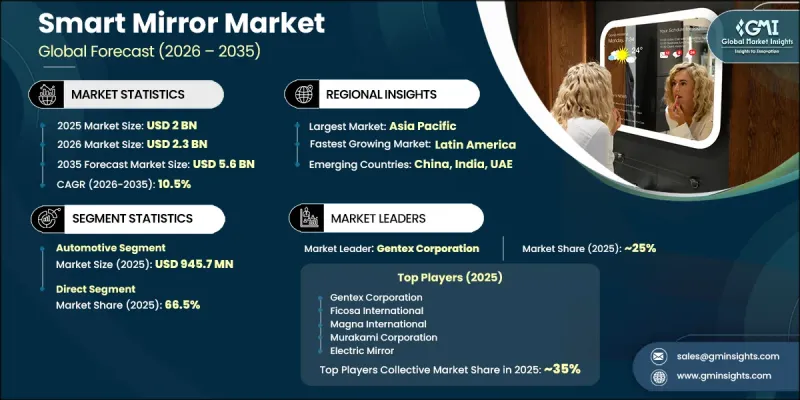
The global smart mirror market was valued at USD 2 billion in 2025 and is estimated to grow at a CAGR of 10.5% to reach USD 5.6 billion by 2035.
The smart mirror industry is expanding rapidly as smart home adoption continues to rise across global consumer markets. Increasing demand for connected living environments is encouraging households to integrate interactive digital solutions that improve convenience and functionality. Smart mirrors are becoming a key component of modern home ecosystems, offering features such as voice-enabled controls, digital displays, and seamless synchronization with other connected devices. Beyond residential applications, the technology is increasingly being deployed across automotive, retail, and hospitality sectors to enhance user interaction and operational efficiency. In vehicles, smart mirrors are contributing to improved safety and driving assistance, while in retail environments, they are transforming customer engagement through personalized experiences. Hospitality providers are also using these systems to enhance guest services through automation and interactive interfaces. Regional growth is further supported by advancements in infrastructure modernization and the rising adoption of electric mobility solutions. Continuous technological innovation, combined with increasing consumer preference for intelligent and integrated systems, is strengthening the long-term growth outlook of the smart mirror market.
| Market Scope | |
|---|---|
| Start Year | 2025 |
| Forecast Year | 2026-2035 |
| Start Value | $2 Billion |
| Forecast Value | $5.6 Billion |
| CAGR | 10.5% |
The automotive segment generated USD 945.7 million in 2025 and is expected to grow at a CAGR of 10.3% from 2026 to 2035. This segment includes advanced mirror systems integrated with safety and monitoring technologies designed to enhance driving performance and situational awareness. Increasing regulatory emphasis on vehicle safety standards and the integration of advanced driver-focused systems are supporting strong adoption. Growing deployment across passenger and commercial vehicles is further reinforcing demand within this segment.
The direct distribution channel accounted for 66.5% share in 2025 and is projected to grow at a CAGR of 10.2% through 2035. This channel includes manufacturer-led sales, direct integration with automotive systems, and business-oriented supply agreements across commercial sectors. Strong engagement between manufacturers and end users is enabling streamlined deployment and customization of smart mirror solutions. The expansion of digital sales platforms and direct procurement models is also contributing to the growth of this segment.
United States smart mirror market reached USD 448.2 million in 2025 and is anticipated to grow at a CAGR of 9.9% from 2026 to 2035. Growth in the country is driven by strong adoption of smart home technologies, high consumer purchasing power, and strict automotive safety regulations. Increasing integration of connected systems in residential and commercial environments is further accelerating demand. The widespread implementation of advanced safety technologies in vehicles is also contributing to market expansion across the region.
Key companies operating in the global smart mirror market include Gentex Corp, Magna International, Harman International, Ficosa International, Electric Mirror, Japan Display Inc, AD Notam, Avis Electronics, Baracoda Group, Dension, Glance Displays, LumiDesign, Keon Technologies, Murakami Kaimeido, and Seura Solutions. Companies in the smart mirror market are adopting multiple strategic initiatives to strengthen their competitive position and expand market presence. Organizations are investing heavily in research and development to enhance product intelligence, display quality, and system integration capabilities. Strategic collaborations with automotive manufacturers and technology providers are enabling faster deployment and broader adoption of advanced mirror systems. Firms are also focusing on expanding their product ecosystems by integrating AI-driven features, voice recognition, and IoT connectivity to improve user experience. Strengthening direct-to-consumer channels and digital distribution platforms is helping companies improve market reach and customer engagement.
Table of Contents
Chapter 1 Research methodology
- 1.1 Research approach
- 1.2 Quality Commitments
- 1.2.1 GMI AI policy & data integrity commitment
- 1.2.1.1 Source consistency protocol
- 1.2.1 GMI AI policy & data integrity commitment
- 1.3 Research trail & confidence scoring
- 1.3.1 Research trail components
- 1.3.2 Scoring components
- 1.4 Data Collection
- 1.4.1 Partial list of primary sources
- 1.5 Data mining sources
- 1.5.1 Paid sources
- 1.5.1.1 Sources, by region
- 1.5.1 Paid sources
- 1.6 Base estimates and calculations
- 1.6.1 Base year calculation
- 1.7 Forecast model
- 1.7.1 Quantified market impact analysis
- 1.7.1.1 Mathematical impact of growth parameters on forecast
- 1.7.1 Quantified market impact analysis
- 1.8 Research transparency addendum
- 1.8.1 Source attribution framework
- 1.8.2 Quality assurance metrics
- 1.8.3 Our commitment to trust
Chapter 2 Executive Summary
- 2.1 Industry 360° synopsis
- 2.2 Key market trends
- 2.2.1 Regional
- 2.2.2 Product
- 2.2.3 Application
- 2.2.4 Distribution channel
Chapter 3 Industry Insights
- 3.1 Industry ecosystem analysis
- 3.1.1 Supplier landscape
- 3.1.2 Profit margin analysis
- 3.1.3 Value addition at each stage
- 3.1.4 Factor affecting the value chain
- 3.2 Industry impact forces
- 3.2.1 Growth drivers
- 3.2.1.1 Increasing Consumer Preference for Smart Home Technologies
- 3.2.1.2 Rising Automotive Safety Regulations
- 3.2.1.3 Growing Interest in Smart Home Technologies
- 3.2.2 Industry pitfalls & challenges
- 3.2.2.1 High Initial Installation and Maintenance Costs
- 3.2.2.2 Privacy and Data Security Concerns
- 3.2.1 Growth drivers
- 3.3 Growth potential analysis
- 3.4 Future market trends
- 3.5 Technology and innovation landscape
- 3.5.1 Current technological trends
- 3.5.2 Emerging technologies
- 3.6 Price trends
- 3.6.1 By region
- 3.6.2 By product
- 3.7 Regulatory landscape
- 3.7.1 Standards and compliance requirements
- 3.7.2 Regional regulatory frameworks
- 3.7.3 Certification standards
- 3.8 Consumer behavior analysis
- 3.8.1 Purchasing patterns
- 3.8.2 Preference analysis
- 3.8.3 Regional variations in consumer behavior
- 3.9 Porter's analysis
- 3.10 PESTEL analysis
- 3.11 Impact of AI & generative AI on the market
- 3.11.1 AI-driven disruption of existing business models
- 3.11.2 GenAI use cases & adoption roadmap by segment
- 3.11.3 Risks, limitations & regulatory considerations
Chapter 4 Competitive Landscape, 2025
- 4.1 Introduction
- 4.2 Company market share analysis
- 4.2.1 By Region
- 4.2.1.1 North America
- 4.2.1.2 Europe
- 4.2.1.3 Asia Pacific
- 4.2.1.4 Latin America
- 4.2.1.5 Middle East & Africa
- 4.2.1 By Region
- 4.3 Company matrix analysis
- 4.4 Competitive analysis of major market players
- 4.5 Competitive positioning matrix
- 4.6 Key developments
- 4.6.1 Mergers & acquisitions
- 4.6.2 Partnerships & collaborations
- 4.6.3 New product launches
- 4.6.4 Expansion plans
Chapter 5 Market Estimates & Forecast, By Technology, 2022 - 2035, (USD Billion) (Units)
- 5.1 Key trends
- 5.2 Hardware
- 5.2.1 Displays
- 5.2.2 Sensors
- 5.2.3 Cameras
- 5.3 Software
- 5.4 Services
Chapter 6 Market Estimates & Forecast, By Application, 2022 - 2035, (USD Billion) (Units)
- 6.1 Key trends
- 6.2 Automotive
- 6.3 Residential
- 6.4 Retail and Fashion
- 6.5 Hospitality
- 6.6 Healthcare
- 6.7 Others
Chapter 7 Market Estimates & Forecast, By Distribution Channel, 2022 - 2035, (USD Billion) (Units)
- 7.1 Key trends
- 7.2 Direct
- 7.3 Indirect
Chapter 8 Market Estimates & Forecast, By Region, 2022 - 2035, (USD Billion) (Units)
- 8.1 Key trends
- 8.2 North America
- 8.2.1 U.S.
- 8.2.2 Canada
- 8.3 Europe
- 8.3.1 Germany
- 8.3.2 UK
- 8.3.3 France
- 8.3.4 Italy
- 8.3.5 Spain
- 8.3.6 Sweden
- 8.4 Asia Pacific
- 8.4.1 China
- 8.4.2 India
- 8.4.3 Japan
- 8.4.4 South Korea
- 8.4.5 Australia
- 8.4.6 Indonesia
- 8.5 Latin America
- 8.5.1 Brazil
- 8.5.2 Mexico
- 8.5.3 Argentina
- 8.6 MEA
- 8.6.1 Saudi Arabia
- 8.6.2 UAE
- 8.6.3 South Africa
Chapter 9 Company Profiles
- 9.1 AD Notam
- 9.2 Avis Electronics
- 9.3 Baracoda Group
- 9.4 Dension
- 9.5 Electric Mirror
- 9.6 Ficosa International
- 9.7 Gentex Corp
- 9.8 Glance Displays
- 9.9 Harman International
- 9.10 LumiDesign
- 9.11 Japan Display Inc
- 9.12 Keon Technologies
- 9.13 Magna International
- 9.14 Murakami Kaimeido
- 9.15 Seura Solutions

