
PUBLISHER: Global Market Insights Inc. | PRODUCT CODE: 2038687

PUBLISHER: Global Market Insights Inc. | PRODUCT CODE: 2038687
Data Center Chillers Market Opportunity, Growth Drivers, Industry Trend Analysis, and Forecast 2026 - 2035
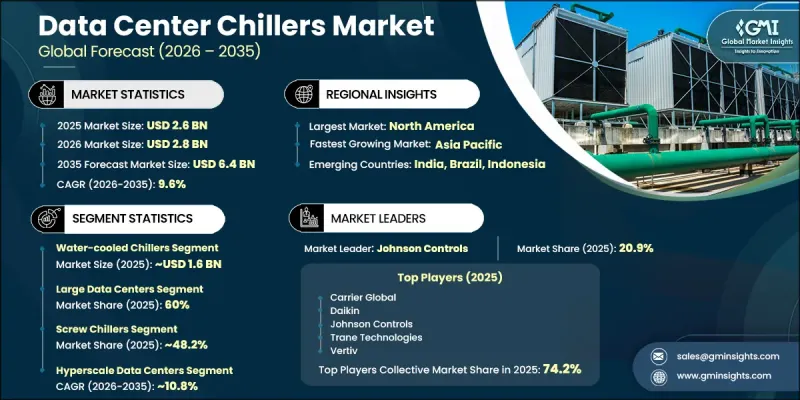
The Global Data Center Chillers Market was valued at USD 2.6 billion in 2025 and is estimated to grow at a CAGR of 9.6% to reach USD 6.4 billion by 2035.
Increasing reliance on digital infrastructure is driving demand for advanced cooling systems capable of handling rising computing loads across modern data centers. As power consumption continues to increase, cooling requirements scale proportionally, creating strong demand for efficient thermal management solutions. The growing density of high-performance computing systems is reshaping chiller design, requiring more compact, energy-efficient, and high-capacity systems. Innovations in cooling technologies are addressing operational constraints while improving performance in space-constrained environments. Geographic variations in infrastructure development and environmental conditions are also influencing deployment strategies. Resource availability is becoming an important consideration, particularly in regions facing environmental constraints, which is shaping the adoption of sustainable cooling technologies. Overall, the increasing need for reliable and efficient cooling across evolving digital ecosystems is expected to drive sustained growth in the data center chillers market.
| Market Scope | |
|---|---|
| Start Year | 2025 |
| Forecast Year | 2026-2035 |
| Start Value | $2.6 Billion |
| Forecast Value | $6.4 Billion |
| CAGR | 9.6% |
The data center chillers market is also benefiting from the rising complexity of IT infrastructure and the need for advanced thermal management systems. Increasing computing intensity is pushing operators to adopt more efficient cooling solutions that ensure system stability and performance. Continuous technological advancements are enabling improved energy efficiency and operational optimization, further strengthening market growth.
The water-cooled systems segment is projected to grow at a CAGR of 10% between 2026 and 2035. This growth is supported by their superior heat transfer capabilities, scalability, and ability to deliver high efficiency in large-scale operations. These systems are increasingly preferred in facilities requiring consistent and high-capacity cooling performance.
The hyperscale data centers segment is anticipated to grow at a CAGR of 10.8% during 2026 to 2035. Growth in this segment is driven by the increasing demand for large-scale computing capabilities, which require advanced cooling solutions to manage rising thermal loads. The expansion of high-capacity data infrastructure is creating a strong need for robust and efficient chiller systems.
U.S. Data Center Chillers Market reached USD 1.2 billion in 2025 and is expected to grow at a CAGR of 9.3% from 2026 to 2035. Market growth in the country is supported by the rapid expansion of advanced computing infrastructure and increasing energy requirements. Rising demand for efficient cooling solutions is encouraging the adoption of next-generation technologies designed to handle high-performance workloads while improving energy efficiency.
Key players operating in the Global Data Center Chillers Market include Carrier Global, Trane Technologies, Johnson Controls, Daikin, Mitsubishi Electric, LG Electronics, Vertiv, Schneider Electric, STULZ, and Rittal. Companies in the Data Center Chillers Market are focusing on innovation, efficiency, and scalability to strengthen their competitive position. They are investing in advanced cooling technologies that enhance performance while reducing energy consumption. Many players are integrating smart monitoring and automation capabilities to improve system management and reliability. Strategic partnerships and collaborations help companies expand their global footprint and address evolving customer requirements. Additionally, manufacturers are prioritizing sustainable solutions, including energy-efficient designs and environmentally friendly refrigerants, to align with regulatory standards. Continuous research and development, along with capacity expansion and product diversification, are enabling companies to meet the growing demand for high-performance cooling systems in modern data center environments.
Table of Contents
Chapter 1 Methodology
- 1.1 Research approach
- 1.2 Quality Commitments
- 1.2.1 GMI AI policy & data integrity commitment
- 1.3 Research Trail & Confidence Scoring
- 1.3.1 Research Trail Components
- 1.3.2 Scoring Components
- 1.4 Data Collection
- 1.5 Data mining sources
- 1.5.1 Paid sources
- 1.6 Base estimates and calculations
- 1.6.1 Base year calculation for any one approach
- 1.7 Forecast
- 1.7.1 Quantified market impact analysis
- 1.8 Research transparency addendum
- 1.8.1 Source attribution framework
- 1.8.2 Quality assurance metrics
- 1.8.3 Our commitment to trust
Chapter 2 Executive Summary
- 2.1 Industry 360° synopsis
- 2.2 Key market trends
- 2.2.1 Regional
- 2.2.2 Product
- 2.2.3 Technology
- 2.2.4 Cooling Capacity
- 2.2.5 Data Center
- 2.2.6 Data Center Size
- 2.2.7 Deployment
- 2.3 TAM analysis, 2026-2035
- 2.4 CXO perspectives: Strategic imperatives
Chapter 3 Industry Insights
- 3.1 Industry ecosystem analysis
- 3.1.1 Supplier landscape
- 3.1.2 Profit margin
- 3.1.3 Cost structure
- 3.1.4 Value addition at each stage
- 3.1.5 Factor affecting the value chain
- 3.1.6 Disruptions
- 3.2 Industry impact forces
- 3.2.1 Growth drivers
- 3.2.1.1 Exponential growth in hyperscale & edge data centers
- 3.2.1.2 Rising rack power densities from AI/HPC workloads
- 3.2.1.3 Stringent energy efficiency & sustainability regulations
- 3.2.1.4 Upgrades and retrofits of existing data centers
- 3.2.2 Industry pitfalls and challenges
- 3.2.2.1 High capital investment & infrastructure costs
- 3.2.2.2 Water scarcity concerns limiting water-cooled systems
- 3.2.3 Market opportunities
- 3.2.3.1 Emergence of liquid cooling technologies for high-density workloads
- 3.2.3.2 Adoption of free cooling & hybrid cooling solutions
- 3.2.3.3 Growing modular & containerized data center deployments
- 3.2.1 Growth drivers
- 3.3 Technology and innovation landscape
- 3.3.1 Current technologies
- 3.3.1.1 Air-Cooled Chillers
- 3.3.1.2 Water-Cooled Chillers
- 3.3.1.3 Direct Expansion (DX) Cooling Systems
- 3.3.1.4 In-Row Cooling Units
- 3.3.2 Emerging technologies
- 3.3.2.1 Magnetic Bearing (Oil-Free) Chillers
- 3.3.2.2 Adiabatic / Evaporative Cooling Systems
- 3.3.2.3 AI-Optimized Chiller Plant Controls
- 3.3.1 Current technologies
- 3.4 Growth potential analysis
- 3.5 Pricing analysis (Driven by Primary Research)
- 3.5.1 Historical price trend analysis
- 3.5.2 Pricing strategy by player type (Premium / Value / Cost-plus)
- 3.6 Regulatory landscape
- 3.6.1 North America
- 3.6.1.1 US - U.S. Environmental Protection Agency
- 3.6.1.2 Canada - Natural Resources Canada
- 3.6.2 Europe
- 3.6.2.1 EU - European Commission
- 3.6.2.2 UK - BSI Group
- 3.6.3 Asia Pacific
- 3.6.3.1 India - Bureau of Energy Efficiency
- 3.6.3.2 China - Ministry of Ecology and Environment
- 3.6.4 Latin America
- 3.6.4.1 Brazil - Agencia Nacional de Energia Eletrica
- 3.6.4.2 Mexico - Secretaria de Energia
- 3.6.5 Middle East & Africa
- 3.6.5.1 Saudi Arabia - Saudi Standards Metrology and Quality Organization
- 3.6.5.2 UAE - Dubai Electricity and Water Authority
- 3.6.1 North America
- 3.7 Porter's analysis
- 3.8 PESTEL analysis
- 3.9 Patent landscape (Driven by Primary Research)
- 3.10 Cost breakdown analysis
- 3.11 Data center capacity & infrastructure landscape
- 3.11.1 Installed capacity (MW) by country
- 3.11.2 Expansion pipeline 2025-2027
- 3.11.3 Utilization rates & supply-demand
- 3.12 Impact of renewable energy integration
- 3.12.1 Integration of solar and wind power with chiller systems
- 3.12.2 Impact on energy cost reduction and operational efficiency
- 3.12.3 Intermittency challenges and thermal storage solutions
- 3.12.4 Grid interaction and demand response capabilities
- 3.12.5 Carbon emission reduction and sustainability goals
- 3.13 Impact of AI & Generative AI on the Market
- 3.13.1 AI-driven disruption of existing business models
- 3.13.2 GenAI use cases & adoption roadmap by segment
- 3.13.3 Risks, limitations & regulatory considerations
- 3.14 Forecast assumptions & scenario analysis (Driven by Primary Research)
- 3.14.1 Base Case - key macro & industry variables driving CAGR
- 3.14.2 Optimistic Scenarios - Favorable macro and industry tailwinds
- 3.14.3 Pessimistic Scenario - Macroeconomic slowdown or industry headwinds
Chapter 4 Competitive Landscape, 2025
- 4.1 Introduction
- 4.2 Company market share analysis
- 4.2.1 North America
- 4.2.2 Europe
- 4.2.3 Asia Pacific
- 4.2.4 LATAM
- 4.2.5 MEA
- 4.3 Competitive analysis of major market players
- 4.4 Competitive positioning matrix
- 4.5 Key developments
- 4.5.1 Mergers & acquisitions
- 4.5.2 Partnerships & collaborations
- 4.5.3 New product launches
- 4.5.4 Expansion plans and funding
- 4.6 Company tier benchmarking
- 4.6.1 Tier classification criteria & qualifying thresholds
- 4.6.2 Tier positioning matrix by revenue, geography & innovation
Chapter 5 Market Estimates & Forecast, By Product, 2022 - 2035 ($Mn, Units)
- 5.1 Key trends
- 5.2 Air-cooled chillers
- 5.3 Water-cooled chillers
- 5.4 Glycol-cooled chillers
Chapter 6 Market Estimates & Forecast, By Technology, 2022 - 2035 ($Mn, Units)
- 6.1 Key trends
- 6.2 Scroll chillers
- 6.3 Screw chillers
- 6.4 Centrifugal chillers
- 6.5 Absorption chillers
- 6.6 Magnetic bearing chillers
Chapter 7 Market Estimates & Forecast, By Cooling Capacity, 2022 - 2035 ($Mn, Units)
- 7.1 Key trends
- 7.2 <500 kW
- 7.3 500-1,000 kW
- 7.4 1,000-2,000 kW
- 7.5 >2,000 kW
Chapter 8 Market Estimates & Forecast, By Data Center, 2022 - 2035 ($Mn, Units)
- 8.1 Key trends
- 8.2 Hyperscale data centers
- 8.3 Colocation data centers
- 8.4 Enterprise data centers
- 8.5 Edge data centers
Chapter 9 Market Estimates & Forecast, By Data Center Size, 2022 - 2035 ($Mn, Units)
- 9.1 Key trends
- 9.2 Small-scale data centers
- 9.3 Medium data centers
- 9.4 Large data centers
Chapter 10 Market Estimates & Forecast, By Deployment, 2022 - 2035 ($Mn, Units)
- 10.1 Key trends
- 10.2 New Installations
- 10.3 Replacements
Chapter 11 Market Estimates & Forecast, By Region, 2022 - 2035 ($Mn, Units)
- 11.1 Key trends
- 11.2 North America
- 11.2.1 US
- 11.2.2 Canada
- 11.3 Europe
- 11.3.1 Germany
- 11.3.2 UK
- 11.3.3 France
- 11.3.4 Italy
- 11.3.5 Spain
- 11.3.6 Sweden
- 11.3.7 Switzerland
- 11.3.8 Netherlands
- 11.3.9 Poland
- 11.4 Asia Pacific
- 11.4.1 China
- 11.4.2 Japan
- 11.4.3 South Korea
- 11.4.4 India
- 11.4.5 Australia
- 11.4.6 New Zealand
- 11.4.7 Singapore
- 11.4.8 Indonesia
- 11.5 Latin America
- 11.5.1 Brazil
- 11.5.2 Mexico
- 11.5.3 Argentina
- 11.5.4 Chile
- 11.6 MEA
- 11.6.1 South Africa
- 11.6.2 Saudi Arabia
- 11.6.3 UAE
Chapter 12 Company Profiles
- 12.1 Global players
- 12.1.1 Trane Technologies
- 12.1.2 Daikin Industries
- 12.1.3 Johnson Controls
- 12.1.4 Carrier Global
- 12.1.5 Schneider Electric
- 12.1.6 Vertiv
- 12.1.7 Mitsubishi Electric
- 12.1.8 LG Electronics
- 12.1.9 STULZ
- 12.1.10 Rittal
- 12.1.11 Airedale International
- 12.2 Regional players
- 12.2.1 Thermax
- 12.2.2 Dimplex Thermal
- 12.2.3 Blue Star
- 12.2.4 Dunham-Bush
- 12.2.5 Aermec
- 12.2.6 Motivair
- 12.3 Emerging players
- 12.3.1 ENGIE
- 12.3.2 Geoclima
- 12.3.3 GalxC

