PUBLISHER: Global Market Insights Inc. | PRODUCT CODE: 2038689

PUBLISHER: Global Market Insights Inc. | PRODUCT CODE: 2038689
Sea Air Logistics Market Opportunity, Growth Drivers, Industry Trend Analysis, and Forecast 2026 - 2035
The Global Sea Air Logistics Market was valued at USD 9.2 billion in 2025 and is estimated to grow at a CAGR of 5.7% to reach USD 16.3 billion by 2035.
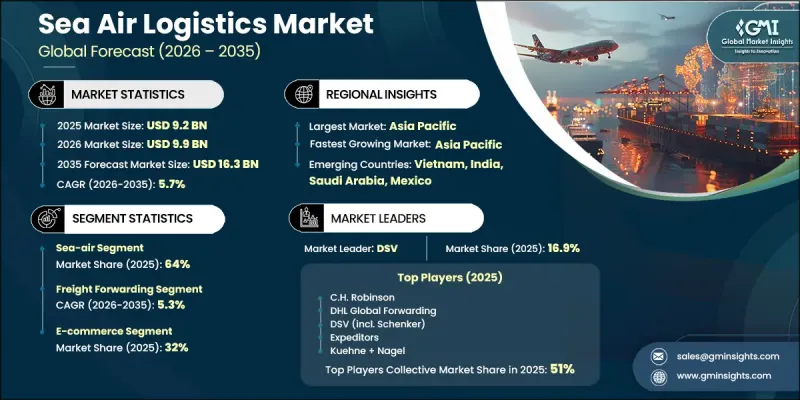
Market expansion is driven by increasing complexity in global trade networks, which is pushing demand for integrated transportation models that balance speed and cost efficiency. Hybrid logistics solutions that combine sea and air transport are gaining traction as businesses seek more reliable alternatives for long-distance cargo movement. Rising supply chain disruptions and uncertainties across key maritime routes are further accelerating the adoption of multimodal strategies. These disruptions are prompting companies to reassess routing decisions and prioritize flexibility in logistics planning. High-value and time-sensitive goods are increasingly relying on combined transport systems to ensure faster and more predictable delivery timelines. Growing international trade activity is also encouraging businesses to adopt cost-optimized shipping models that reduce dependency on single-mode transport. As global commerce becomes more dynamic, sea-air logistics is emerging as a strategic solution that enhances resilience, improves transit efficiency, and supports evolving supply chain requirements across industries.
| Market Scope | |
|---|---|
| Start Year | 2025 |
| Forecast Year | 2026-2035 |
| Start Value | $9.2 Billion |
| Forecast Value | $16.3 Billion |
| CAGR | 5.7% |
The sea-air segment accounted for a 64% share in 2025 and is projected to grow at a CAGR of 6.3% from 2026 to 2035. This segment remains a preferred logistics approach for optimizing both transit time and shipping costs across major global trade routes. By combining ocean freight efficiency with air transport speed, it delivers a balanced solution for international cargo movement. The model is particularly effective for shipments requiring moderate delivery timelines while maintaining cost efficiency, supporting its strong position in the global logistics landscape.
The freight forwarding segment held a 50.7% share in 2025 and is expected to grow at a CAGR of 5.3% through 2035. This segment plays a critical role in managing end-to-end cargo movement by coordinating transport modes, selecting carriers, and handling documentation processes. It enables seamless international trade operations by simplifying complex logistics requirements. Increasing reliance on integrated shipping solutions is driving demand for freight forwarding services, as businesses seek improved efficiency, reduced transit costs, and streamlined global supply chain management.
China Sea Air Logistics Market accounted for 49% share in 2025 supported by strong export-driven manufacturing activity and extensive global trade connectivity. The country's advanced port infrastructure and well-developed air cargo facilities enable efficient multimodal transportation networks. Coastal logistics hubs further enhance cargo flow efficiency, strengthening China's role as a key center for international logistics operations. Rising cross-border e-commerce activity is also contributing to sustained demand for faster and more flexible delivery solutions.
Key players operating in the Global Sea Air Logistics Market include Kuehne + Nagel, DHL Global Forwarding, DSV, Expeditors, C.H. Robinson, CEVA Logistics, Sinotrans, Nippon Express, UPS Supply Chain Solutions, and Kerry Logistics. Companies in the Sea Air Logistics Market are focusing on expanding integrated service offerings, digital transformation, and global network optimization to strengthen their market position. Investments in advanced tracking systems and supply chain visibility tools are enabling improved shipment coordination and operational efficiency. Firms are also forming strategic partnerships and alliances to enhance geographic reach and service capabilities. Diversification of logistics solutions, including flexible multimodal options, is helping companies cater to evolving customer requirements. Additionally, businesses are prioritizing automation, data analytics, and real-time monitoring to improve decision-making and reduce transit delays. Expansion into emerging trade corridors is further supporting growth and enhancing competitive positioning across global markets.
Table of Contents
Chapter 1 Methodology
- 1.1 Research approach
- 1.2 Quality Commitments
- 1.2.1 GMI AI policy & data integrity commitment
- 1.2.1.1 Source consistency protocol
- 1.2.1 GMI AI policy & data integrity commitment
- 1.3 Research Trail & Confidence Scoring
- 1.3.1 Research Trail Components
- 1.3.2 Scoring Components
- 1.4 Data Collection
- 1.4.1 Partial list of primary sources
- 1.5 Data mining sources
- 1.5.1 Paid sources
- 1.5.1.1 Sources, by region
- 1.5.1 Paid sources
- 1.6 Base estimates and calculations
- 1.6.1 Base year calculation for any one approach
- 1.7 Forecast model
- 1.7.1 Quantified market impact analysis
- 1.7.1.1 Mathematical impact of growth parameters on forecast
- 1.7.1 Quantified market impact analysis
- 1.8 Research transparency addendum
- 1.8.1 Source attribution framework
- 1.8.2 Quality assurance metrics
- 1.8.3 Our commitment to trust
Chapter 2 Executive Summary
- 2.1 Industry 360° synopsis, 2022 - 2035
- 2.2 Key market trends
- 2.2.1 Regional
- 2.2.2 Transportation Mode
- 2.2.3 Service
- 2.2.4 Industry Vertical
- 2.3 TAM Analysis, 2026-2035
- 2.4 CXO perspectives: Strategic imperatives
Chapter 3 Industry Insights
- 3.1 Industry ecosystem analysis
- 3.1.1 Supplier landscape
- 3.1.2 Profit margin analysis
- 3.1.3 Cost structure
- 3.1.4 Value addition at each stage
- 3.1.5 Factor affecting the value chain
- 3.1.6 Disruptions
- 3.2 Industry impact forces
- 3.2.1 Growth drivers
- 3.2.1.1 Geopolitical maritime disruptions and rerouting
- 3.2.1.2 China Plus One" manufacturing shift
- 3.2.1.3 Cross-border e-commerce boom
- 3.2.1.4 Inventory strategy shifts
- 3.2.2 Industry pitfalls and challenges
- 3.2.2.1 Volatile air freight rates and capacity constraints
- 3.2.2.2 Infrastructure bottlenecks at transit hubs
- 3.2.3 Market opportunities
- 3.2.3.1 Expansion of CEIV Pharma and cold-chain logistics
- 3.2.3.2 Digitalization and AI in customs brokerage
- 3.2.3.3 Investment in emerging MEA hubs
- 3.2.1 Growth drivers
- 3.3 Growth potential analysis
- 3.4 Regulatory landscape
- 3.4.1 North America
- 3.4.1.1 United States freight transport and cargo security regulations
- 3.4.1.2 United States customs and border compliance framework
- 3.4.1.3 Canada freight transport and customs regulations
- 3.4.2 Europe
- 3.4.2.1 European Union customs and trade compliance framework
- 3.4.2.2 European Union air and maritime safety regulations
- 3.4.2.3 Environmental regulations for freight transport
- 3.4.3 Asia Pacific
- 3.4.3.1 China trade and customs regulations
- 3.4.3.2 India logistics and customs compliance standards
- 3.4.3.3 Japan cargo safety and transport regulations
- 3.4.3.4 Australia biosecurity and import export regulations
- 3.4.3.5 ASEAN trade and logistics frameworks
- 3.4.4 Latin America
- 3.4.4.1 Brazil customs and freight regulations
- 3.4.4.2 Argentina trade and logistics compliance
- 3.4.4.3 Mexico transport and customs regulations
- 3.4.5 Middle East & Africa
- 3.4.5.1 United Arab Emirates logistics and free zone regulations
- 3.4.5.2 Saudi Arabia freight and inspection regulations
- 3.4.5.3 South Africa customs and transport compliance
- 3.4.1 North America
- 3.5 Porter's analysis
- 3.6 PESTEL analysis
- 3.7 Technology and innovation landscape
- 3.7.1 Current technological trends
- 3.7.2 Emerging technologies
- 3.8 Pricing Analysis (Driven by primary research)
- 3.8.1 Historical Price Trend Analysis
- 3.8.2 Pricing Strategy by Player Type
- 3.9 Cost breakdown analysis
- 3.10 Sustainability and environmental aspects
- 3.10.1 Sustainable practices
- 3.10.2 Waste reduction strategies
- 3.10.3 Energy efficiency in production
- 3.10.4 Eco-friendly Initiatives
- 3.10.5 Carbon footprint considerations
- 3.11 Trade flow analysis (Driven by paid database)
- 3.11.1 Key global trade corridors
- 3.11.2 Major origin and destination hubs
- 3.11.3 Cargo flow patterns by region
- 3.12 Contract and pricing model analysis
- 3.12.1 Long term contracts vs spot pricing
- 3.12.2 Pricing determinants across routes
- 3.12.3 Margin variability by service type
- 3.13 Impact of AI and Generative AI on the Market
- 3.13.1 AI Driven Disruption of Existing Business Models
- 3.13.2 GenAI Use Cases and Adoption Roadmap by Segment
- 3.13.3 Risks Limitations and Regulatory Considerations
- 3.14 Forecast assumptions & scenario analysis (Driven by Primary Research)
- 3.14.1 Base Case- Key Macro & Industry Variables Driving CAGR
- 3.14.2 Optimistic Scenarios- Favorable macro and industry tailwinds
- 3.14.3 Pessimistic Scenario - Macroeconomic slowdown or industry headwinds
Chapter 4 Competitive Landscape, 2025
- 4.1 Introduction
- 4.2 Company market share analysis
- 4.2.1 North America
- 4.2.2 Europe
- 4.2.3 Asia Pacific
- 4.2.4 LATAM
- 4.2.5 MEA
- 4.3 Competitive analysis of major market players
- 4.4 Competitive positioning matrix
- 4.5 Key developments
- 4.5.1 Mergers & acquisitions
- 4.5.2 Partnerships & collaborations
- 4.5.3 New Product Launches
- 4.5.4 Expansion Plans and funding
Chapter 5 Market Estimates & Forecast, By Transportation Mode, 2022 - 2035 (USD Mn, Tons)
- 5.1 Key trends
- 5.2 Sea-Air
- 5.3 Air-Sea
- 5.4 Others
Chapter 6 Market Estimates & Forecast, By Service, 2022 - 2035 (USD Mn, Tons)
- 6.1 Key trends
- 6.2 Freight forwarding
- 6.3 Warehousing and distribution
- 6.4 Customs brokerage
- 6.5 Value-added services
Chapter 7 Market Estimates & Forecast, By Industry Vertical, 2022 - 2035 (USD Mn, Tons)
- 7.1 Key trends
- 7.2 E-commerce
- 7.3 Automotive
- 7.4 Machinery & equipment
- 7.5 Pharmaceuticals
- 7.6 Consumer goods
- 7.7 Others
Chapter 8 Market Estimates & Forecast, By Region, 2022 - 2035 (USD Mn, Tons)
- 8.1 Key trends
- 8.2 North America
- 8.2.1 US
- 8.2.2 Canada
- 8.3 Europe
- 8.3.1 Germany
- 8.3.2 UK
- 8.3.3 France
- 8.3.4 Italy
- 8.3.5 Spain
- 8.3.6 Russia
- 8.3.7 Norway
- 8.3.8 Netherlands
- 8.3.9 Sweden
- 8.4 Asia Pacific
- 8.4.1 China
- 8.4.2 India
- 8.4.3 Japan
- 8.4.4 Australia
- 8.4.5 South Korea
- 8.4.6 Singapore
- 8.4.7 Thailand
- 8.4.8 Indonesia
- 8.4.9 Vietnam
- 8.5 Latin America
- 8.5.1 Brazil
- 8.5.2 Mexico
- 8.5.3 Argentina
- 8.6 MEA
- 8.6.1 South Africa
- 8.6.2 Saudi Arabia
- 8.6.3 UAE
- 8.6.4 Turkey
Chapter 9 Company Profiles
- 9.1 Global Players
- 9.1.1 CEVA Logistics
- 9.1.2 DHL Global Forwarding
- 9.1.3 DSV
- 9.1.4 Expeditors
- 9.1.5 Kuehne+Nagel
- 9.1.6 Nippon Express
- 9.1.7 Sinotrans
- 9.1.8 UPS Supply Chain Solutions
- 9.2 Regional Players
- 9.2.1 Aramex
- 9.2.2 Dachser
- 9.2.3 Dimerco Express
- 9.2.4 GWC (Gulf Warehousing Company)
- 9.2.5 Hellmann Worldwide Logistics
- 9.2.6 Kerry Logistics
- 9.2.7 Toll
- 9.3 Emerging Players/Disruptors
- 9.3.1 Beacon
- 9.3.2 Flexport
- 9.3.3 Forto
- 9.3.4 OVRSEA
- 9.3.5 Zencargo

